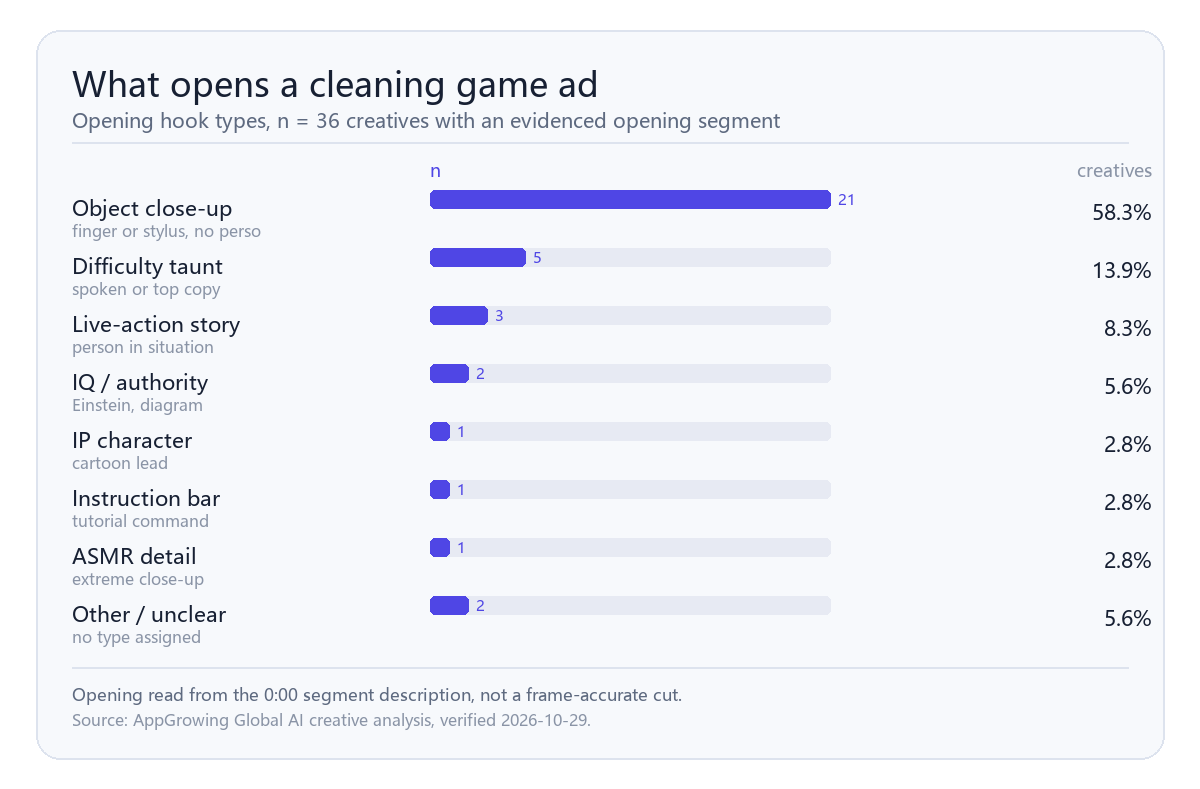
Of 36 cleaning and sorting game creatives with an evidenced opening segment, 21 (58.3%) open on a single object with a fingertip or stylus and no person in frame. Five (13.9%) open on a difficulty taunt, carried in voice-over or top copy rather than in the picture. Nine close on ASMR copy and only four carry an explicit install instruction. This genre sells the look of an object that can be operated, not a story.
What should the opening shot actually be?
Coded from segment descriptions, the split is: object close-up 21, difficulty provocation 5, live-action situation 3, IQ or knowledge label 2, and one each of IP character, instruction bar and ASMR detail, with two unclassified. The object close-ups share a pattern. The mechanism fills the frame at 0:00, the fingertip or pen tip lands on the interaction point within the first second, and the segment resolves into a single operation loop.
The provocation group deserves its own note. All five depend on speech or on-screen copy such as "harder than you think" or "try to solve this"; the picture itself does not stage any difficulty. The taunt is written, not shot. If your team plans a difficulty hook, budget for a line of copy or a voice track, not for a more complex opening scene.
Are voice-over and music-only creatives two production lines?
They are. The 15 voice-over creatives average 33.1 seconds with a 24-second median; the 17 music-only creatives average 25.4 seconds with a 29-second median. The structural difference matters more than the length. Voice-over creatives open on a situation, a taunt or self-talk, and gameplay arrives between 2 and 10 seconds. Music-only creatives start on gameplay at 0:00, run a single loop, and skip the setup entirely.
Who carries the information changes with that. In the voice-over group the narration explains the rule, judges the difficulty and delivers the closing line; in the music-only group the frame feedback and the click sound do the work, with a text overlay or top copy carrying the message.
Placement splits along the same line in this sample. Sixteen of 17 music-only creatives ran on AdMob and YouTube, while seven of 15 voice-over creatives also appeared on Meta-family placements. That is a distribution, not a causal finding, but it is enough to argue against one cut running everywhere.
Why do most of these ads end without an install ask?
Fifteen of 100 records carry an empty slogan, and only four show an explicit install or download instruction, in on-screen copy or in speech. The largest closing group is mood: nine creatives end on ASMR or relaxation lines such as "ASMR Cleanup: Peaceful Escape". Another six close on a capability question with no button attached, for example "Can you quickly find the same tile?".
That runs against the usual game-ad habit. In this genre the ending carries the emotional landing rather than the conversion ask, and 22 of the opening-evidenced creatives were annotated as lacking clear conversion guidance. Treat that as a genre norm, not as an oversight by individual advertisers.
How should a team split the work?
Three decisions. First, fix the opening as an object close-up with no person in frame and the interaction point visible inside the first second. Second, if you want difficulty in the cut, put it in the voice track or the top copy instead of staging it visually. Third, split production by placement: keep the voice-over cut for Meta-family inventory, keep the music-only cut for AdMob and YouTube, and let the ending land on mood unless the campaign is explicitly chasing installs.
Two things not to do. Do not treat voice-over as a music-only cut with an audio track bolted on, because the opening structures differ. And do not read these proportions as a performance result; they describe what the genre currently looks like.
When does this structure not apply?
When the product is management or narrative driven rather than a tactile de-stress loop, a single-object opening drops the thing that makes the product different. The sample here was pulled through screw, organizing and cleaning keywords, so it tilts toward tactile products by construction, and the structure holds for that group. This is an advertising activity signal, not a campaign performance result.
Want your cleaning creatives benchmarked?
Get a free benchmark check based on your specific app or game category.