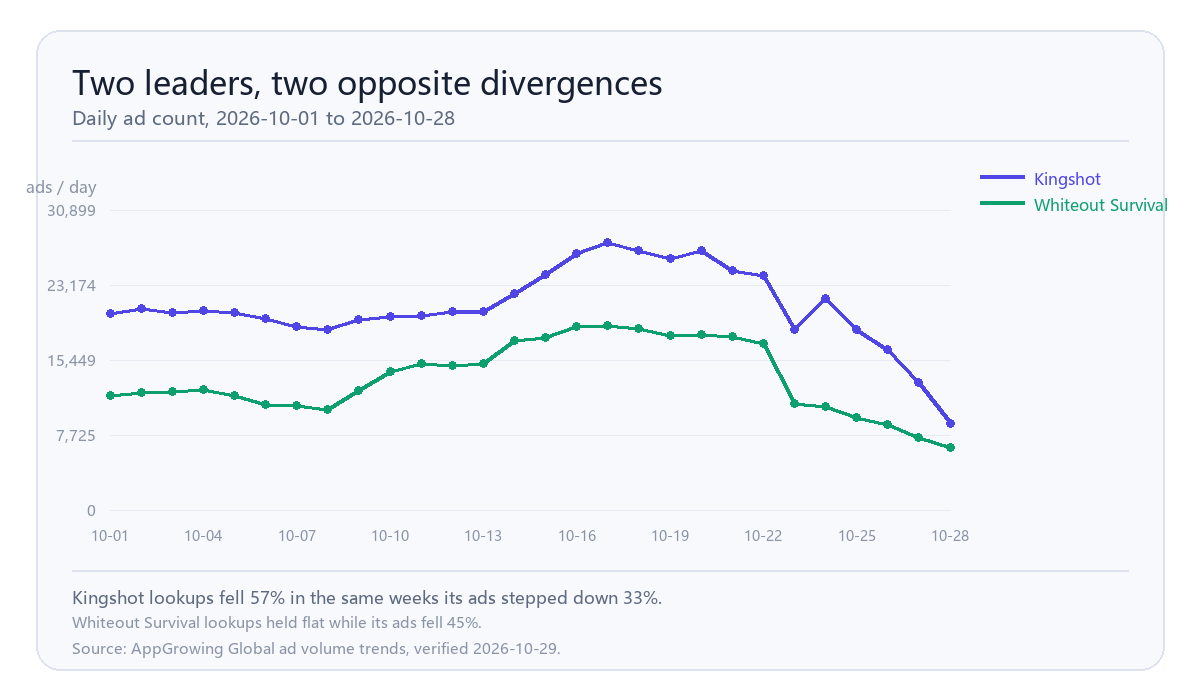
Kingshot fell from first to ninth in ad-tool lookups between the weeks of 2026-10-15 and 2026-10-28, a 57% drop. Its daily ad count fell 33% over the same window, from 26,043 to 17,372. Whiteout Survival moved the other way at the lookup layer, holding flat at 17 to 18 across its three keyword aliases, while its daily ad count fell 45%, from 18,330 to 10,139. Two genre leaders, opposite divergences, and neither one can be read as a campaign outcome.
Which of the two numbers moved first?
For Kingshot, the daily curve steps down between 21 and 22 October. The prior week averaged 26,043 ads a day; the following week averaged 17,372. That is a step, not a decay, and the lookup change covers the same two weeks, so week-level data cannot order the two events.
The monthly view adds something the weekly view hides. Kingshot averaged 19,476 ads a day in September and 20,942 in October, still up 7.5% across the month. A last-week step down inside a rising month reads more like a decision than an exhausted budget, which matters when you are deciding whether to treat the drop as a retreat.
Why did Whiteout Survival's lookups hold while its spend fell?
Because its lookup line never rose in the first place. Combined across the three aliases it sits at 17 to 18, flat, and flat lines do not fall with spend. There is a measurement trap here worth naming. Using only the phrase whiteout survival gives 12 in the prior week and 8 in the current week, a 33% drop. Adding wos and whiteout brings the same entity back to flat. One entity, two methods, two opposite conclusions.
Are a lookup drop and a spend cut the same event?
No. Lookup interest measures what peers are checking; ad volume measures what advertisers are buying. In Kingshot's case the lookup drop is larger than the spend cut, so attention is cooling faster than the account is shrinking. In Whiteout's case spend fell while attention held, so a buying decision has happened that peers have not registered yet. Those two shapes call for different monitoring responses: the first protects against reading an exit that is not happening, the second protects against missing one that is.
How should a team monitor two leaders that diverge?
Three rules. First, merge aliases before anything else and confirm each entity has one measured series. Second, separate the monthly and weekly views: monthly for direction, weekly for the turning point. Third, only write a trend conclusion when lookups and spend point the same way; when they diverge, write the divergence and name the window.
Applied here, the defensible reading is narrow. Kingshot is coming off a yearly high, and Whiteout is contracting while attention sits flat. Anything wider than that outruns the data.
In weekly reporting this means two lines per competitor rather than one: lookups and spend, each with its own direction, plus a note on the weeks where they disagree. A blended score would average away exactly the signal the comparison exists to surface.
Two things not to do. Do not treat a single alias's drop as the entity's drop. And do not turn one week's step into a reversal while the monthly average is still rising.
What does the absolute gap between the two leaders hide?
Kingshot runs at roughly two to three times Whiteout's daily volume across the window, which is why the two percentages should not be placed side by side as if they described the same base. A 33% cut on 26,000 ads removes about 8,700 ad records a day; a 45% cut on 18,000 removes about 8,200. The relative numbers point in different directions, but the absolute removal is nearly identical. When two competitors cut by different percentages, compare what left the account rather than the rate, because the rate is a function of where each one started.
When does this comparison stop working?
When the two products sit at different points in their own cycles. Kingshot is running near a yearly peak with roughly three times Whiteout's ad volume, so direction is comparable and magnitude is not. Use this pattern to guide monitoring, not to judge campaign efficiency.
Want your two closest competitors compared this way?
Get a free benchmark check based on your specific app or game category.