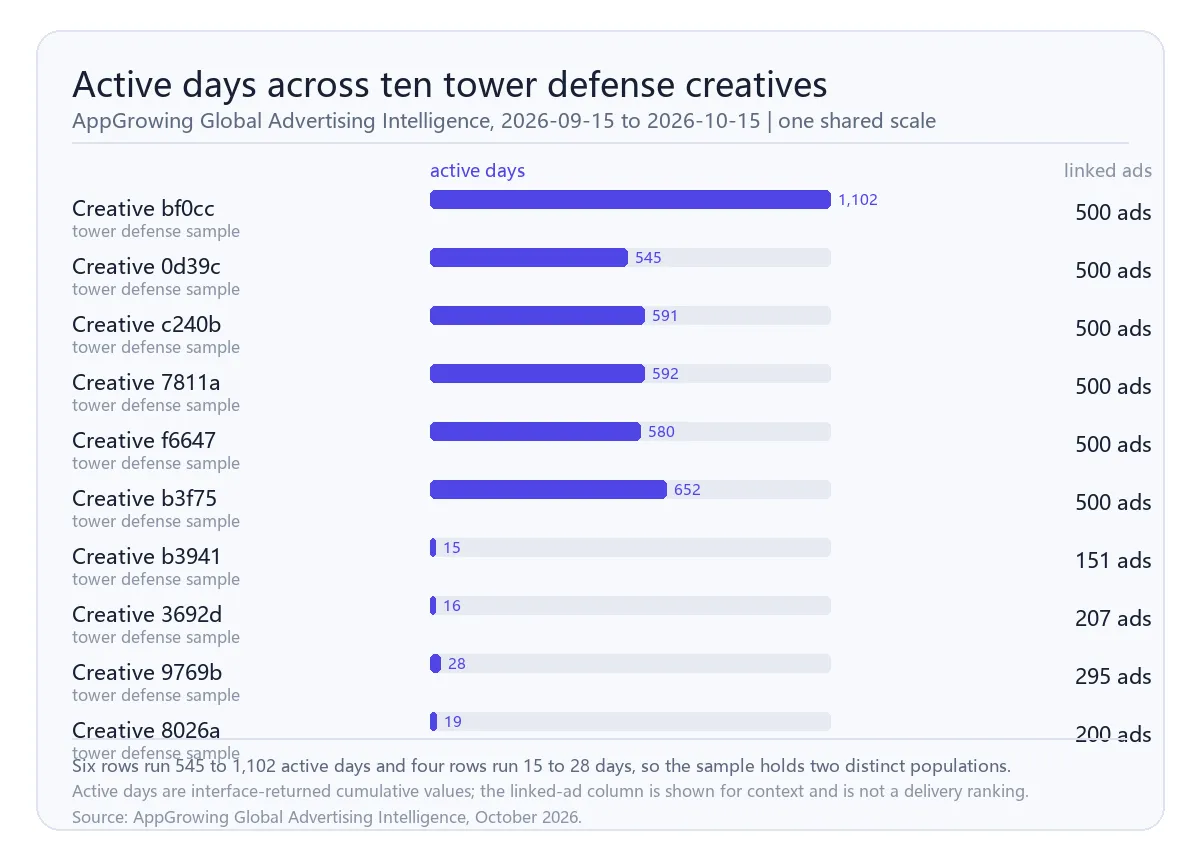
To plan tower defense creative capacity, separate the long-running track from the newly launched track before you look at any single asset. AppGrowing Global returned a 46,725-creative pool for the tower defense style inside the strategy category for 2026-09-15 to 2026-10-15, of which 24,125 records sit in the newly launched filter, roughly 51.6 percent, while the ten reviewed creatives split cleanly between 545 to 1,102 active days and 15 to 28 active days.
How fast is this pool turning over?
More than half of the returned matching records sit in the newly launched filter. Among the ten creatives reviewed in detail, six carry 545 to 1,102 active days, which means they have been running for a long time, and four carry only 15 to 28 days, which means they arrived recently. Both populations exist inside the same category at the same time, which is why a single monitoring cadence cannot describe this pool.
What separates an evergreen tower defense creative from a fresh one?
The long runners in this sample favour a single-take continuous gameplay sequence of 30 to 74 seconds, with the prompt embedded in the voiceover and placed at the mid-roll reward peak. The fresh arrivals invert that: they are multi-cut montages or static image collages with three to eight seconds per scene, and the download marker tends to appear only in the final frame. One further difference is visible across the sample, where still images make up roughly thirty percent of the high-ranking new arrivals but under ten percent of the long-running set, which reads like a cheap-first testing order rather than a creative preference. If that order holds, then a still image reaching the top of the new set is a signal to watch for a video version arriving shortly after.
Which conventions are universal in this category?
Three appear in almost every sampled row. The first is a top-down or isometric perspective. The second is the wave counter as core proof, so the viewer can see which wave is running and whether the line holds. The third is a four-beat loop of resource, build, defend and upgrade. The voiceover often states the same promise in words, for example a line asserting no ads and a skill-based fight that names the title directly. Because the perspective and the loop are close to universal, differentiation in this category tends to happen in art style and in scene length rather than in the core mechanic.
What should teams monitor in this category?
Run two tracks rather than one. Check the long-running track weekly, watching for a new asset taking over and for whether the old ones are still active. Check the fresh track daily or every other day, because a new creative can reach a high linked-ad value within days. Keeping the two tracks in separate tables matters, because a single snapshot that mixes a 1,102-day asset with a 15-day asset cannot be read as one trend, and a weekly read of the fresh track will already be too late to describe it.
What should teams check before copying a tower defense format?
First, check the field caliber: many rows in this sample report the same linked-ad value, which looks like a reporting ceiling rather than a precise scale figure, so it should not be used to rank delivery intensity. Second, check attribution: most rows carry no structured product name, so only titles named in a voiceover can be attributed with confidence. Third, remember that cumulative impressions are lifetime values and that no comparison window was available for this round, so any statement about the category accelerating or slowing would be unsupported.
Not sure how fast your tower defense creative set is actually turning over?
Get a free benchmark check based on your specific app or game category.
The useful output of this kind of pool read is not a single number but two cadences. Once the long-running set and the fresh set are tracked apart, the interesting question shifts from how big the category is to which of the two tracks a given competitor is currently running in. That question also travels well across categories: any genre with a high refresh share and a strong evergreen tail can be read the same way, by splitting the sample before reading any individual asset.
