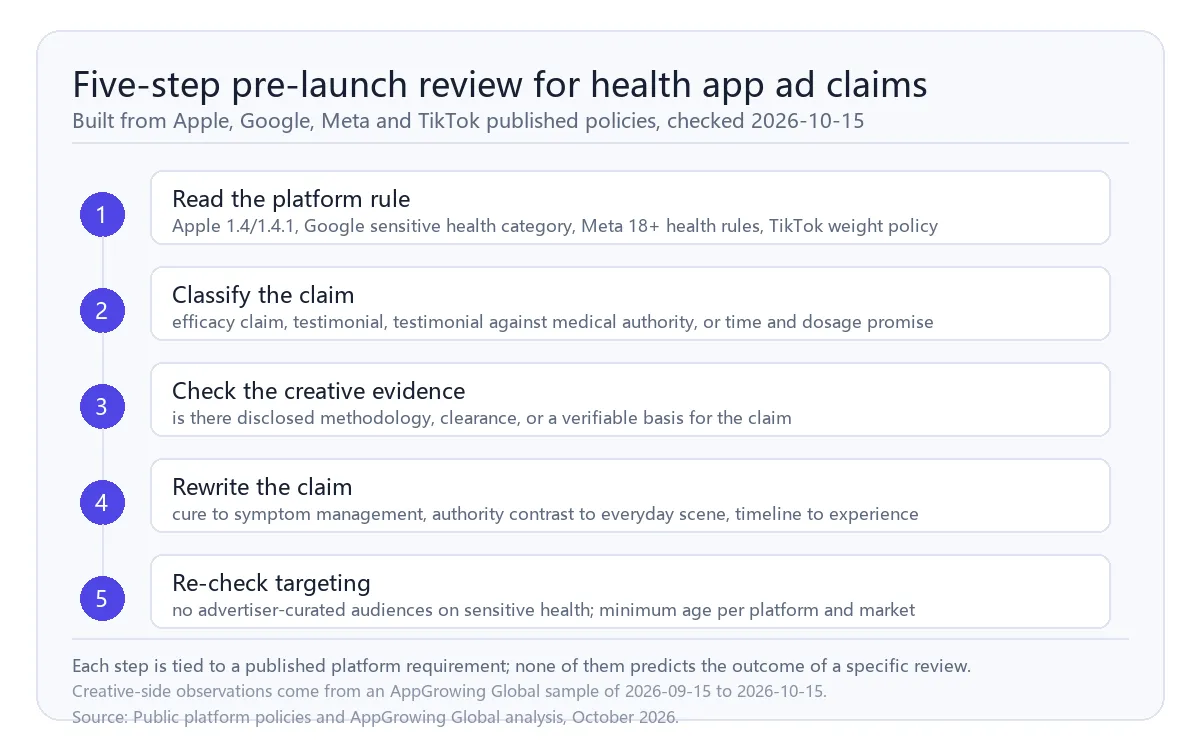
To review a health or medical app ad before launch, work in five steps: read the platform rule, classify the claim, check the creative evidence, rewrite the claim, then re-check the targeting settings. Apple asks medical apps to disclose the data and methodology behind any accuracy claim and to point users to a doctor; Google treats health as a sensitive interest category and blocks advertiser-curated audiences on those ads; Meta requires weight, dietary and cosmetic ads to target people aged 18 or over; TikTok restricts weight-management claims to adult audiences and forbids misleading before-and-after comparisons.
What do the major platforms actually restrict?
Apple's guidelines state that medical apps which could provide inaccurate data, or be used for diagnosing or treating patients, are reviewed with greater scrutiny, that the app must clearly disclose the data and methodology supporting health-measurement accuracy claims, and that it should remind users to check with a doctor. Google places health content in a sensitive interest category covering physical and mental health conditions, chronic-condition treatments and medical devices, and prohibits advertiser-curated audiences for advertising in that category. Meta's health and wellness standards require weight-loss, dietary and cosmetic advertising to be targeted at people aged 18 and over, ban claims that cure or eliminate a named list of incurable diseases, and ban appearance-inferiority statements and clickbait-style exaggerated promises. TikTok's weight-management policy restricts weight-loss claims to adult audiences, forbids presenting a product as the only solution, and its misleading-content policy bans before-and-after comparisons that create a wrong impression of results.
Which claim patterns carry the most review risk?
The creative sample behind this workflow clusters into four risk types. The first contrasts a personal testimonial with medical authority, for example a claim that no doctor could help and the speaker fixed it alone. The second uses a first-person before-and-after testimonial. The third narrates a sensitive health situation such as pregnancy or a chronic condition. The fourth frames time and dosage as a promise, for example five minutes a day or a day-by-day progress count. The third type sits inside both sensitive health and personal-attribute rules, which makes it the highest-risk pattern of the four. The first two are the most common in the sample, and both top-exposure creatives are testimonial-led, which is why the testimonial is the pattern most teams need a rule for.
What should the pre-launch review check?
Three checks, in order. First, does every efficacy claim in the asset have disclosure of data and methodology, or a regulatory clearance, behind it. Second, does any testimonial touch an incurable disease or a sensitive health situation. Third, do the targeting settings include advertiser-curated audiences or audiences below the minimum age the platform sets for this content. A failure on any one of the three should stop the asset from going live rather than being noted as a risk to watch.
How should the review be documented?
Keep one sheet per asset with four columns: the claim as written, the policy source that governs it, the evidence behind it, and the action taken. The policy column is what makes the sheet reusable, because the same claim has to be re-checked when a platform updates its standards, and a reviewer who cannot see which page the decision came from has to start over. Note the date each page was read as well, since enforcement language changes without a visible version number on every page.
How should a risky claim be rewritten?
Move from cure language to symptom-management language, replace medical-authority contrast with an everyday user scene, convert a committed timeline into an experience description that promises no specific outcome, and remove any statement that disparages appearance. Then re-run all three checks, because a rewritten claim inside unchanged targeting settings is still the same risk.
What should teams verify about targeting settings?
Targeting limits on health advertising are often stricter than the creative limits. Google states that advertiser-curated audiences cannot be used when promoting in a sensitive interest category. Meta and TikTok apply minimum-age requirements to weight, dietary and cosmetic content. The review list therefore has to include targeting, and it has to be run per platform, because a compliant setup on one network is not a compliant setup on another.
Not sure whether your health app's ad claims will survive platform review?
Get a free benchmark check based on your specific app or game category.
Health advertising is reviewed on evidence rather than on tone, so the useful habit is to separate what the ad claims from how it is worded. Teams that keep the claim list, the targeting list and the policy source in one review sheet catch most rejections before the asset is even uploaded.
