Six of the 50 keywords on the week's ad-tool lookup list did not resolve to a single app. DramaWave ranked with a score of 5 and returned zero creatives, tipsy ranked 11 and resolved to twelve unrelated products, and cash, odd clean, 3 minutes challenge and one numeric string resolved to nothing usable. A second problem is duplication: whiteout survival looks like a 33% drop alone and is flat once its aliases are merged.
Which keywords failed the entity check?
Six patterns. First, ranked but with no creatives: DramaWave has lookup interest and no delivery in the window. Second, keywords too broad to resolve, where tipsy returned twelve different products and odd clean returned deduction puzzles. Third, sub-genre words shared by several products, which is what cash produced, pulling cash-reward and withdrawal titles. Fourth, truncated task descriptions such as 3 minutes challenge, which carries a gameplay phrase rather than a product. Fifth, dirty rows, including one purely numeric keyword this week. Sixth, an empty keyword row in the prior week that still carried a score of 10.
Why can a keyword with no product still rank?
Because the list records searching, not spending. When peers look into a direction they type a product name, a mechanic, or a name they just heard, and all three count. The list has no obligation to resolve to a product; it reports where attention landed. Reading it as a product inventory turns attention into imagined supply.
What happens when one game is split into three keywords?
The conclusion flips. whiteout survival alone reads 8 this week against 12 last week, a 33% drop. Add wos and whiteout and the same entity reads 18 against 17, flat. One entity, one window, two methods, opposite readings. The drama cluster shows the same shape from the other side: merged it is 12 to 14, slightly up, while dramabox alone fell from 6 to 4.
What does a keyword with zero creatives mean for planning?
It means the name is circulating without supply behind it yet. That can happen for three reasons: a title that is pre-registration or regionally limited, a name peers invented while describing a direction, or a product that has stopped buying entirely. All three are worth logging and none of them support a volume estimate. The practical move is to keep the keyword in an attention column and re-check it the following week, because a name that appears with zero creatives and then gains delivery is an early signal, while a name that stays at zero is usually noise.
How often should the merge rule be reviewed?
Once a quarter, and never mid-series. Alias sets grow as products localise, so the rule needs periodic review, but changing it between two weeks makes the comparison between those weeks meaningless. The safer habit is to record the rule with each pull, so a later reader can tell whether a movement came from the market or from a change in grouping. In this window the rule covered three aliases for one title and would have produced a 33% drop if only the longest name had been used.
How do you validate a keyword in four steps?
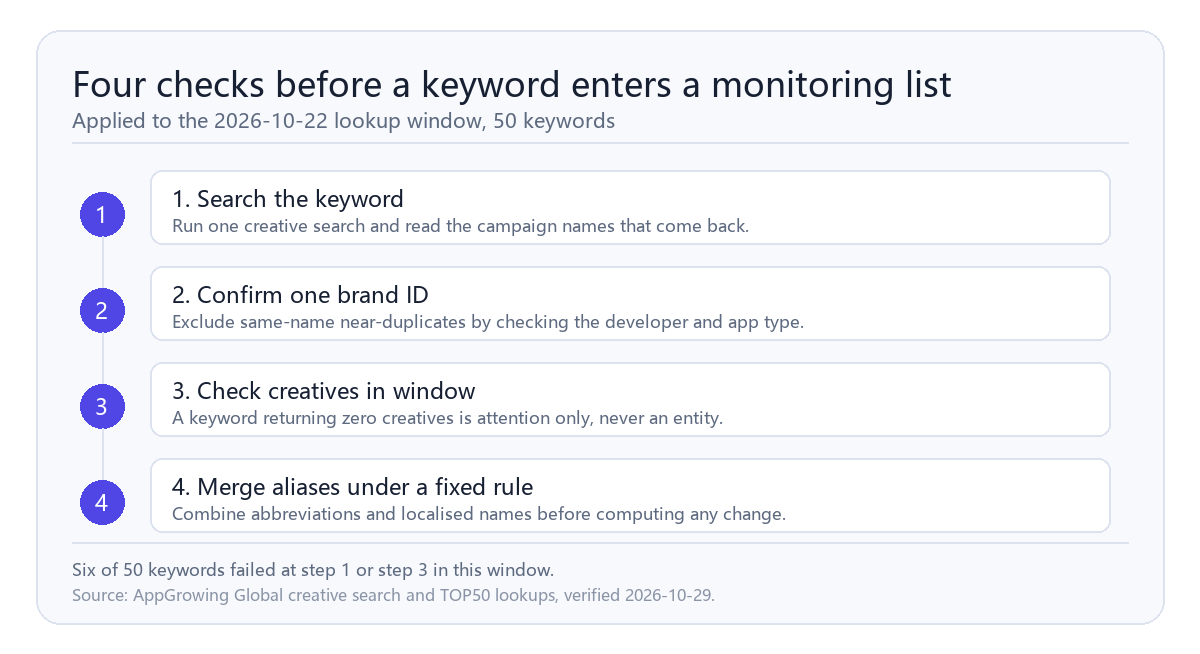
First, run one creative search on the keyword and check whether the returned campaign names converge on one product. Second, confirm that product has a single brand ID, excluding same-name near-duplicates by hand. Third, check whether any creatives exist inside the window, because a keyword returning zero can only be logged as attention. Fourth, merge aliases before computing any change, and keep the merge rule fixed rather than changing it week to week.
Two cautions. Do not write an entity-level conclusion from a single alias. And do not attribute a category word's heat to whichever product happens to rank near it.
When is a category word still useful?
When the question is about direction rather than a product. clean, screw and merge do not resolve to one title, but they show which direction peers are exploring, and paired with ad volume they support cluster-level judgement. The difference is where the conclusion lands: product conclusions require a resolved entity, cluster conclusions can come from category words. Use this to clean a monitoring list, not to infer player demand.
Want your keyword list validated against real creatives?
Get a free benchmark check based on your specific app or game category.