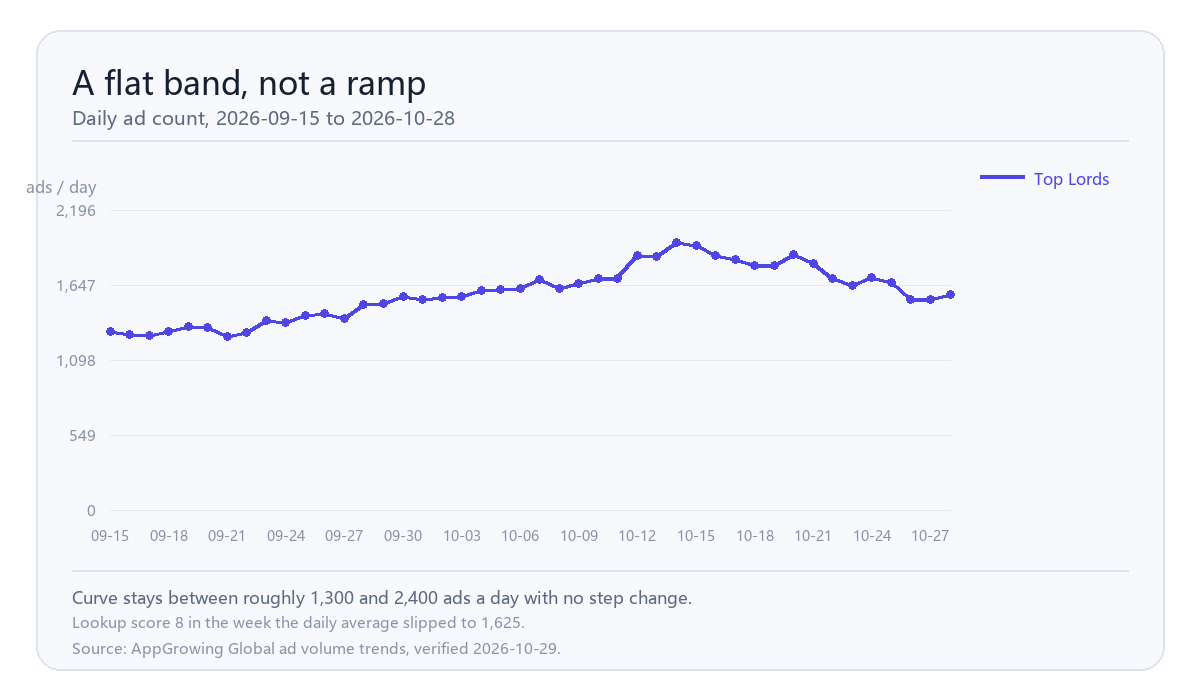
Top Lords entered the ad-tool lookup list for the first time this week with a lookup score of 8, and its daily ad count is 1,625, which is 12% below the prior week's 1,841. In the same week Kingshot ran 17,372 ads a day and Whiteout Survival ran 10,139. Being looked up and being scaled are two different events here, and the second one has not happened: the two-month curve has stayed between roughly 1,300 and 2,400 ads a day without a step change.
Does entering the list mean the product is scaling?
No. The list records what peers are checking. A product that is scaling shows a step up in daily volume with new ads rising alongside it, and neither appears in this series. What appears is a flat band with a mild decline in the latest week, which is the shape of a product still testing its buying rather than one committing to it.
Where does 1,625 ads a day sit against the genre?
About 9% of Kingshot's 17,372 and 16% of Whiteout Survival's 10,139 in the same week. That places it below the leaders and inside the range where a title validates creative and payback in a narrow slice before deciding whether to commit. The number is not small in absolute terms, but in strategy games it is a testing level rather than a scale level.
What does the creative length suggest?
The two creatives still running this week are 57 and 40 seconds, both vertical. Strategy titles tend to run longer explainer cuts than de-stress titles because they have to establish a resource loop and a combat goal, and both of these sit in the mid-range for the genre rather than at the short hook end.
Why does a product get looked up before it scales?
Because lookups track discovery, and discovery is cheap while scaling is expensive. A new strategy title becomes visible to peers through its creative in feeds, through store placement, or through a competitor's saved list, and each of those routes produces lookups long before it produces meaningful ad volume. In this case the product has been running since at least mid-September at a stable level, so what changed this week is that peers noticed it, not that the account changed behaviour.
What would an actual scale-up look like in this data?
Three markers. A step change in daily volume rather than drift, so a move from the 1,300 to 2,400 band into a new band that holds. A new-ad count that rises with the volume, since buying at scale requires new creative rather than more ads on old assets. And a widening of the creative mix, with additional lengths or formats appearing. None of the three is present this week, which is why the entry reads as observation rather than competition.
How does this differ from the leaders' pattern?
Kingshot is coming off a yearly high and cutting 33% of its daily volume, and Whiteout Survival cut 45% while its lookups held flat. Both are large accounts changing behaviour. Top Lords is a small account not changing behaviour while attention arrives. Grouping the three under a single "SLG is moving" heading would flatten exactly the difference that makes each one actionable.
Should it get a slot in the weekly report?
Yes, but a downgraded one. Three steps. First, place it in the observation column rather than the comparison column, tracking only daily ads and daily new ads. Second, attach an upgrade trigger: two consecutive weeks above 3,000 ads a day, or a single-week doubling in new ads. Third, log creative length and opening type only, without drawing structural conclusions from two records.
Two cautions. Do not read a lookup entry as a scaling signal. And do not generalise a creative strategy from two assets.
When should this be re-evaluated?
When daily volume holds above 3,000 for two weeks, or when new ads double inside a single week. Until then it belongs to lookups as noise and to spend as an observation target. This is an advertising activity signal, not a verdict on product performance.
Want a new competitor sized in one query?
Get a free benchmark check based on your specific app or game category.