In the week of 2026-10-22 to 2026-10-28, two game clusters gained lookup interest and four lost it. Cleaning and de-stress keywords rose from 22 to 69 while their entry count went from three to ten, cash-and-reward keywords appeared at 14, and survival strategy fell from 95 to 67, merge from 28 to 14, AI photo from 20 to 12 and utility from 44 to 28. Treat this table as a monitoring priority list, not a demand forecast.
Which clusters gained and which lost?
The two risers, cleaning and cash, are both low-friction genres that demo well in a single frame. The four fallers, survival strategy, merge, AI photo and utility, all need more explanation inside a creative. That split holds across this two-week window. Whether it holds across four weeks is a question for the next period, because a single-week rotation in a 50-row list is thin evidence on its own.
What does a cluster rising actually prove?
That peers are checking the direction. Cleaning tripling does not mean players are installing cleaning games; it means the people doing competitor research started looking at that lane in the same week. Read as demand, it misleads product decisions. Read as attention, it explains why creative analysis requests in that genre jumped.
Why do cluster sums disagree with single-keyword moves?
Because alias counts and entry counts change. Survival strategy fell 29% at the cluster level, yet Whiteout Survival is flat once its three aliases are merged, and the drop belongs to Kingshot and Top War as single points. Merge fell 50% largely because merge and merge cooking thinned out as entries rather than because one product cut volume. A cluster number only means something next to its entry count and its alias rule.
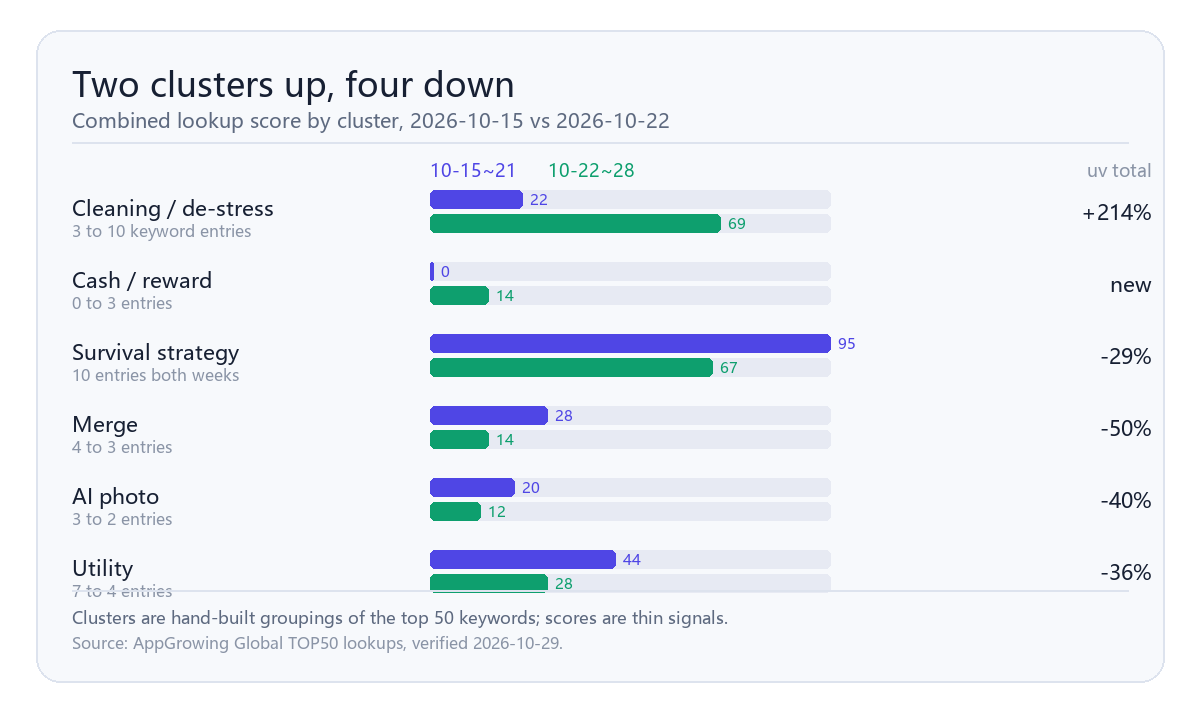
Which single keywords drove the cluster moves?
Three names account for most of the upward movement. Rotate Rings arrived at the top of the list with a score of 16 after being absent the week before, tipsy rose from 7 to 11, and clean plus its two variants took the cleaning cluster from three entries to ten. On the falling side, Kingshot alone accounts for twelve points of the survival drop, and vpn and translate leaving the list account for thirteen of the sixteen points the utility cluster lost. Cluster tables hide this, which is why the single-keyword layer should be read alongside them rather than after them.
How does a cluster rise relate to what is being bought?
Loosely, and not in a fixed direction. In this window the cleaning cluster tripled while daily ad volume across eight cleaning games fell 18%, so the cluster rise described attention arriving as supply pulled back. That combination is more informative than either number alone: a cluster rising while spend falls marks a lane peers are investigating before committing, and a cluster rising with spend marks one that is already being bought. Checking both takes one extra pull and changes the conclusion.
How should a team use a weekly cluster table?
Three steps. First, freeze the grouping rule week to week, because a rule that changes mid-series makes the trend unreadable. Second, read entry count before volume: more entries means attention spreading, fewer means it concentrating. Third, route the risers to the creative team for structural work and the fallers to the competitor team for confirmation that the retreat is real.
Two cautions. Do not read a cluster sum as genre size. And do not let one week overturn a monthly conclusion.
What should be watched next week?
Three markers. Whether cleaning's entry count keeps growing, since falling back under five would mark a one-week spotlight rather than a shift. Whether cash produces a second verifiable entity, because only one product currently resolves. And whether survival strategy stops falling, since a further decline would mark the second stage of a leader pullback.
None of the three is settled by this week's data. Write the thresholds down before next Monday so the following table is read against a standard rather than against memory. Use the table to decide where to look, then pull ad volume before writing anything about a genre's direction.
Want this cluster table every week?
Get a free benchmark check based on your specific app or game category.