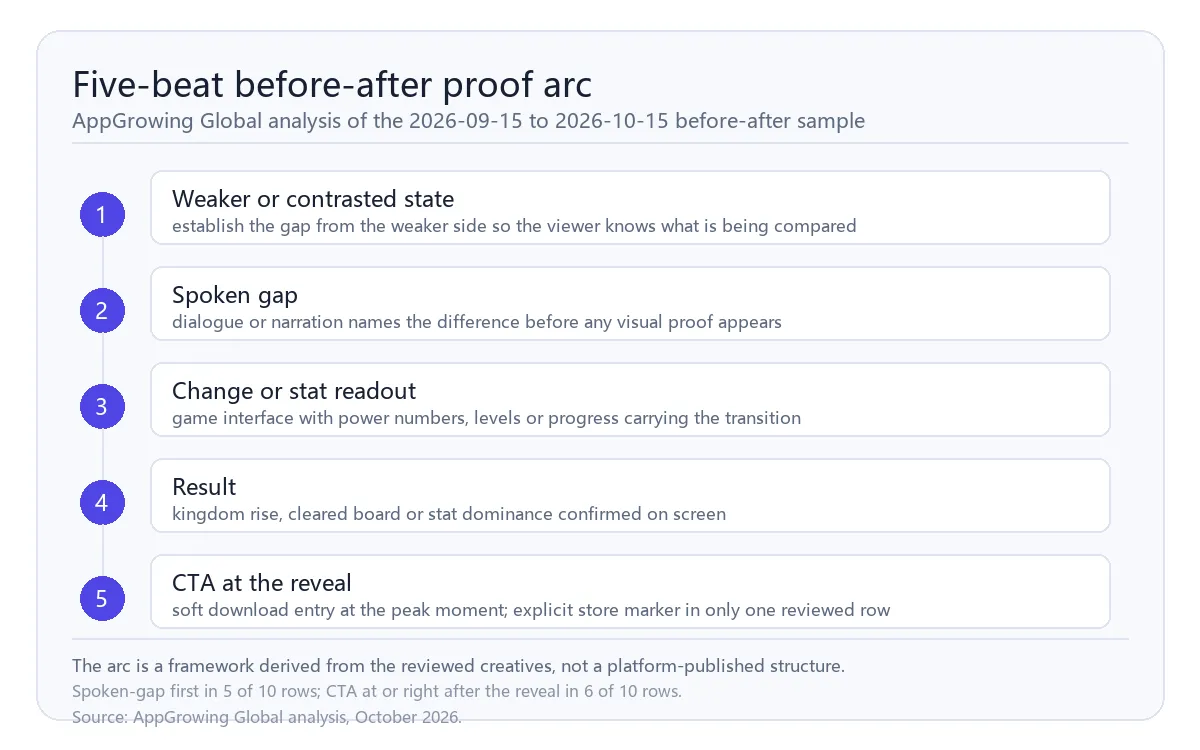
To build a before-after proof ad, state the contrast out loud first, confirm it with gameplay second, and place the download prompt at the moment the numbers are revealed. In an AppGrowing Global sample of 10 before-after creatives from 2026-09-15 to 2026-10-15, 5 introduce the gap through dialogue or narration before any visual proof, and the 6 rows where a download entry is identifiable place it at or immediately after the power reveal.
Why does the contrast get spoken before it is shown?
Because the viewer needs to know what is being compared. One sampled row carries the whole contrast in dialogue, contrasting a cool fleet against a weak one, at 50,257,212 cumulative impressions, 1,205 active days and 22 linked ad creatives. Another row uses a spoken level and power challenge before any numbers appear, at 19,778,897 impressions, 111 active days and 92 linked ad creatives. The line sets the frame, and the footage then supplies the evidence, which keeps the proof from having to be inferred from a split screen. It also means the ad can use a conversation instead of a production-heavy comparison graphic, which is cheaper to shoot and easier to localise, since only the dialogue has to change per market.
How should the change itself be shown?
Effective rows do not skip the middle. One timeline-style creative opens in a real-life social scene, then cuts to a game interface carrying power numbers, and finally lands on a kingdom-building result, with stat readouts and achievement prompts carrying the transition. Without that middle beat the comparison is an assertion rather than a proof, because the viewer never sees how the change happened. The middle beat is also where the ad earns the right to show a large number at the end, since the number reads as the output of a process the viewer just watched.
Where should the CTA sit?
At the reveal, not after it. In the 6 rows where a download entry can be identified, it appears at or immediately after the moment the power numbers are shown, and it is usually soft: a brand name, a streamer holding the device, or a decorated game logo rather than a direct download command. Only one row shows an explicit store download marker at the resolution point. The pattern suggests the close works as part of the reveal rather than as a separate card appended to it.
What should a brief hold fixed?
Five beats: the weaker or contrasted state, the spoken gap, the change or stat readout, the result, then the CTA. Once the order is fixed, the actor, the scene and the numbers can be swapped per variant while the proof structure stays constant, which is what lets a batch of creatives share one logic without reading as repeats. Fixing the beats also makes review faster, because a reviewer can check each beat against the brief instead of judging the whole cut at once.
Which comparison framing should a team pick?
Two framings dominate the sample and they answer different questions. Peer mockery, where one side taunts the other, answers who is stronger right now and works without any transformation. Self-growth, where the same player moves from a weak state to a dominant one, answers what changes if you keep playing. Choosing between them is a decision about what the viewer should want, not about which is more dramatic, and the sample shows both inside the same category.
What should teams check before copying the structure?
First, check whether the shot description is complete: at least one row in this sample returned an empty visual description, and a missing description is not evidence that no CTA exists. Second, check the caliber: cumulative impressions and active days are lifetime values, so they cannot be read as in-window growth. Third, make sure the comparison target is instantly legible, because a spoken gap cannot rescue a visual one the viewer cannot parse.
Not sure which before-after proof your game's ad should lead with?
Get a free benchmark check based on your specific app or game category.
Before-after proof is a sequencing problem rather than a graphics problem. Saying the gap first, showing the change in the middle and asking at the reveal turns a claim about power into something the viewer watched happen, which is also why the same five beats survive a change of category, actor or market.
