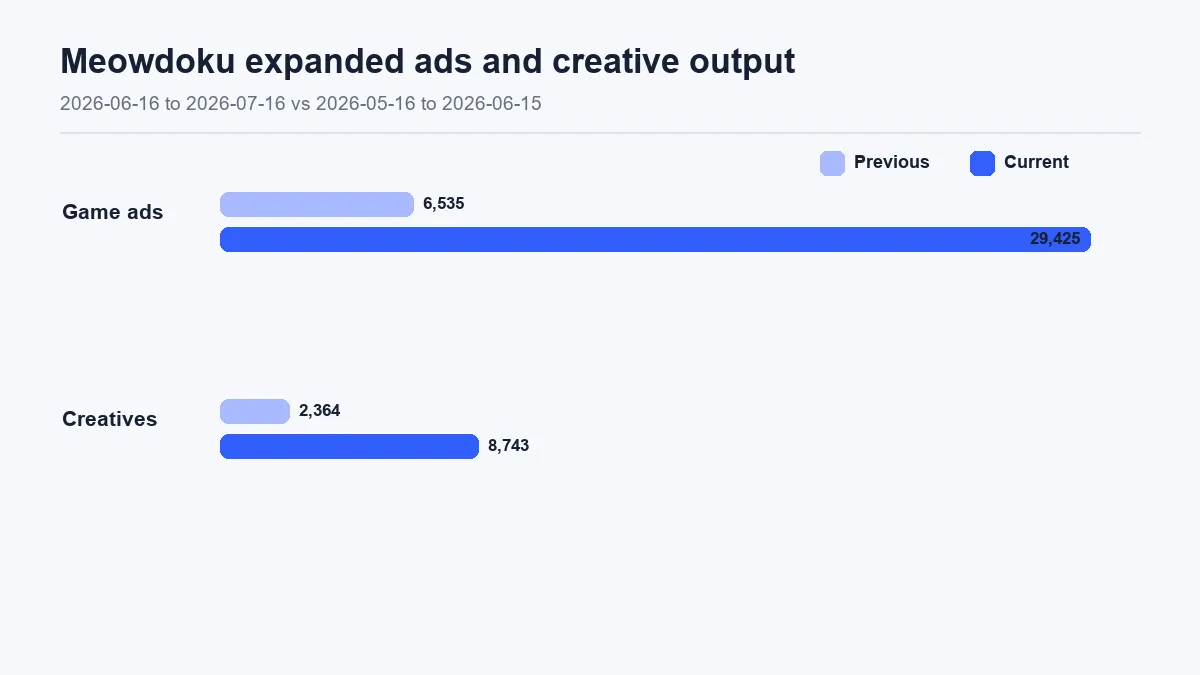
Logic-puzzle ads do not fail because they show a board. They fail when the viewer cannot identify one solvable step. Meowdoku turns a rule into the hook, then makes deduction visible through X marks, row and column elimination, and cat icons. Game-ad volume rose from 6,535 to 29,425 and creative volume from 2,364 to 8,743, so the next review should focus on concept expansion and localization rather than only retained assets.
| Metric | Previous Period | Current Period | Change |
|---|---|---|---|
| Game ads | 6,535 | 29,425 | +350.3% |
| Game creatives | 2,364 | 8,743 | +269.8% |
Why can a rule explanation work as the hook?
The current aggclaw query identified about 85 high-impression Meowdoku materials. Approximately 29 used a rule-explanation hook. At least seven English materials repeated a version of Okay, so here's the deal, while at least five Chinese-language materials used the equivalent instructional opening. The wording establishes a direct teacher-and-solver relationship before the viewer understands the entire board.
The middle makes the claim testable. About 95% of rule-demo materials explained one cat per color. About 90% demonstrated row or column exclusivity, roughly 85% showed that cats cannot touch, and about 70% completed a deduction by showing that only one colored square remained. Immediate X marks and cat icons provide visible proof that the rule changed the board.
What does street interaction change?
At least six sampled creatives moved the grid onto an outdoor floor or whiteboard. A real person stepped onto tiles, pointed to cells, or solved the puzzle in front of a crowd. The street format did not create a new rule. It changed the evidence from a screen recording into a spatial performance that a passerby could follow.
That distinction matters for testing. Treat street interaction, presenter-led explanation, and direct screen recording as formats inside the same rule family. Keep the puzzle constraint, deduction sequence, and CTA stable while comparing them. A new presenter or location is an execution variant unless the viewer is asked to make a different logical judgment.
What should teams review during rapid expansion?
Meowdoku ads increased 350.3% and creatives increased 269.8% in the current equal-period comparison. Both metrics moving sharply upward supports an expansion review. Teams should label new rules, languages, localized voiceovers, street demonstrations, app-icon end cards, and slogan treatments before deciding which concepts are genuinely new.
A translated version remains part of the same family when the board and deduction are unchanged. A material enters a new concept row when it introduces a different constraint, a different order of reasoning, or a different task for the viewer. This prevents a large library from overstating conceptual diversity simply because it contains many markets and presenters.
How should a rule-led creative test work?
In round one, keep the board fixed and change only the opening rule. Compare one cat per color, row and column exclusivity, and no adjacency. In round two, keep the rule fixed and change visual feedback through X marks, color highlights, or cat placement. In round three, keep both stable and compare screen recording, presenter explanation, and street-grid performance.
The end card should continue the same promise. Meowdoku repeatedly uses a cat-face icon, a search or download prompt, and language similar to simple rules, tricky board. If a localized version adds No Ads or totally free, product and regional reviewers should verify the relevant build before release. The strongest adaptation preserves the logic the viewer just learned instead of replacing it with a generic puzzle slogan.
The weekly review should keep rule family, language, presentation format, puzzle completion, and end-card treatment on one sheet. If the rule remains unchanged while output grows, check whether the expansion is mostly localization. Create a new script family only when the opening introduces a different deduction that can stand on its own in the first three seconds. Also record whether the material shows one complete cause-and-effect sequence from exclusion to cat placement. A tutorial that cuts away before the deduction resolves may explain rules without delivering the satisfaction that makes the hook credible.
Finally, check whether the first deduction remains understandable without sound. If the logic depends entirely on voiceover, add visible constraints and feedback before scaling the version across languages.
