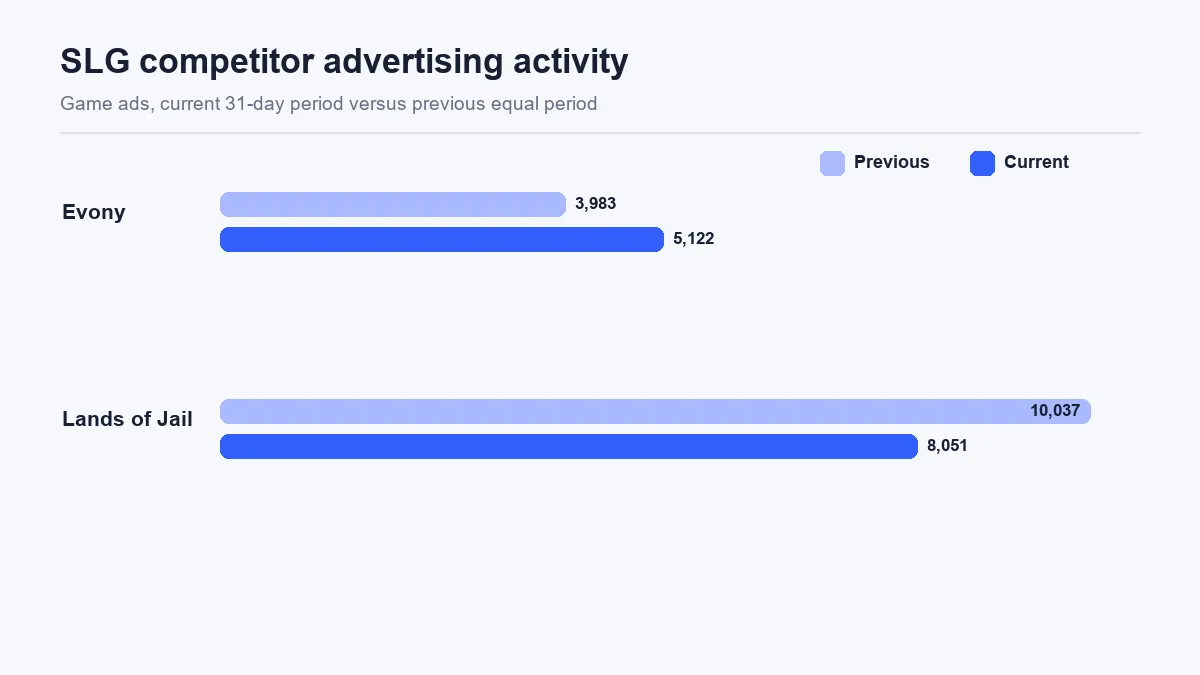
SLG teams often treat bridge runs, failure screens, and army spectacle as separate creative ideas. A better comparison breaks every asset into four parts: setback, upgrade action, proof of power, and CTA continuation. Verified AppGrowing data shows why the competitors need different review paths. Evony game-ad volume rose from 3,983 to 5,122, while Lands of Jail fell from 10,037 to 8,051 during 2026-06-16 to 2026-07-16 versus the previous equal period.
| Competitor | Previous Ads | Current Ads | Change | Previous Creatives | Current Creatives | Change |
|---|---|---|---|---|---|---|
| Evony | 3,983 | 5,122 | +28.6% | 705 | 758 | +7.5% |
| Lands of Jail | 10,037 | 8,051 | -19.8% | 4,482 | 4,355 | -2.8% |
What is the shared failure-to-power path?
The current aggclaw query reviewed more than 708 Evony creatives and more than 157 Last War creatives. It found repeated challenge openings built around failure, bridge runs, or number-gate decisions. Evony used the 99% fail expression in at least 15 sampled creatives. Last War used a bridge-run proxy mechanic in at least 30. These counts support a shared structure, not a claim that every SLG uses the same scene.
The structure begins by making weakness visible. A hero chooses the wrong gate, a small army is overwhelmed, or progress stops at an obstacle. The middle supplies an upgrade through units, resources, equipment, heroes, or construction. The final proof is deliberately legible: a larger number, a stronger squad, a developed base, or a reversed battle result. The viewer does not need to understand the full 4X loop to understand the promised direction of progress.
How should activity changes alter review priority?
Evony increased ad volume by 28.6% while creative volume rose only 7.5%. That relationship should trigger a concentration review. Teams should check whether more delivery is accumulating around a narrower set of retained structures, then compare the repetition of the 99% fail challenge, multi-character combat, and transition into actual gameplay. This is an advertising-activity signal, not a campaign-efficiency result.
Lands of Jail moved in the opposite direction. Ads declined 19.8% and creatives declined 2.8%. Its next review should start with surviving assets rather than assume a broad expansion. The current material query supports a recurring chaos-to-order path for Lands of Jail, including dirty prison openings, cleaning actions, prisoner work, and facility upgrades. That path belongs in its own competitor column rather than being forced into an Evony bridge template.
How can teams avoid assigning a cluster claim to one app?
Use three evidence labels in the review sheet. App-specific means the observation was repeated inside that title's sampled creatives. Cluster means the structure appeared across more than one relevant title. Hypothesis means the team still needs a title-specific query. A bridge-run cluster does not prove that the minigame represents every product, and a fail CTA does not prove stronger conversion.
Last War illustrates why the label matters. Its material sample supports proxy minigames, unit upgrades, base systems, and failure end states. Its keyword advertising snapshot, however, did not resolve cleanly to the exact App ID, so volume claims remain excluded. The title can inform structural comparison without entering the numeric ranking.
What should the next script test change?
Start by keeping the upgrade and payoff fixed while changing only the setback. Compare a wrong choice, insufficient army strength, and resource scarcity. In the next round, keep the setback fixed and vary the proof of power through numbers, army scale, base development, or battle outcome. This sequence reveals whether the opening problem or the visible payoff changed comprehension.
Every test should also record when proxy play gives way to a real-system clue. If the opening promises a simple number gate but the middle never connects it to units, resources, heroes, or construction, revise the promise map before production. The useful SLG test is not another surface reskin. It is a controlled change to one step in the setback-to-power story.
Keep the previous week's labels in the review rather than rebuilding the taxonomy each time. When a concept family remains active, compare whether its opening, system reveal, and CTA are becoming narrower or broader. When a genuinely new family appears, create a separate test row. This cadence places activity movement, structural change, and script decisions on one timeline, so the team can explain why an asset moved from watchlist to production.
