Royal Match does not treat the puzzle board as an isolated selling point. Its recurring structure links a King-in-peril or comic-failure opening to a solvable situation, then uses a Pick or Try Again end state to turn correction instinct into an action prompt. Current-period game ads rose from 12,455 to 14,641 while creatives fell from 3,566 to 2,786, making retained structures the first review priority.
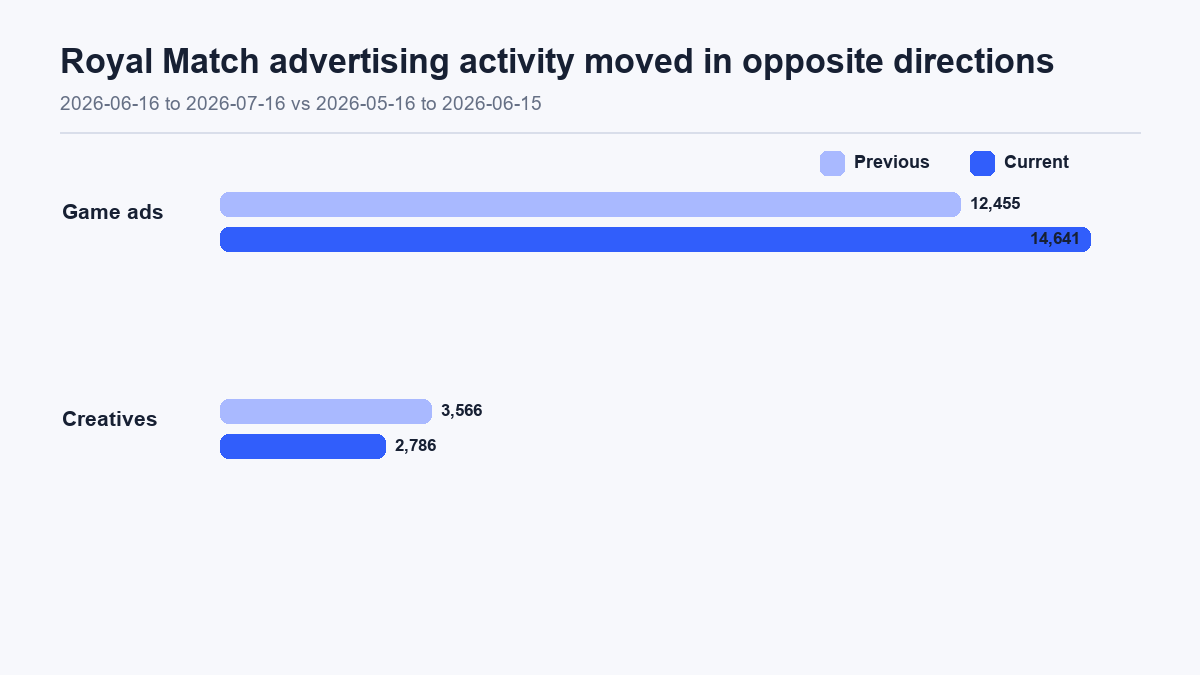
| Metric | Previous Period | Current Period | Change |
|---|---|---|---|
| Game ads | 12,455 | 14,641 | +17.5% |
| Game creatives | 3,566 | 2,786 | -21.9% |
How do crisis and satisfying play work together?
The verified material sample shows two useful entrances. A character chased by danger, caught in a trap, or placed in an absurd situation creates an immediate task. A close match-3 chain reaction creates fast visual satisfaction. The first format makes the viewer want to repair an outcome; the second demonstrates the feedback of the mechanic. Teams should label them as separate openings rather than assume that one replaces the other.
Where does the No Ads expression belong?
No Ads appeared repeatedly in the Royal Match material sample as a differentiation expression. A review should record where it appears: whether it resolves a pain point in the opening, removes doubt after gameplay, or becomes an action reason near the CTA. Product, legal, and regional teams should confirm that the claim is true for the relevant version and market. It is not a generic line that can be copied without verification.
What makes a failure CTA a real script test?
Keep the crisis-failure-choice rhythm and change one meaningful variable: the endangered character, the reason for failure, the player choice, or the board feedback. A new colour treatment or character skin is an execution variant. A change in the judgment the viewer is asked to make is a script-level test. That distinction prevents a creative library from filling with nearly identical false-failure assets.
How should story, board play, and CTA form one path?
A useful review splits the asset into four time blocks. The first three seconds establish a crisis or absurd situation; they do not need to explain every rule. The next section should show at least one legible puzzle action, such as matching, choosing, removing an obstacle, or helping the character escape. If the middle shows story without actionable feedback, the viewer understands that the character has a problem but not what the game experience is. If the opening shows only a board, the asset demonstrates a mechanic but may not give the viewer a reason to keep watching.
Pick or Try Again should not be reviewed as a standalone button. It converts the preceding failure into an unfinished choice. The viewer has seen why the outcome is wrong, so the invitation to correct it has context. Teams should inspect whether the second before the CTA makes the failure legible and whether the CTA continues the same character, problem, and board logic. When the end card is unrelated to the story, the correction impulse is interrupted.
When should a pattern remain in the watchlist?
Keep a pattern in the watchlist when the crisis appears in one new asset only, or when the gameplay reveal is too short to connect it with the character task. Promote it to a script test only when crisis, visible resolution, and correction CTA recur in more than one retained asset. The conclusion should remain structural: the pattern is worth reviewing. It should not translate lookup UV or advertising counts into a claim about creative performance.
How should a weekly creative review work?
On day one, choose representative retained assets for character crisis, direct board play, and chain reaction. Record the exact timing of the opening, gameplay reveal, and CTA. On day two, classify the failure: a wrong choice, a delayed response, or too many obstacles. Check which failure can naturally lead into board interaction. On day three, write two resolution versions for one failure type: one with direct matching and one with a task choice. On day four, ask product or regional reviewers to check No Ads, rewards, levels, and character promises. On day five, decide which scripts enter production and which remain on the competitor watchlist.
This cadence puts story, gameplay, copy, and expression review on one sheet from the beginning. A team does not have to duplicate crisis scenes simply to raise asset count. Every new version should answer one question: did it change the problem the viewer is asked to solve, or did it only change the surface treatment? Only the first is a useful script experiment.
