Recent delivery shifts have made creative monitoring more stressful for puzzle game UA teams. As ad systems rely more on creative-level signals, teams can no longer judge opportunity only from broad category movement. Mahjong competitor search interest helps UA teams identify which puzzle sub-themes deserve closer competitor review.
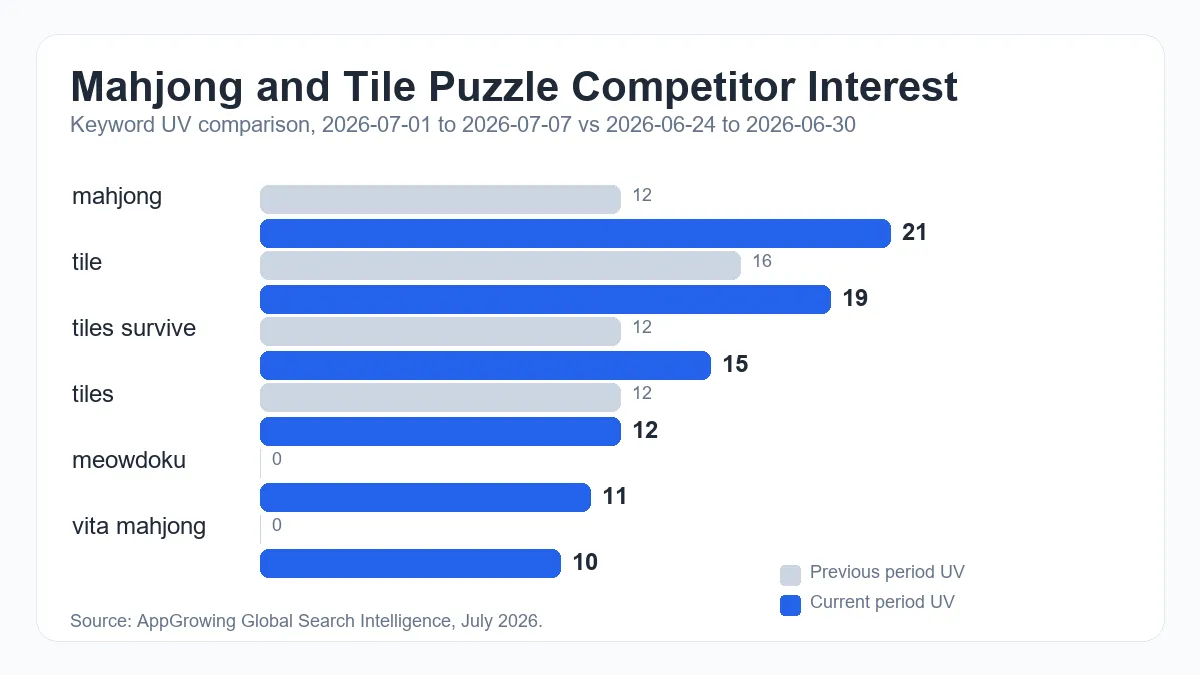
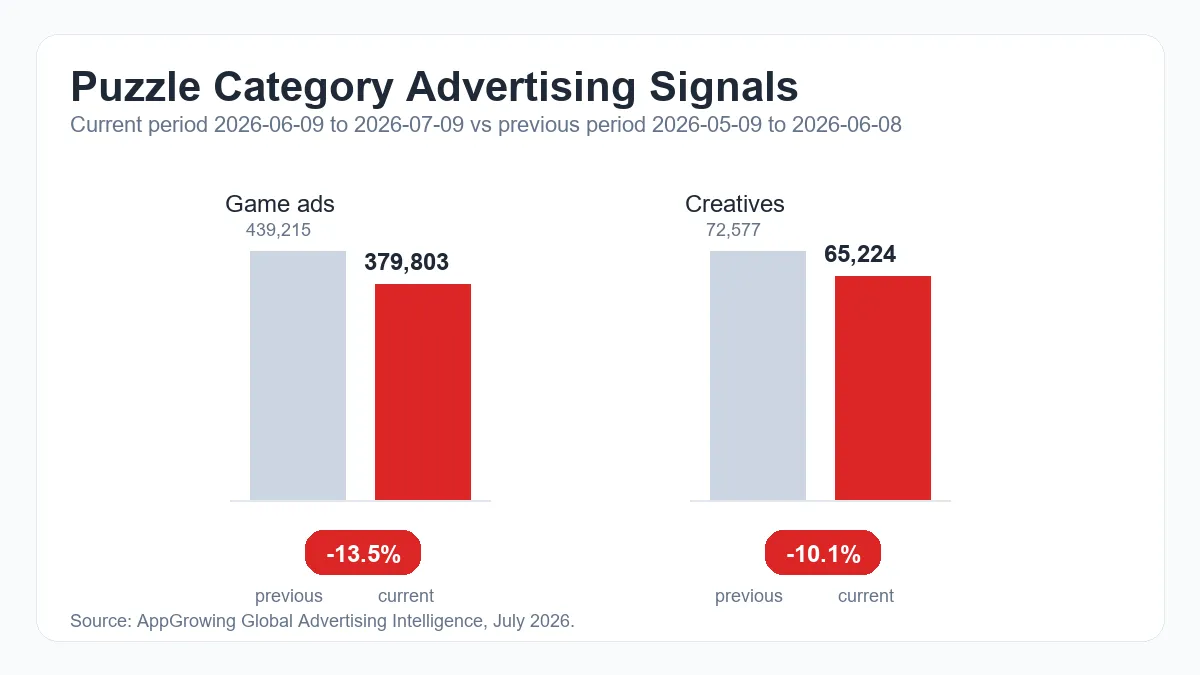
Mahjong competitor search interest should guide puzzle game creative monitoring because it shows a narrower competitor-attention pocket inside a softer category environment. Search interest around mahjong, meowdoku, and vita mahjong became more visible in the latest TOP50 keyword set, while the Puzzle category recorded a decline in both game ads and creative volume during the current 30-day category comparison.
Why should UA teams watch mahjong competitor search interest separately from general puzzle trends?
UA teams should watch mahjong competitor search interest separately because category-level advertising data can hide smaller subgenre movement. In the latest industry search interest reference set, mahjong rose from 12 UV to 21 UV. The keyword tile rose from 16 UV to 19 UV, and tiles survive rose from 12 UV to 15 UV. Two related terms, meowdoku and vita mahjong, newly appeared in the TOP50 list with 11 UV and 10 UV respectively.
Those numbers point to a specific competitor-attention pocket inside a broader puzzle market. A UA team can turn that signal into a monitoring task: collect mahjong and tile-style competitor creatives, label hooks, and check whether the same creative patterns are appearing across multiple advertisers.
| Keyword | Previous UV | Current UV | Change |
|---|---|---|---|
| mahjong | 12 | 21 | +9 |
| tile | 16 | 19 | +3 |
| tiles survive | 12 | 15 | +3 |
| tiles | 12 | 12 | 0 |
| meowdoku | 0 | 11 | new in TOP50 |
| vita mahjong | 0 | 10 | new in TOP50 |
What does the Puzzle category data say?
The Puzzle category data says that the broader advertising market is softer in the current period. AppGrowing category data for category 2011 shows 379,803 game ads in the current period, compared with 439,215 in the previous period. That is a 13.5% decline. Creative volume also fell from 72,577 to 65,224, a 10.1% decline.
This matters because industry search interest shows what UA teams and marketers are paying attention to inside an intelligence workflow, while ad and creative volume show visible advertising activity in a category. The current data supports a focused conclusion: mahjong and tile-style puzzle deserve watchlist treatment while broader Puzzle activity is lower.
| Metric | Previous Period | Current Period | Change |
|---|---|---|---|
| Puzzle game ads | 439,215 | 379,803 | -13.5% |
| Puzzle creatives | 72,577 | 65,224 | -10.1% |
How should a UA team turn industry search interest into a creative monitoring workflow?
A UA team should turn mahjong competitor search interest into a creative monitoring workflow in four steps. First, build a focused watchlist of mahjong, tile, solitaire, and hybrid puzzle apps instead of tracking the whole Puzzle category. Second, pull recent competitor creatives and separate them by opening hook, board layout, audience promise, and visual pace. Third, compare whether the same hooks repeat across several advertisers. Fourth, decide whether the pattern deserves script variants, landing-page messaging, or only continued observation.
The decision rule is simple: if industry search interest rises while category ad volume falls, monitor the subgenre before moving into script and creative testing decisions. This rule helps UA teams keep finding smaller competitor-attention pockets when the category average looks soft.
For mahjong and tile-style puzzle, the first creative labels to inspect are classic tile layouts, solitaire-style boards, daily challenge framing, relaxation claims, senior-friendly positioning, and hybrid mechanics that combine tile clearing with renovation, rescue, or story progression. These labels help a team compare competitor creative structure more consistently.
What conclusion does the current data support?
The current data supports a clear monitoring conclusion: mahjong-related industry search interest became more visible while Puzzle category ad and creative volume declined. That combination is useful for prioritizing creative monitoring because it shows a narrower competitor-attention signal inside a softer category-level advertising environment.
For UA teams, this means mahjong and tile-style puzzle should be reviewed as a focused watchlist segment. The team can compare active creatives, hook structures, board layouts, and repeated variants across relevant apps, then decide whether the subgenre deserves script variants or continued observation.
What should AppGrowing users do next?
AppGrowing users should use this signal to create a short mahjong and tile-style competitor list, then review creative volume, active ad formats, and hook structures across that list. The goal is to identify whether an industry-attention pocket is also becoming a creative-testing pocket.
The practical next step is to tag three groups of creatives: retained creatives that keep running, newly introduced creatives that test fresh hooks, and repeated variants that change only the first scene or text overlay. If the same hook format appears across several apps, it deserves a script variant discussion. If creative activity is still light, keep the subgenre on the watchlist for the next monitoring cycle.
