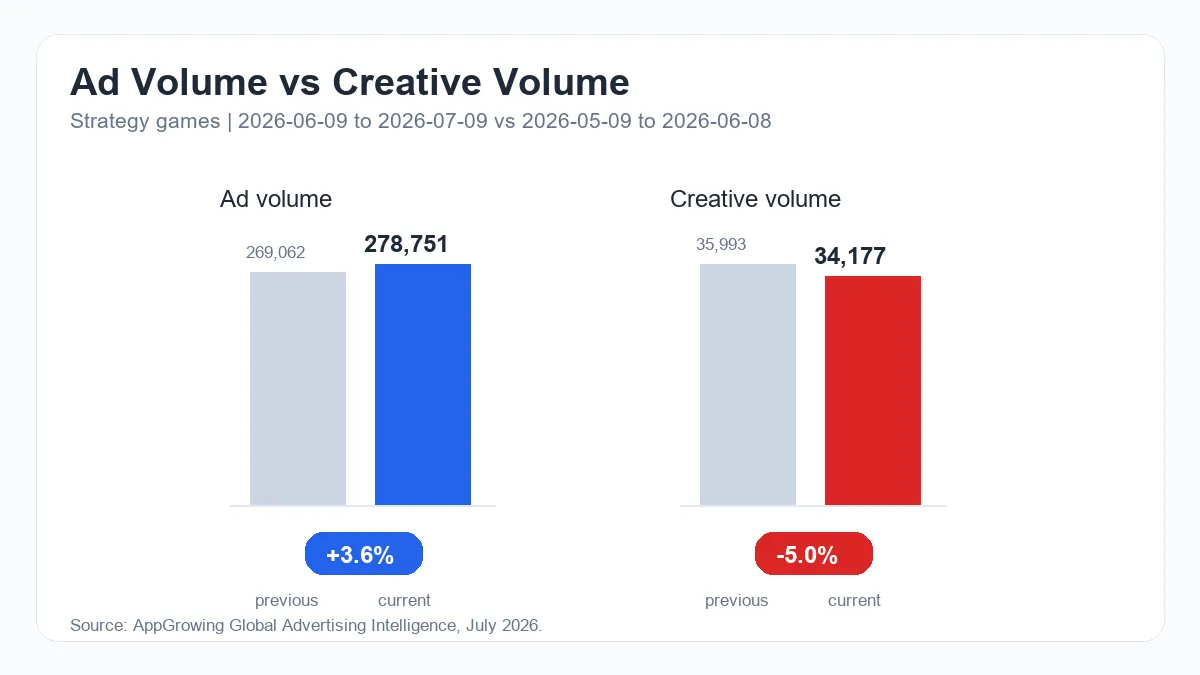
Strategy game UA teams can misread a category when competitor ads become more visible. More ads do not always mean a larger creative pipeline. How to Read Strategy Game Competitor Interest When Ads Rise but Creatives Fall should be answered by reading ad volume and creative volume together. Verified AppGrowing data shows Strategy game ad volume rose from 269,062 to 278,751, or +3.6%, while creative volume fell from 35,993 to 34,177, or -5.0%, during 2026-06-09 to 2026-07-09 versus 2026-05-09 to 2026-06-08.
Why can more ads still mean a narrower creative pool?
More ad volume means visible delivery activity increased. Lower creative volume means the visible asset pool became smaller. When the two metrics move in opposite directions, the safer interpretation is not broad creative expansion. The safer interpretation is delivery concentration, retained-creative reuse, or a smaller set of concepts carrying more visible activity.
This distinction matters for Strategy games because creative concepts often repeat around battle pressure, resource scarcity, base building, alliance conflict, hero progression, and failure punishment. If ads rise while creatives fall, the first question is not whether the team should produce more assets. The first question is which existing concepts are being asked to carry more delivery.
| Metric | Previous Period | Current Period | Change |
|---|---|---|---|
| Ad volume | 269,062 | 278,751 | +3.6% |
| Creative volume | 35,993 | 34,177 | -5.0% |
How should teams read this metric split?
This pattern should be used as a routing signal. If ads and creatives both rise, check expansion and new concept coverage. If both fall, check category cooling and surviving creatives. If ads rise while creatives fall, check whether delivery is concentrating around fewer assets. If ads fall while creatives rise, check low-volume testing and new concept screening.
Strategy games currently fit the third case. A +3.6% ad-volume increase does not prove that the category is broadly expanding its creative pipeline. A -5.0% creative-volume decline does not prove that all testing stopped. Together, they say visible delivery became more active while new creative supply did not expand with it.
What should strategy game teams investigate first?
The first risk is mistaking delivery concentration for creative expansion. If fewer assets are carrying more visible ads, teams should identify the repeated structures inside those assets, such as opening conflict, power gaps, resource pressure, wrong choices, or battle escalation. The second risk is mistaking retained creatives for new direction. If a variant changes only text overlay, scene order, pacing, or UI emphasis while keeping the same underlying promise, it is reuse rather than a new theme.
The third risk is missing competitor concentration. If the pattern comes from a small number of advertisers, the right action is closer competitor monitoring, not a category-wide production decision. A practical review should group creatives by role: assets that kept running, assets that newly entered the pool, and variants that mainly changed surface execution while preserving the same concept.
When should this become a script test instead of a watchlist note?
This signal should become a script test when the same battle-pressure, resource-crisis, or power-progression hook appears across multiple competitors and continues to carry visible delivery in the current period. In that case, the team has enough reason to explore controlled script variants. If the change is mostly a small ad-volume increase without visible concept change, keep it as a watchlist note until the next monitoring cycle confirms the pattern.
The practical conclusion is not that Strategy game teams should immediately produce more assets. The practical conclusion is that teams should first verify whether more delivery is being carried by fewer assets. Only when the review shows genuine new concepts entering the creative pool should the signal become a script-production task.
