Over the past year, AI apps have moved far beyond the tech community and become part of everyday life for users around the world.
From photo editing and AI chat to learning, productivity, music creation, and video generation, capabilities that once required professional skills are now accessible to almost anyone. As AI applications move past the “novelty” stage and enter a new phase of scaled commercial competition, a new set of questions has emerged:
Which markets are still growing?
Which categories are becoming increasingly crowded?
What kinds of creatives can still capture users’ attention?
To help answer these questions, AppGrowing, in collaboration with Youdao Ads, has released the “2026 Q1 AI App Marketing Trend & Growth Strategies” report in the form of an interactive web experience. The report explores AI app marketing trends across three key dimensions: the global market landscape, regional insights, and high-performing creative strategies.
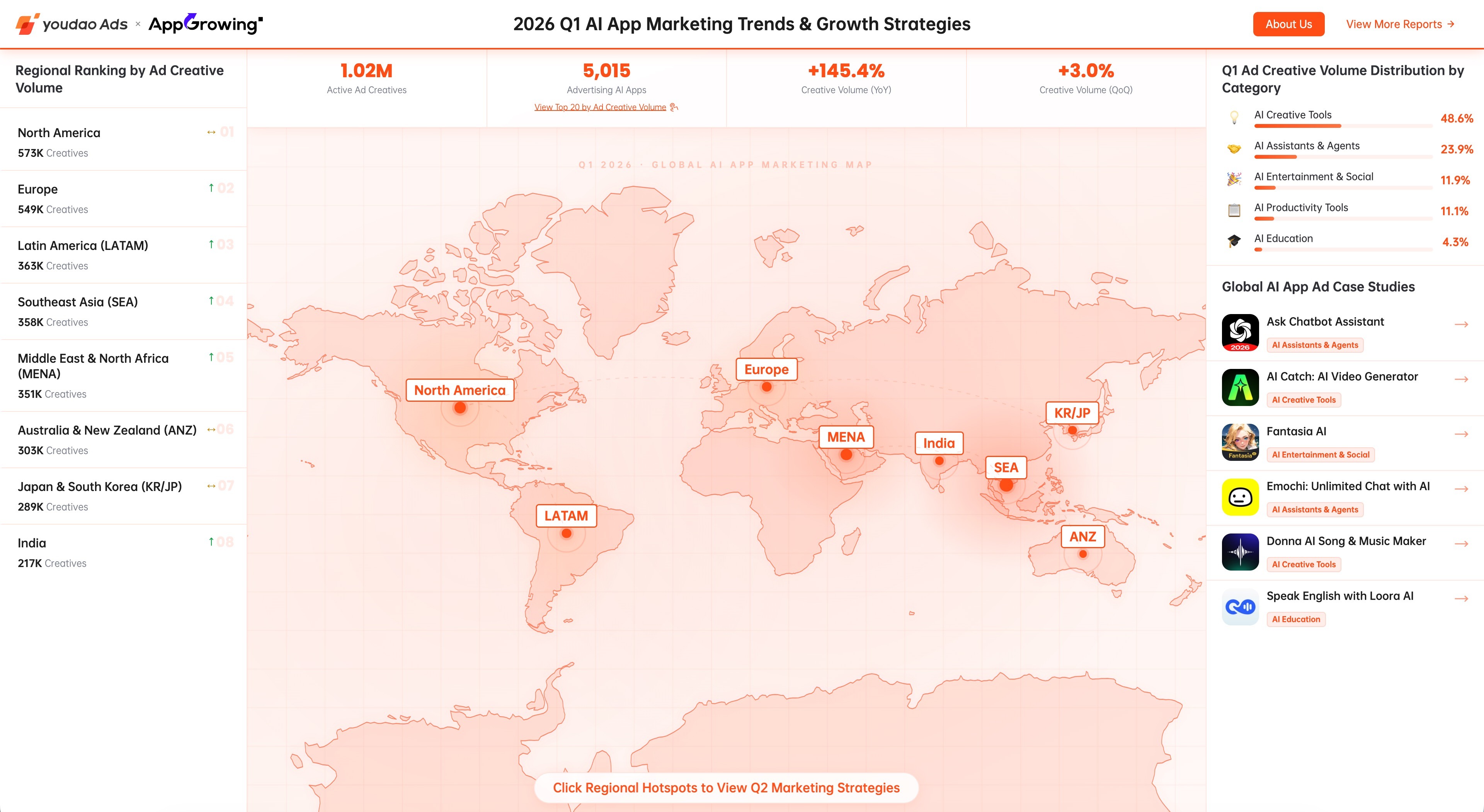
Rather than presenting the findings as a static report, the interactive format allows readers to explore different sections based on their own priorities, making the insights more focused and actionable.
👉 Read the full report here: https://www.youdaoads.com/en-US/insights/5e615ec6e2118b3d1dbf58769b1d50f3
AI App Growth Is Becoming More Segmented
In Q1 2026, the global paid user acquisition market for AI apps continued to expand, evolving from early-stage experimentation into more normalized and competitive growth.
According to AppGrowing data, AI apps reached 1.016 million active ad creatives, with more than 5,000 active advertisers in the category. Year over year, the number of creatives increased by 145.4%, while the number of active apps grew by 56.5%.
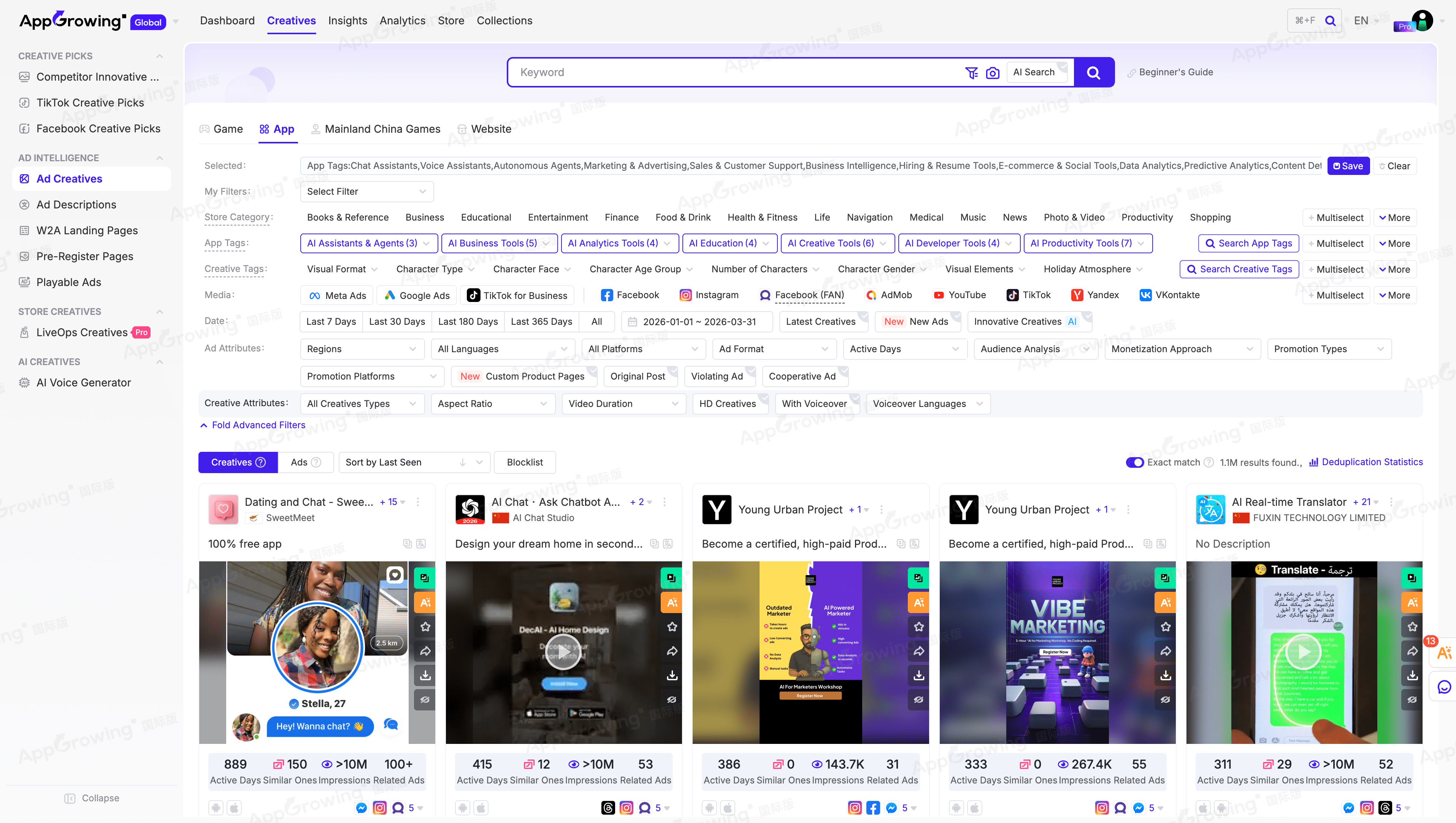
source: AppGrowing
This suggests that competition is no longer simply about who enters the market. The real challenge is who can consistently produce more creatives—and more effective ones.
At the same time, the market is showing signs of greater discipline. Creative volume increased by only 3.0% quarter over quarter, while the number of active apps rose by 8.2%. New players are still entering the space, but advertisers are becoming more cautious with their media spending. As user acquisition costs continue to rise, many teams are shifting from broad-scale spending to more focused testing, optimization, and creative reuse.
Category growth is also becoming more differentiated. AI creative tools accounted for nearly half of total ad activity, while AI assistants and agents represented 23.9%. Entertainment, social, and productivity tools each accounted for around 11%.
This makes sense. Image, video, music, and character-based AI products are naturally suited to short-form video advertising. In just a few seconds, advertisers can show a clear before-and-after transformation or deliver an immediate emotional payoff.
As a result, effective AI app marketing is changing. It is no longer enough to show what AI can do. The stronger approach is to show what users can become, achieve, or feel after using it.
Regional Markets Are Defining Product Positioning
North America and Europe remain major markets in terms of traffic scale, monetization potential, and subscription behavior. For many AI app advertisers, these mature markets still form the foundation of global growth.
But focusing only on top-tier markets may mean missing important signals elsewhere. Regional differences are becoming more important, not just for media buying, but for product positioning, messaging, and creative strategy.
Southeast Asia: Mobile-First Users and Visual Creativity
Southeast Asia is a strongly mobile-first region, where smartphones are often the primary gateway to the internet. This has shaped user behavior around content consumption, social interaction, and app discovery.
Users in the region are highly familiar with short-form video, social feeds, and mobile-native ad formats. In Q1, this was reflected in the advertising rankings: among the top 10 AI apps promoted in Southeast Asia, six were image or video editing products, including apps such as Picshiner, PhotoVerse, and ArtPic.
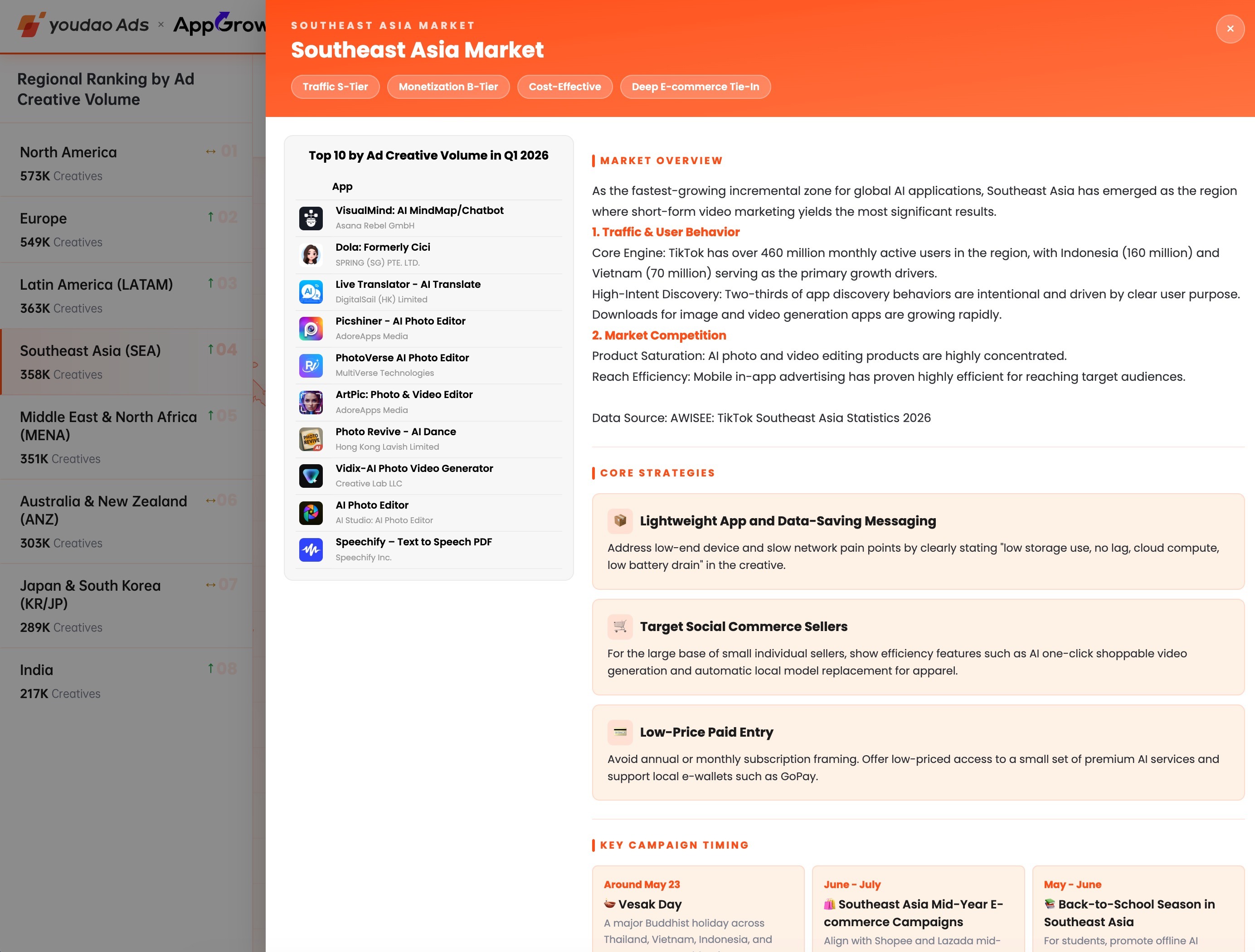
Visual content creation and sharing are among the most common forms of social engagement in the region. AI photo editing and AI video tools fit naturally into that behavior.
However, when many products offer similar functionality and invest heavily in paid growth, feature parity becomes a challenge. The next stage of competition will depend less on what a product can do, and more on whether its creatives can stand out with clearer use cases, stronger emotional hooks, and more localized storytelling.
MENA: Digital Companionship and Emotional Needs
In the Middle East and North Africa, cultural norms and social expectations can shape how users interact, communicate, and seek emotional connection. In some markets, offline social interaction—especially between men and women—may be more structured or limited by local customs.
This creates an interesting opportunity for virtual companionship and AI character-based products, which can offer private, imaginative, and emotionally engaging experiences in digital spaces.
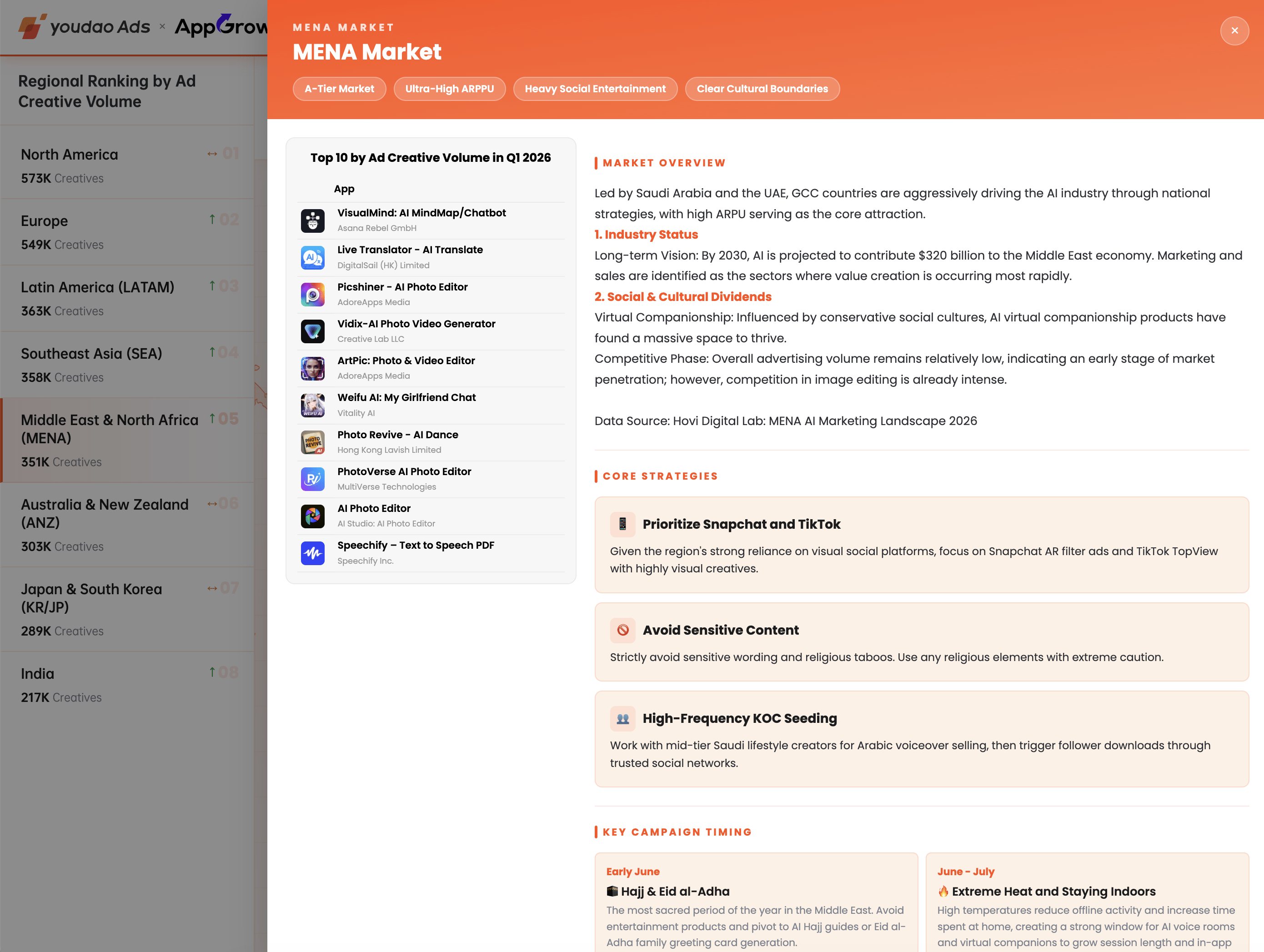
In the MENA promotion rankings, one example is Weifu AI: My Girlfriend Chat, a virtual girlfriend app. Its presence reflects a broader trend: in markets where certain forms of real-world interaction may be less accessible or more sensitive, virtual emotional products can provide an alternative form of companionship and self-expression.
The key is to approach this category with cultural awareness and respect. Emotional AI products need to be localized carefully—not only in language, but also in tone, character design, relationship dynamics, and boundaries.
India: Android Optimization and the Opportunity Around English Learning
In India, Android-focused AI apps represent a significant share of the market. This is closely tied to the structure of the local smartphone market, where affordable Android devices dominate and hardware conditions can vary widely across users.
For AI app developers, this means Android optimization is not optional. Device fragmentation, memory limitations, and different system versions all need to be considered when building and marketing products for the Indian market.
Beyond hardware, language needs also play an important role. India has one of the world’s largest English-speaking populations, but actual English proficiency levels vary significantly across regions, education backgrounds, and work environments. Many users speak a mix of English and local languages in daily life, and improving spoken English remains a meaningful goal for education, employment, and social mobility.
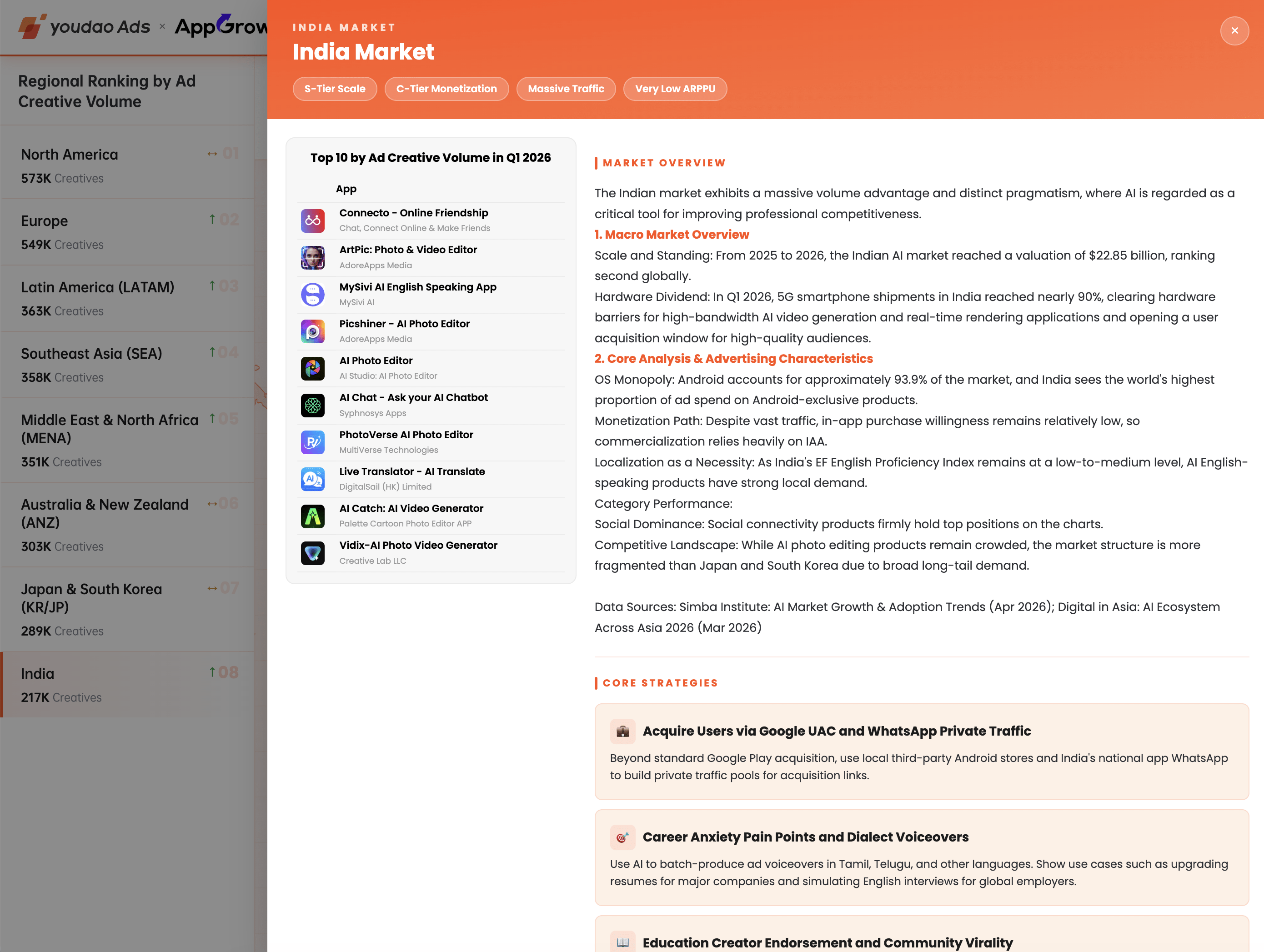
This is where products such as MySivi AI English Speaking App find a strong user need. The opportunity is not simply “AI language learning,” but AI as a practical tool for confidence, communication, and career development.
The broader lesson is clear: the same AI capability can carry very different user motivations across markets. Growth depends on understanding not just what users can do with AI, but why they need it in the first place.
Creative Breakthroughs: Two Ad Strategies That Are Working
Using AppGrowing’s AI-powered creative analysis, we examined high-performing AI app creatives from Q1 and identified two creative strategies that are gaining traction.
The first is turning AI capabilities into social identity expression.
As AI technology becomes more mature and widely available, it is becoming harder for products to differentiate through technology alone. This is especially true for creative tools. Many apps offer similar editing effects, filters, generation features, or templates, which means advertising must compete through packaging, scenarios, and emotional relevance.
Most AI creative tools follow a social media-driven logic: users see an effect, find it fun or relevant, and download the app to try it themselves. But trends can be short-lived, and no campaign can test every possible effect at scale.

source: AppGrowing
The more reliable approach is to connect AI effects with specific social display scenarios.
Couple avatars, matching wallpapers, best-friend photos, pet transformations, stylized portraits, and other identity-driven formats are not just visual effects. They are ways for users to express relationships, personality, humor, and belonging on social platforms.

source: AppGrowing
In other words, the strongest AI creative ads do not simply say, “Look what this tool can generate.” They say, “This is how you can present yourself, your relationships, or your lifestyle online.”
The second strategy is the rise of AI comic-drama-style creatives.
AI-generated comic and short-drama content has become one of the year’s most notable creative formats, with companies across multiple industries testing it as a performance marketing tool. For AI apps, it is also becoming an increasingly relevant direction.
Virtual companionship and AI role-chat products are especially well suited to this format because they already have characters, personalities, and story settings. Around the same character, advertisers can quickly create scenes such as first encounters, misunderstandings, emotional conflict, confession, reunion, or suspense.

source: AppGrowing
These story-driven creatives make it easier for audiences to emotionally engage with the ad. Compared with traditional function-led advertising, comic-drama creatives can create stronger immersion and give users a reason to care about the character or scenario before they even download the app.
As AI production costs continue to decrease, paid creatives are likely to become more like a content production system. Winning teams will need not only media buying capabilities, but also the ability to generate, test, and iterate creative narratives at scale.
A Marketing Map for the Next Stage of AI App Growth
All of these insights—global growth patterns, regional market differences, and high-performing creative strategies—are brought together in the “2026 Q1 AI App Marketing Trend & Growth Strategies” interactive report.
The goal of the report is to help AI app teams better understand:
Why a market needs their product,
How user motivations differ across regions,
And what happens in the few seconds when an ad successfully captures attention.
AI app is no longer just about competing for traffic. It is increasingly about competing for understanding.
For teams looking to identify their next growth market, refine their positioning, or improve creative performance, this map offers a clearer view of where the opportunities are—and how to approach them.
