At the 2025 Google Apps Summit in Vietnam, one statistic stopped the industry in its tracks: Vietnam’s mobile mobile app and game IAP revenue grew by 65% year-over-year, making it one of the fastest-growing markets in APAC.
Behind these high-growth figures, a potential shift deserves even more attention.
The MR and UA teams at local Vietnamese publisher Funtap Games told AppGrowing that the Southeast Asian market is shifting from being driven by traffic dividends to being driven by content competition. The growth model that previously relied on low-cost user acquisition and celebrity endorsements is rapidly losing its effectiveness.
As a result, what determines growth is no longer just securing S-level products or how much traffic is purchased, but whether a team can continuously output content that resonates with users.
Game Publishing Capability = Content Understanding Capability
Founded in 2015, Funtap Games has grown into one of the top three mobile game publishers in Vietnam.
The company’s development journey clearly reflects the expansion and evolution of the Southeast Asian gaming market: from leading the development and publishing of Xianxia and Wuxia MMORPGs, as well as deep-strategy Three Kingdoms titles, to expanding into a more diversified portfolio including SLG, esports, and midcore to hardcore, community-driven games.
Funtap Games has successfully published a range of standout titles across Vietnam and Southeast Asia, including Mobile Legends: Bang Bang (MLBB), Genshin Impact, Arknights: Endfield, and Last War.
At the same time, Funtap Games is progressively expanding into the global market through co-development and co-production partnerships with studios, with a strategic focus on casual and hyper-casual games to optimize scalability and enhance global market reach.
The flourishing of diverse game categories not only means more opportunities in the SEA market but also signifies an upgrade in publishing logic. The brute force tactics of the past—celebrity marketing + burst UA—are now rarely effective. To truly move users, publishers must deeply explore localized forms of content expression.
Taking Mobile Legends: Bang Bang as an example, Funtap Games shared that its user profile primarily consists of males aged 15-30 who prefer competition and social interaction. At the same time, local Southeast Asian players have distinct content consumption habits: they have strong social attributes, are keen on sharing game clips and gameplay reflections, follow trending memes and topics, and use TikTok with high frequency.

Based on target user profiles, Funtap Games has gone beyond conventional publishing and instead implemented localized adjustments across community operations, local esports systems, player feedback channels, and UA marketing. These efforts ensure that its products remain closely aligned with Southeast Asian players’ usage habits and cultural context.
In terms of E-sports, for instance, besides standard national-level tournaments, Funtap Games invested significant energy at the campus and grassroots levels. This included establishing talent cultivation paths with universities and holding various large-scale offline activities (such as Big Offline, Mini Festivals, and Cosplay competitions) to attract potential audiences and diversify emotional links with ordinary players.

On the UA side, MLBB focused its spend on TikTok to match the local preference for the platform. It is understood that TikTok accounted for 48% of the ad spend, followed by Google at 42%. Video was the dominant creative format, accounting for 89%.
Funtap Games noted that a key insight in live-service game operations is that ensuring in-game experience alone is far from enough. The foundation of long-term operations lies in creative content, localized expression, and emotional resonance derived from the game product itself.
This also suggests that publishing is no longer merely about introducing a product to the market. Instead, it is about reconstructing the product's content expression so that the product eventually becomes part of the local cultural content.
Layering and Unification of Content Expression
Under the “Creative is the New Targeting” Trend
In AppGrowing's view, advertising entered the content-driven stage even earlier than the publishing phase. Furthermore, under the “Creative is the New Targeting” trend, its importance has been further elevated.
Funtap Games shared their experience operating Last War: Survival in the Vietnamese market, which clearly illustrates the shift in UA logic.
In terms of genre, SLG remains a major revenue driver in Vietnam. However, in the past, the top of the market was mostly occupied by traditional gameplay products like Rise of Kingdoms. The shift occurred in 2024. Since the success of Century Games’ Whiteout Survival, “SLG Lightweighting” has become a new proposition, leading to a succession of new hits, with Last War: Survival being a representative example.
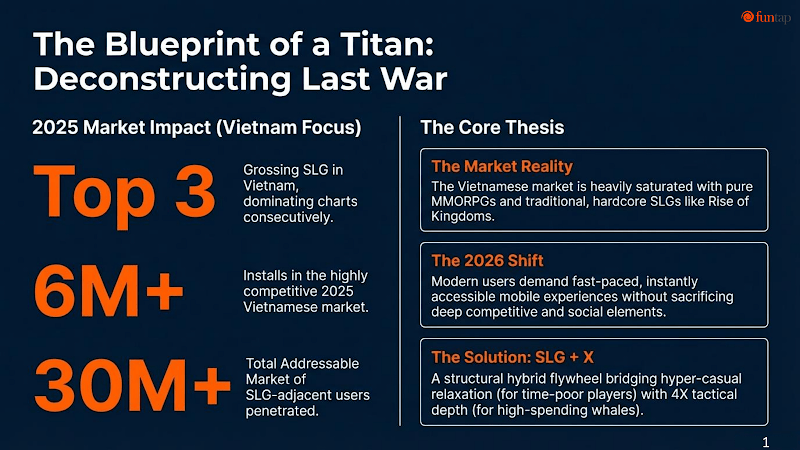
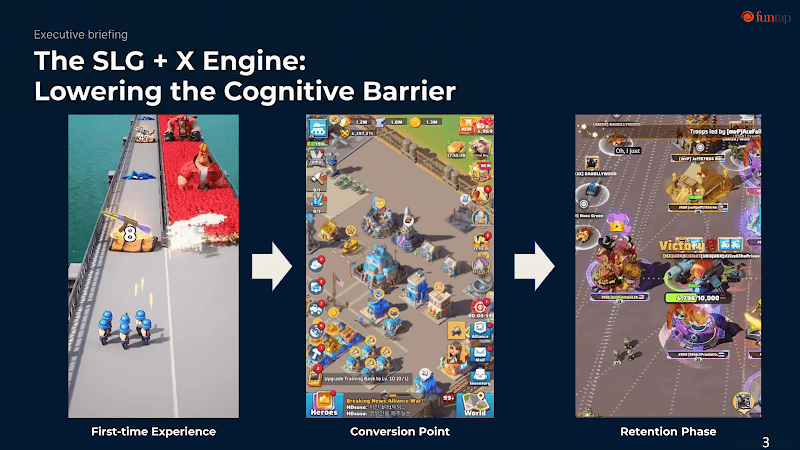
Funtap Games breaks down user perception of Last War: Survival into three stages: early, mid, and late.
In the early stage (0–5 seconds), the game uses hyper-casual sub-gameplay such as “choice-based gate-running” as an entry point. The simple control mechanics and instant visual feedback significantly lower the perceived barrier for users. In the mid stage, tower defense and boss battles are gradually introduced, shifting players’ attention toward mid-core gameplay. Only after this does the game unlock core SLG mechanics such as 4X marching systems.
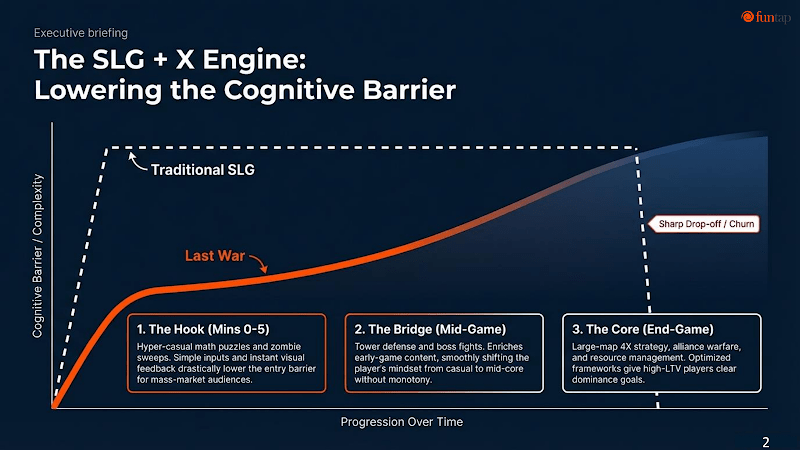
Compared to traditional SLGs, this “light-to-heavy” design significantly reduces user churn and enables more casual users to smoothly transition into mid-core and hardcore gameplay systems. This structure also directly shapes the game’s UA strategy: using lightweight gameplay as the entry hook to attract users, maintaining consistency through the in-game experience, and then gradually guiding players toward core gameplay mechanics.
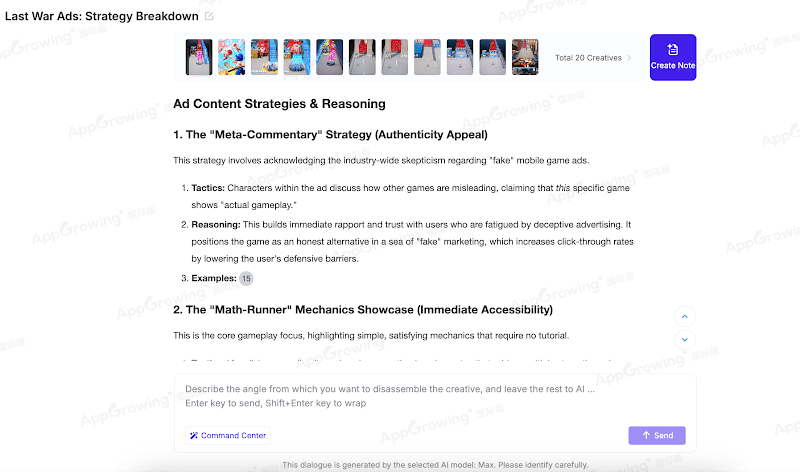
Through the “AI Strategic Analysis” of AppGrowing, we analyzed creatives in the Top 100 exposure.
Most creatives used “choice-gate running” as the core gameplay, utilizing a content structure of “survival pressure → path choice → result feedback (success/failure)” to complete gameplay demonstration and emotional triggering in a very short time.
Funtap Games revealed that sub-gameplay creatives accounted for more than 50% of the distribution, with Google and Facebook being the primary channels, combined accounting for 90% of the spend.
The success of Last War: Survival is often attributed to the deep integration of gameplay design and sub-gameplay-driven UA strategies. However, at its core, it reflects consistency in how game content is expressed.
As AppGrowing previously noted, rather than focusing on individual high-performing creatives, ad platforms are now more concerned with whether an entire ad account consistently delivers the same directional content signals. The overall coherence and thematic focus of creatives has become a key factor influencing delivery stability.
On the basis of maintaining consistency in content expression, creatives are also expected to serve the function of audience screening and layering. Funtap Games noted that although Last War: Survival creatives all use sub-gameplay as the entry hook, they adopt different narrative approaches to further segment and refine target audiences.
This logic is consistent with the “The Four Quadrants of Ad Creative Innovation Strategy” proposed by AppGrowing.
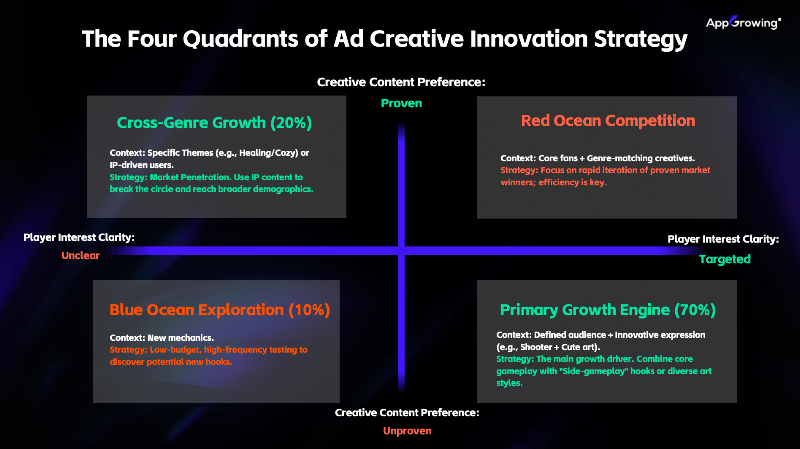
Sub-gameplay creatives belong to the “Primary Growth Engine” type. Player preferences for gameplay are not absolute; users who like casual gameplay do not necessarily reject hardcore gameplay like SLG. The key lies in clever packaging to capture the interest of these potential audiences.
For example, "Success/Failure" endings are common in videos, but different narrative logics can be used to precisely reach different types of niche users. For instance, creatives emphasizing "survival pressure + wrong choice + failure penalty" make it easier for platforms to match strategy-oriented and challenge-oriented users. Meanwhile, creatives emphasizing "rapid growth + numerical crushing + successful clearance" make it easier to match casual players and thrill-oriented users.
 |
 |
The creative strategy for Mobile Legends: Bang Bang follows a similar logic. For example, one of its creatives leverages AI-generated content to produce animated shorts featuring in-game heroes as the main characters. With humorous storylines and a final twist, the video aligns closely with the type of light, entertaining content that Vietnamese users are accustomed to consuming on social media platforms, thereby enabling incremental reach across different content verticals.

However, it is important to note that layering does not mean divergence. Creatives can have multiple forms of expression, but their underlying logic must remain unchanged: the layering strategy can only be effectively identified based on stable content signals.
In other words, content consistency determines whether you can scale up, while layering determines whom you scale to.
Content Expression Capability
as the New Growth Threshold
In the domestic Chinese game industry over the past few years, "Content is King" was often mentioned as a keyword, but it mostly referred to the R&D level. Today, the requirement for content expression capability has extended to the publishing and UA stages and has become a new threshold for growth.
Funtap Games noted that while the Southeast Asian gaming market still holds significant potential, it is no longer a market where success can be achieved through one-off marketing bursts or simple product imports. Only teams that truly understand local cultural context, deeply understand their products, and possess strong content expression capabilities are able to stand out in an increasingly competitive landscape—not just those with strong games. Funtap Games’ core advantage lies precisely in the localized content expression capabilities it has built through years of deep engagement in the SEA market.
From AppGrowing’s perspective, content expression capability on the UA side is no longer merely a matter of creative inspiration. It has evolved into a systematic capability that can be continuously replicated and scaled.
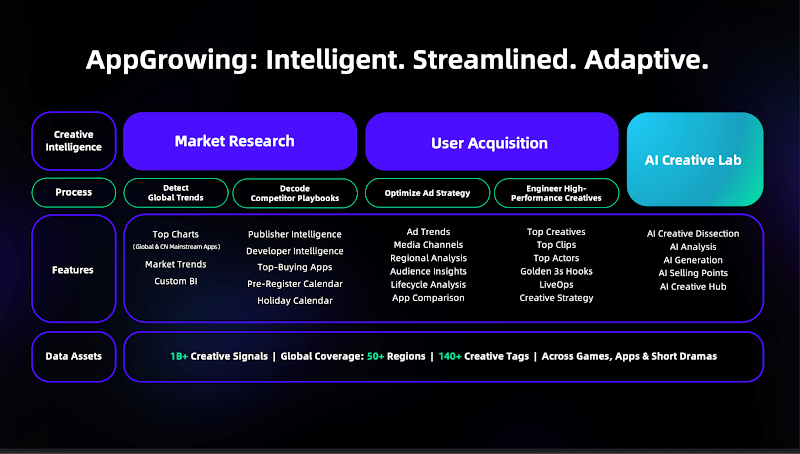
With AppGrowing’s Top Clips and Creative Selling Points features, advertisers can identify the most effective winning creatives from massive creative libraries. Combined with AI Creative Dissection and AI Analysis capabilities, they can further deconstruct creative structures and selling-point combinations. On this basis, the AI Mimic Feature can then transform these insights into scalable, reusable creatives, further guiding content production and iteration.
In essence, what AppGrowing provides is not merely a set of tools, but a framework that helps advertisers evolve content expression capability from experience-dependent manual work into an executable and replicable creative methodology.
As traffic dividends fade, growth in emerging markets such as Southeast Asia is ultimately returning to a more fundamental question: whether content truly matches user needs and can continuously generate value.
*This article is jointly produced by AppGrowing and the MR and UA teams of Funtap Games. All text, data, and charts contained herein are protected by applicable trademark and copyright laws. Certain data, text, or image materials are sourced from publicly available information and cited solely for illustrative purposes, with ownership remaining with their respective original authors.
No part of this article may be reproduced, copied, plagiarized, photocopied, translated, or otherwise used in any form or by any means without prior permission. Any reprint, excerpt, or other use of the data or viewpoints contained herein must clearly indicate “Source: AppGrowing, Funtap Games” and may not delete, alter, or rewrite the original content.
The content is provided for general reference only and should not be regarded as advice or relied upon for any specific matter.
