Last War is a useful case for a narrower question: how can a complex strategy, construction, and resource loop be packaged as an instantly legible minigame? Failure or blockage creates a low-friction conflict; bridge-running, obstacle-pushing, or merge actions supply a visible sense of progress; army, resource, and base scale then provide a larger growth payoff. The current aggclaw query reviewed more than 157 Last War creatives from 2026-06-16 to 2026-07-16.
Why is simplified packaging useful?
A strategy loop can be difficult to explain in a short asset. A proxy mechanic gives the viewer a familiar action before the ad introduces the broader system. The point is not that the proxy is the product. The point is that it can make an abstract progress promise visible quickly.
What must a consistency review check?
Simplification also creates a risk. If a proxy mechanic is presented as the only or central experience while the product is mainly a more complex strategy loop, the creative, copy, and landing path need an explicit consistency review. Teams should discuss that gap as an expectation-management issue, not as a claimed performance advantage.
How should variants be grouped?
Group each asset by its promise. Does the opening promise obstacle solving, number growth, or army scale? Does the middle explain resources or construction? Does the CTA continue the same promise? Versions that only change the bridge, numbers, or opponents while compressing the loop into a progress minigame belong to one proxy-mechanic family. A shift to alliance conflict, base decisions, or a different core pressure is a new concept direction.
How can proxy play support a real product promise?
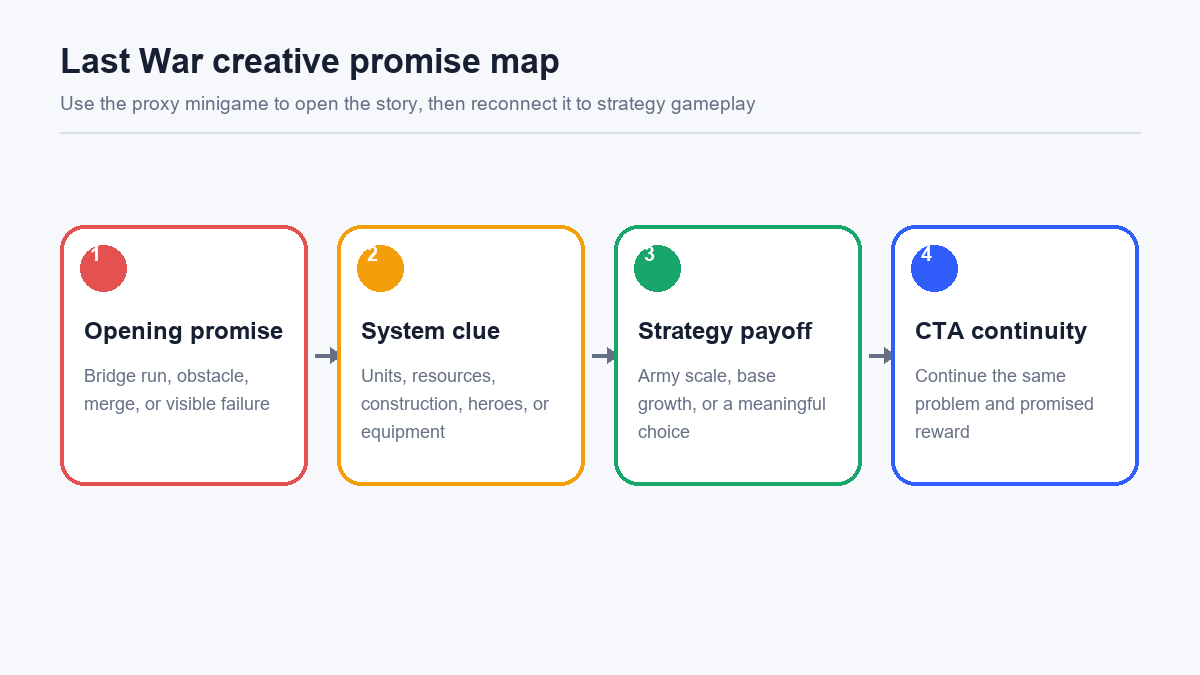
A proxy mechanic should lower first-glance comprehension cost, not replace the product explanation. After the bridge run, merge, or obstacle action, an asset should reveal at least one real-loop clue: how units grow, how resources enter construction, how a base changes later choices, or how alliance and battle outcomes matter. The viewer then sees a path from an intuitive action to a strategy payoff rather than an isolated minigame.
Add a promise map to every version. Field one is the opening-action promise. Field two is the real-system clue in the middle. Field three is the CTA promise. When the three fields align, the asset can enter normal testing. When the opening and middle are unrelated, or the CTA abandons the story for a generic download line, revise for consistency. The same map gives product and legal reviewers an early way to flag expressions that can create the wrong expectation.
What should the next review deliver?
A weekly review should be more than an ad-count table. It should list the proxy-mechanic family, retained or new status, time of real-gameplay reveal, promise-map status, and risks needing review. For retained assets, ask why the proxy remains in use. For new assets, ask whether it changes the way the strategy loop is explained. For surface rewrites, ask whether they only replace obstacles and numbers. This turns competitor observation into a concrete script decision.
How strong are the current material signals?
The current aggclaw query reviewed more than 157 Last War creatives. At least 30 were dedicated to bridge-run or runner-style proxy play, while more than 80 used UGC or TikTok-style presentation. These counts are strong enough to identify recurring families. They are not evidence that one family converts better than another.
Separate format from promise in the review sheet. UGC is a presentation format; bridge running is a proxy mechanic; unit growth, equipment upgrades, resources, and base construction are system clues. A useful script row records all three levels. This prevents a team from treating a new creator, voiceover, or visual skin as a genuinely new strategy concept.
What is the release gate for a proxy-minigame script?
Before production, the script should pass four checks. The opening action must be understandable without narration. The middle must reveal at least one real strategy-system clue. The payoff must follow from that clue rather than jump to unrelated spectacle. The CTA must continue the same promise. If one check fails, revise the connection before adding localization or surface variants.
The same gate applies to the landing path. A simple opening can be useful, but the store page and early product experience should not abandon the promised direction of progress. Use the proxy mechanic as an entry point into strategy, not as a substitute for explaining what the player will manage, build, or improve.
