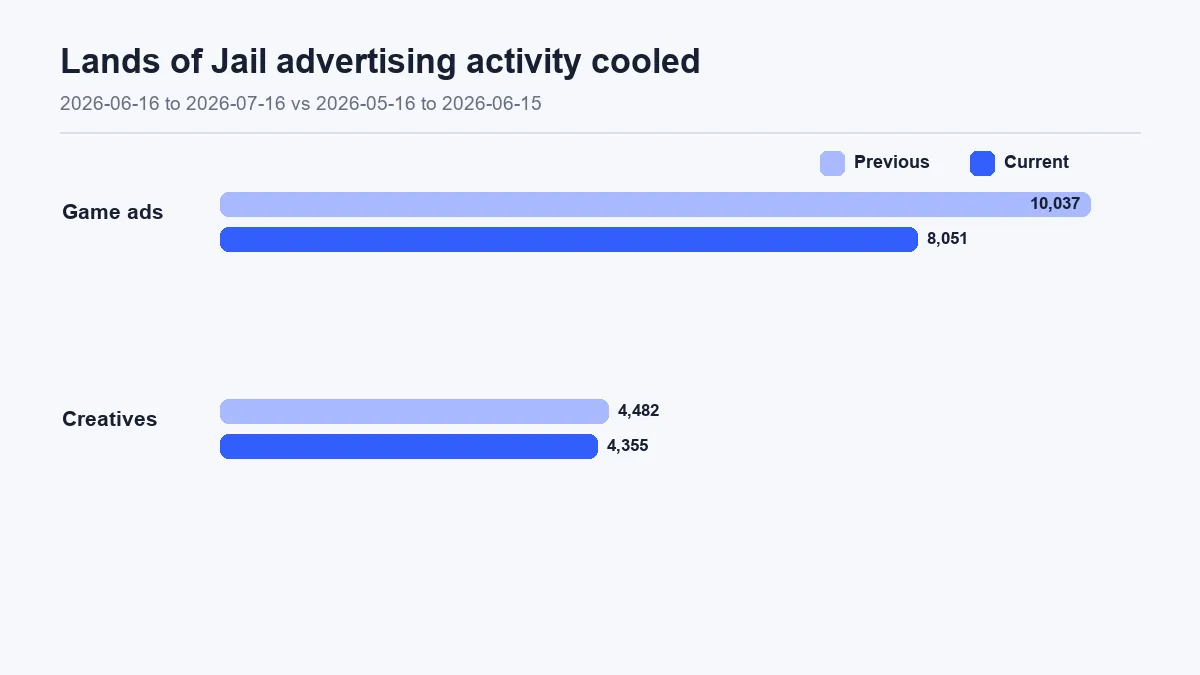
Management-game ads often use chaos as visual spectacle without turning it into a task the player can perform. Lands of Jail creates a clearer loop when a prisoner complaint or broken facility defines the problem, then cleaning, repair, hiring, and upgrades visibly restore order. Game ads fell 19.8% and creative volume fell 2.8%, so the next review should begin with surviving chaos-to-order structures rather than automatic concept expansion.
| Metric | Previous Period | Current Period | Change |
|---|---|---|---|
| Game ads | 10,037 | 8,051 | -19.8% |
| Game creatives | 4,482 | 4,355 | -2.8% |
What kind of chaos becomes a useful task?
The current aggclaw query identified about 62 Lands of Jail materials. More than 50 shared a dirty-prison-to-cleaning-and-upgrade structure. Openings included prisoner complaints about heat, toilets, food, or cells; riots and prison-van accidents; and a zero-resource start with one guard and one prisoner. The sample repeated that zero-resource line in at least three materials.
The useful hook does not simply show a filthy prison. It links the disorder to one facility or management failure. A hot cell implies a fan. An unusable toilet implies cleaning or construction. A shortage of staff implies hiring. The viewer can anticipate the first response before the full management interface appears.
How does cleaning prove management progress?
The middle repeatedly showed scrubbing toilets and floors, removing garbage and rats, hiring an assistant, and building fans, toilets, offices, or factories. Cleaning generated money, money funded an upgrade, and the upgrade opened another area. The progression is legible because one action changes both the environment and the available management options.
Before-and-after framing strengthens the proof. The player character cleans or repairs the same visible space, allowing the viewer to compare dirty with clean and broken with functional. That continuity is more useful than cutting from chaos to an unrelated wealth screen. It shows how the reward was produced.
Which assets deserve attention during cooling activity?
Lands of Jail game ads declined from 10,037 to 8,051, while game creatives declined from 4,482 to 4,355. Both metrics falling supports a surviving-creative review. Teams should identify which complaint, cleaning action, and reward combinations remain active, then compare whether those families are narrowing or adding new management choices.
A version that changes only trash, colors, or characters remains an execution variant. A version becomes a new concept when it changes the facility problem, the income loop, or the management decision. This rule keeps the review focused on structural learning rather than replacing cooled activity with a large number of cosmetic changes.
Which expressions require a risk review?
The sample included riots, equipment destruction, and slogans implying unrestricted control over prisoners. These expressions may trigger age-rating or platform content-policy review. The script sheet should record violence intensity, prisoner agency, reward framing, and market restrictions before production.
Keep the reward focused on facility improvement, sanitation, safety, and operational order. Avoid presenting harm, cruelty, or forced labor as the aspirational payoff. A useful risk rule is simple: if the joke or reward depends on removing a prisoner's agency, route the version to content-policy review and prepare a management-focused alternative before localization begins.
The review should also record complaint, action, economic feedback, and facility result in time order. If the opening complains about heat but the middle only removes trash, the script needs a causal bridge. If the player installs a fan but the room never becomes visibly safer or more functional, the payoff is incomplete. Compare these fields each week to see whether surviving materials strengthen one management promise or merely escalate the disorder. The production handoff should include a lower-risk alternative that preserves the same mechanic through sanitation, safety, and operational efficiency. This gives regional teams a usable option when riot, cruelty, or unrestricted-control language cannot run in a target market.
A four-column storyboard also improves script learning. Column one states the complaint in plain language. Column two shows the first player action. Column three records currency or capacity change. Column four shows the upgraded facility. When one column is missing, the creative may still look dramatic, but it no longer explains the management loop. Retained assets that complete all four columns should receive priority in the next script review.
