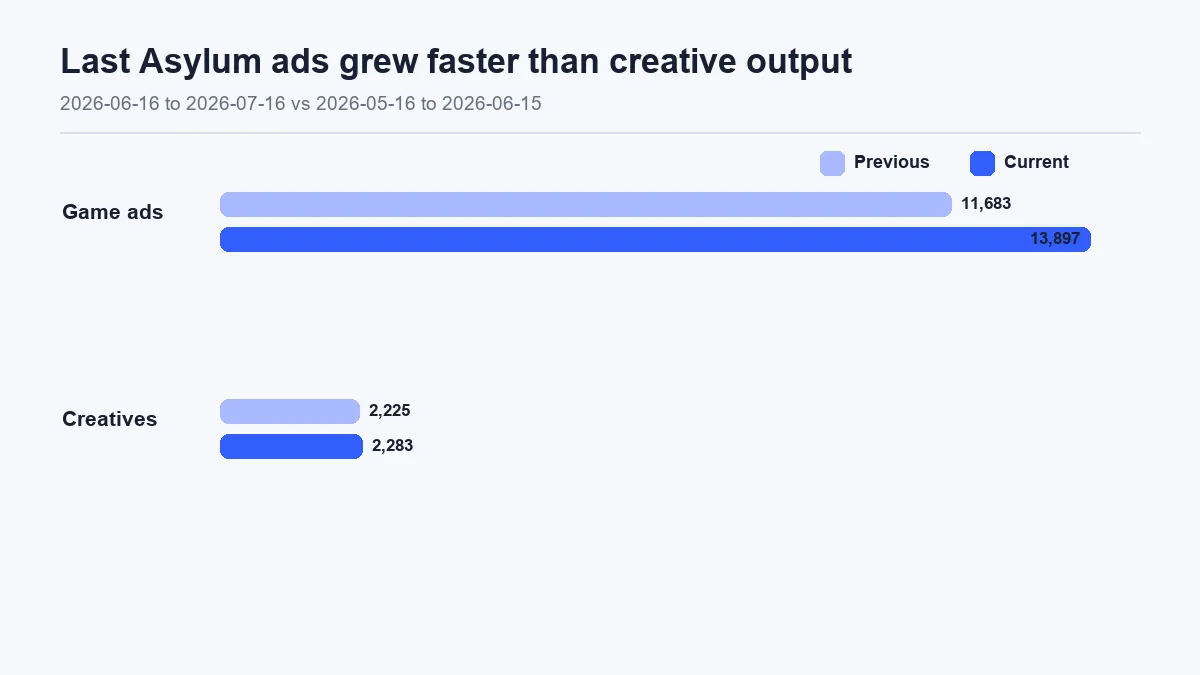
Survival-management ads can establish a powerful world without explaining the player's responsibility. Last Asylum uses the Plague Doctor as a visual anchor, a seven-day challenge as time pressure, and treatment, alchemy, hospital levels, and city building as proof of control. Game ads rose 18.9% while creative volume increased only 2.6%, making concentration among retained concept families the first question for the next review.
| Metric | Previous Period | Current Period | Change |
|---|---|---|---|
| Game ads | 11,683 | 13,897 | +18.9% |
| Game creatives | 2,225 | 2,283 | +2.6% |
Why does the Plague Doctor work as a visual anchor?
The current aggclaw query identified about 70 high-impression Last Asylum materials. More than 40 prominently featured the Plague Doctor. The bird mask, wide-brimmed hat, green goggles, potion, and dark treatment setting create stable recognition before the management interface appears. The returned dataset did not use this character in the other apps included in the query.
The character also connects three parts of the promise. The mask represents the plague threat. The potion and treatment table suggest a response. The hospital and city systems reveal the larger responsibility. This continuity gives the creative a product role rather than using the Plague Doctor as horror decoration.
How does seven-day survival enter the management loop?
More than 25 sampled materials used seven-day survival framing, and at least 12 repeated a version of Can you survive until the seventh day. The question establishes time pressure, but the middle must explain how survival is achieved. Sampled materials showed patient treatment, potion crafting, hospital upgrades, resource collection, defense, and town expansion.
Hospital level also became a status signal. At least three dialogue-led materials compared levels such as 30 and 200. That comparison converts an abstract management loop into visible progression. Teams can test countdown pressure and status comparison separately, then check whether each still leads into real hospital or city-management footage.
What should teams inspect when ads grow faster than creatives?
Last Asylum game ads increased from 11,683 to 13,897, while game creatives moved from 2,225 to 2,283. Ad activity grew much faster than creative output. This relationship supports a concentration review rather than an assumption that the title introduced many new concepts.
Start with four retained families: the Plague Doctor reveal, seventh-day challenge, hospital-level comparison, and expansion into city management. Record how each moves from character close-up to real interface, when the first management action appears, and whether the CTA continues the same task through language such as expand your hospital or battle the plague.
How should No Pay to Win and countdown language be reviewed?
At least three sampled materials used a testimonial opening similar to no ads, no pay to win, sometimes paired with a claim that the speaker deleted every other game. No Pay to Win requires evidence about purchasable items, progression speed, competitive advantage, and the full monetization path. No Ads requires lifecycle and market verification.
The seven-day line needs a different check. Confirm that it describes a challenge or narrative milestone rather than implying the game ends after seven days. Also review plague, rat, corpse, and horror imagery for age-rating and market requirements. A strong script keeps the Plague Doctor, survival pressure, and hospital responsibility connected while making every monetization and duration expression supportable.
The weekly review should record when the Plague Doctor appears, the first treatment or management action, the evidence of hospital progression, and the task continued by the CTA. If the character provides horror imagery but never enters the treatment loop, label the material as a worldbuilding variant. Create a new script family only when a patient, potion, resource choice, or facility decision changes the management judgment. This prevents different masks, camera angles, and voiceovers from inflating the concept count.
Prepare a version of each family without absolute monetization language. The same Plague Doctor reveal and hospital-management path can work without No Ads or No Pay to Win when those claims cannot be substantiated for a market or build. Keeping a claim-light alternative in the production package reduces late rewrites and lets regional reviewers focus on horror intensity, duration framing, and product consistency separately.
The threat, treatment action, and hospital growth should also remain understandable during a sound-off review.
