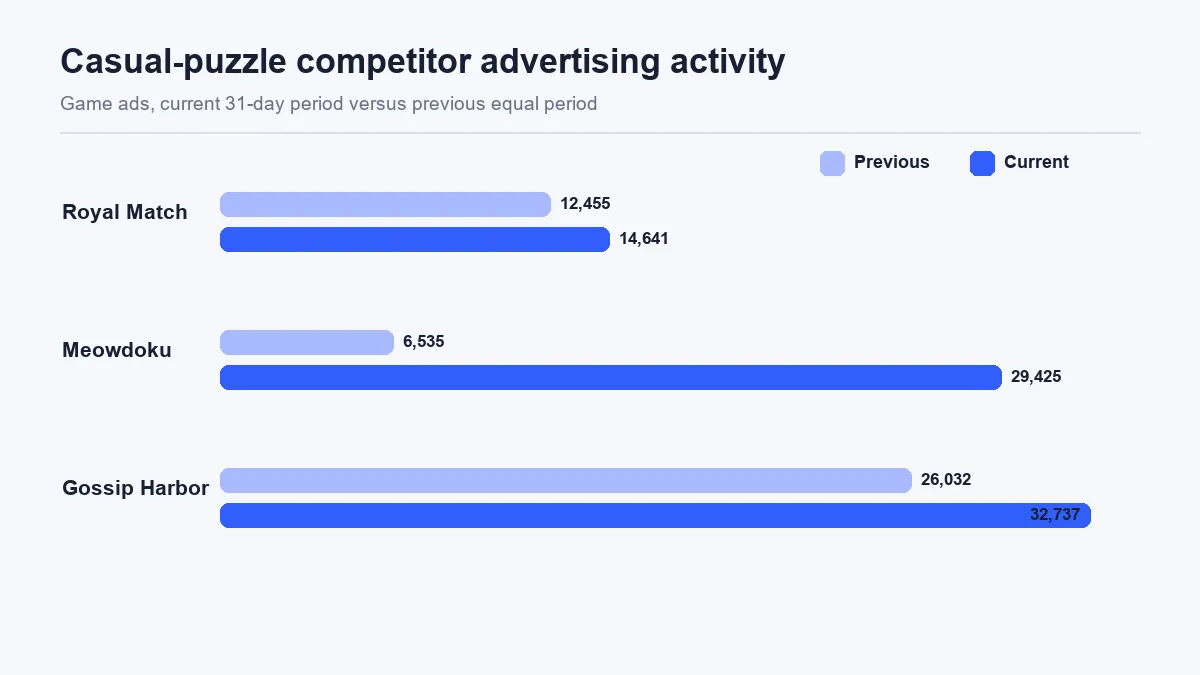
Casual-puzzle teams often copy the character, scene, and CTA when a competitor crisis story looks promising, creating a mixed test that teaches them very little. A stronger comparison separates three roles: the unfinished task in the opening, the visible resolution in the middle, and the correction, continuation, or reward requested by the CTA. Royal Match, Meowdoku, and Gossip Harbor all increased game-ad activity in the current period, but their creative-volume patterns moved differently.
| App | Ad Change | Creative Change | Review Priority |
|---|---|---|---|
| Royal Match | 12,455→14,641, +17.5% | 3,566→2,786, -21.9% | Retained structures |
| Meowdoku | 6,535→29,425, +350.3% | 2,364→8,743, +269.8% | New rule and localization variants |
| Gossip Harbor | 26,032→32,737, +25.8% | 6,086→5,523, -9.2% | Narrative-to-play transitions |
How does each app create the opening task?
Royal Match makes correction emotionally immediate. In the current sample of more than 60 creatives, about 85% opened with the King in immediate danger or comic distress. More than 25 used a King-and-pursuer opening. The viewer understands who needs help before the board appears, so the puzzle becomes a response to a visible problem.
Meowdoku uses comprehension rather than character danger. More than 80% of its 100-plus sampled creatives opened with a colorful grid and the one-cat-per-color rule. At least 30 explained that rule directly, while a smaller group used street interaction with a life-sized grid. The unfinished task is logical: locate the cat that must occupy a constrained square.
Gossip Harbor uses emotional continuity. More than 70% of its 100-plus sampled creatives opened with a distressed character in a snowy or damaged setting, while about 15% used absurd comedy. The task is to restore warmth, shelter, or order. These observations are app-specific. Royal Match's King-in-peril device should not be assigned to the other two titles.
How can teams compare resolution without copying performance?
Tag the role of the middle section. Royal Match uses match-3 play, path clearing, and EXIT objectives to resolve the King's predicament. Meowdoku shows a 6×6 color grid and deduction rules, making the logic itself the payoff. Gossip Harbor moves from story into merge, sealing, cleaning, or renovation actions that restore comfort.
The shared principle is visible resolution, not a shared mechanic. A useful adaptation asks what the viewer can see being fixed. Copying the King, cat, or winter character would confuse surface execution with narrative function. Teams should preserve the role of the resolution while selecting a mechanic and character that belong to their product.
What do diverging activity signals change?
Royal Match increased ads 17.5% while creatives declined 21.9%. Gossip Harbor increased ads 25.8% while creatives declined 9.2%. Both patterns support a retained-structure review: identify which concept families remain visible, how many surface variants they carry, and whether the transition into gameplay remains consistent.
Meowdoku moved differently. Ads rose 350.3% and creatives rose 269.8%. That combination supports an expansion review. Teams should examine new rule-explanation variants, localization, street interaction, and end-card treatment rather than focus only on survivors. These are monitoring decisions, not claims about campaign efficiency.
How should the test matrix stay interpretable?
Put opening type across the top: danger, absurd comedy, direct rule, and emotional story. Put resolution type down the side: board chain, logical deduction, merge or repair, and task choice. Add a final column for correction, story continuation, search prompt, or reward CTA. Select one cell and change one variable per asset.
Also add an expression-review flag. Royal Match used No Ads in more than 18 sampled creatives, Meowdoku used localized no-ad wording in some variants, and Gossip Harbor used no-ad or permanently-free promises in at least 15. These claims require product, legal, and regional confirmation. The matrix is complete only when story, gameplay, CTA, and claim review remain connected.
Update the matrix continuously instead of rebuilding it for each report. Keep the prior period's concept labels, then open a new cell only when an asset changes the task, resolution, or CTA role. Language, character, and editing changes can remain variants inside an existing cell. This makes it easier to see whether an app is expanding conceptual coverage or increasing execution volume around a familiar structure, and it gives the next script meeting a clear starting point.
