Top War is attracting more industry lookup interest while its observed advertising activity is cooling modestly. Weekly UV increased from 14 to 19 and PV increased from 17 to 27. Over the latest monthly comparison, game ads fell from 3,974 to 3,686 and creatives fell from 1,382 to 1,215. The useful response is to inspect the creative families that remain visible after the decline, not to treat higher lookup interest as proof of campaign expansion.
Why does rising attention not mean Top War is scaling ads?
The search and advertising datasets describe different actions. AppGrowing UV and PV show industry lookup interest inside a data platform. They do not represent player demand, store searches, installs, or campaign results. The monthly ad and creative counts describe observed advertising activity around Top War.
Top War’s weekly UV increased 35.7 percent and PV increased 58.8 percent. During the monthly window, game ads declined 7.2 percent and creatives declined 12.1 percent. Creatives per 10,000 ads moved from 3,477.6 to 3,296.3, a 5.2 percent decrease. This combination raises monitoring priority while supporting a cooldown diagnosis.
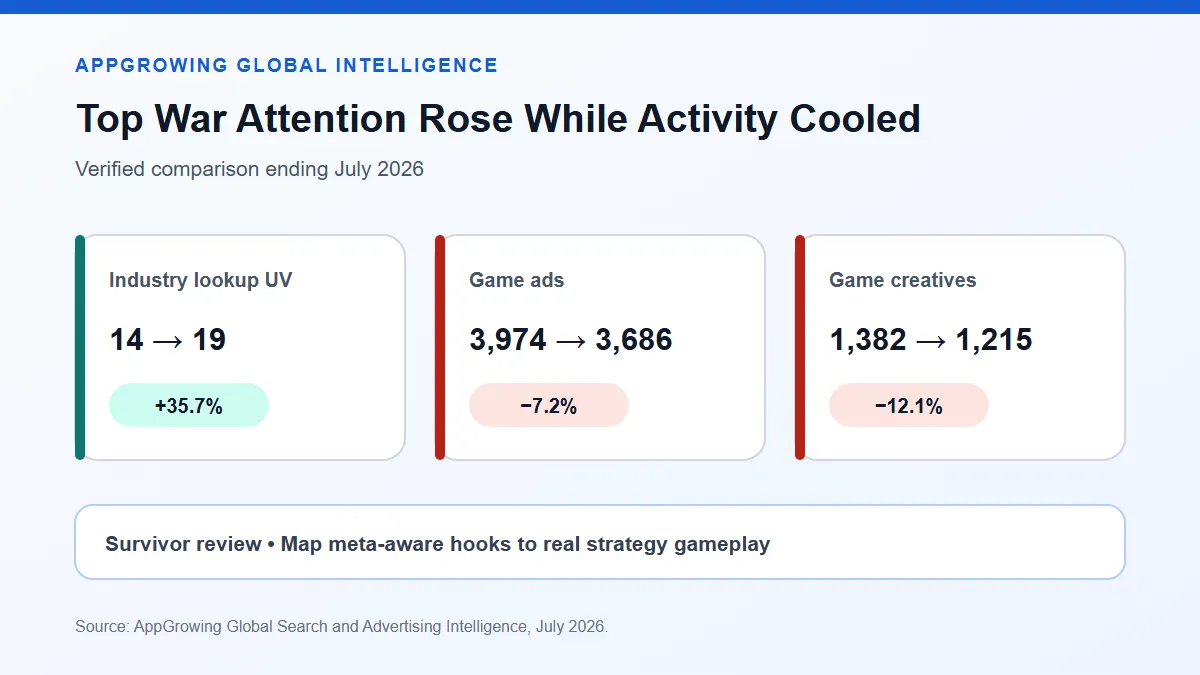
The chart keeps the two ideas separate. More marketers are looking at the entity, yet the matched advertising pool is smaller. A competitor team should therefore review retained messages, high-impression materials, and repeated structures before it recommends new scripts.
The smaller pool can make prioritization easier. It reduces the first review set and lets the team compare the remaining creative families by product clarity, claim risk, and the strength of the gameplay transition.
Which Top War hooks remain prominent during the cooldown?
AppGrowing’s aggclaw analysis covered 1,033 Top War materials from June 30 to July 30. The top five recorded 9,142,535, 8,700,442, 7,866,305, 5,399,315, and 5,002,179 impressions. Those figures identify a substantial group of materials worth inspecting even while the overall monthly pool is smaller.
Three recurring families stood out. The first is a meta-aware opening that directly references the familiar little blue character or acknowledges that viewers have seen similar ads before. The second uses a real-person testimonial around free-to-play or No Ads expressions. The third uses visual collection loops with +1 and +99 numbers, magnetic gathering, and rapid growth.
The meta-aware family turns skepticism into the opening conflict. The collection family creates an unfinished action through rising numbers, defeat screens, retries, and sudden upgrades. Some materials end at the emotional peak rather than with a conventional download card. The review question is whether that curiosity bridge reaches the real strategy, battle, or base-building experience clearly enough.
How should creative teams review the gap between hook and game?
Use a promise-to-proof checklist. Record what the first three seconds promise, when actual game systems appear, how long they remain visible, and what the final frame asks the viewer to do. If a material spends most of its time on blue-character collection and shows strategy play only briefly, classify it as a weak product bridge even if its impression count is high.
Keep materials that connect the meta-reference to a meaningful gameplay reveal. Rewrite those that repeat number growth without explaining the deeper loop. Review No Ads, free-to-play, and similar statements separately against the current product experience and platform rules. A creative pattern can be visible in the data without making every claim safe to reuse.
What should the Top War watchlist decide next?
If lookup interest continues rising while ads and creatives continue falling, keep Top War high on the watchlist and focus on survivor analysis. If ads recover while creatives keep falling, inspect delivery concentration. If both recover and a new hook family appears, treat the change as a possible new testing phase.
Here’s a pattern I keep seeing. Mature creative systems often keep a recognizable symbol long after the first novelty fades. The strategic task is not to remove the symbol automatically. It is to test whether the symbol still leads to a clear product truth. For Top War, that means measuring the creative bridge from meta-aware blue-character hooks to strategy gameplay, without making unsupported claims about CTR, CPI, or retention.
