Lordrush has moved from a very small base into a rapid advertising and creative expansion phase. The game newly entered AppGrowing’s weekly industry-search TOP50 with 13 UV. In the latest equal-length monthly comparison, observed game ads increased from 7 to 1,144 and creatives increased from 14 to 244. Those signals justify a higher competitor-monitoring priority. They do not yet prove durable scale because the comparison starts from an unusually low base.
Which numbers make Lordrush worth adding to the watchlist?
A new lookup signal becomes more useful when it is matched with actual advertising activity. Lordrush was absent from the previous weekly TOP50 and appeared in the current period with 13 UV and 13 PV. Absence does not mean zero searches. It means the keyword did not meet the previous list’s visible threshold.
The monthly advertising comparison provides the stronger expansion evidence. Game ads rose from 7 to 1,144, while game creatives rose from 14 to 244. Expressed as percentages, those changes are 16,242.9 percent and 1,642.9 percent. The percentages are mathematically correct but operationally unstable because the previous base was tiny. UA teams should lead with the current observable pool, then keep the low-base warning beside the growth calculation.
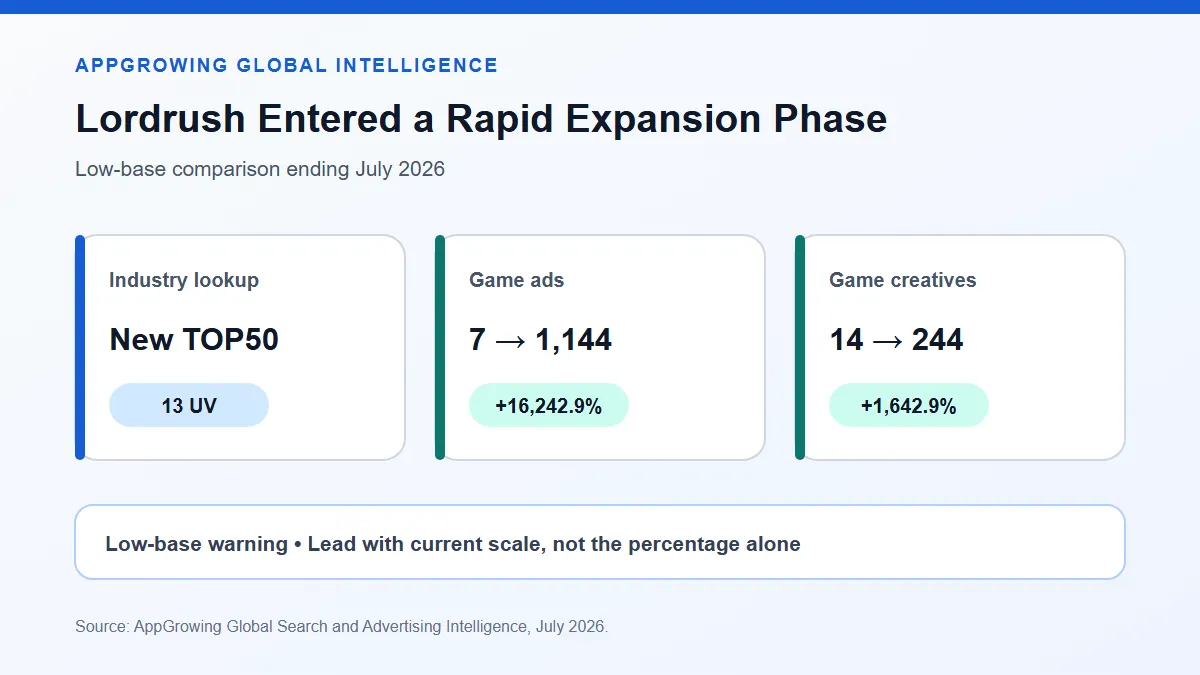
The chart helps a competitor team see the stage change quickly. Lordrush is no longer represented by a handful of observations. It now has enough ads and creatives to support a structured review of concept families, repeated variants, and the relationship between the opening promise and the gameplay shown.
That distinction also keeps the review grounded. The current pool is large enough for analysis, but one additional monthly cycle is still needed before the team describes the movement as a stable operating pattern.
Which creative structures are carrying the expansion?
AppGrowing’s aggclaw analysis reviewed 220 Lordrush creatives from June 30 to July 30. The top five materials recorded 2,596,574, 2,122,576, 2,004,250, 1,582,792, and 1,366,868 impressions. Three of the five used a period-skit-plus-gameplay structure, making that family the clearest starting point for review.
The openings were not identical. One began with an overwhelming enemy and a streamer-style play-by-play. Another used domestic comedy around a burning dinner. A third created an identity reversal by showing a king doing manual work. The remaining two relied on a cinematic cavalry siege and a status-driven period drama. This variety matters because it shows that the repeated structure is broader than one line or costume.
Several materials placed a No Ads expression inside the character conflict and then moved into resource collection, tower defense, siege combat, or base building. A recurring closing image showed the kingdom from an elevated view. The reusable lesson is continuity. The hook creates a promise, the middle supplies gameplay proof, and the close restores the larger kingdom-building aspiration.
How should teams review the No Ads and gameplay connection?
Separate claim review from creative review. A No Ads or similar expression should be checked against the actual product experience and current platform policy before reuse. Creatively, the team should ask whether the claim is essential to the story, whether the gameplay shown resolves the opening conflict, and whether the final image communicates the same product promise.
Do not copy the line and assume the structure has been reproduced. Build a promise map with four fields. Record the first conflict, the claim, the gameplay proof, and the closing payoff. A variant is meaningfully new only when one of those relationships changes. Changing the actor while preserving the same conflict and proof is a cosmetic variant.
What would confirm that the expansion is continuing?
Use a three-step monitoring rule. First, check whether ads and creatives continue rising together in the next period. Second, inspect whether the new materials add hook families or only extend the same period-skit pattern. Third, compare high-impression materials by active days and ad variants to see whether delivery is becoming concentrated.
If ads keep rising while creatives flatten, shift the review toward distribution concentration. If both measures decline, analyze the surviving materials and retained promises. If both continue rising and new hook families appear, treat Lordrush as a broader concept-expansion case. For now, the evidence supports frequent monitoring, not a claim of long-term campaign success.
