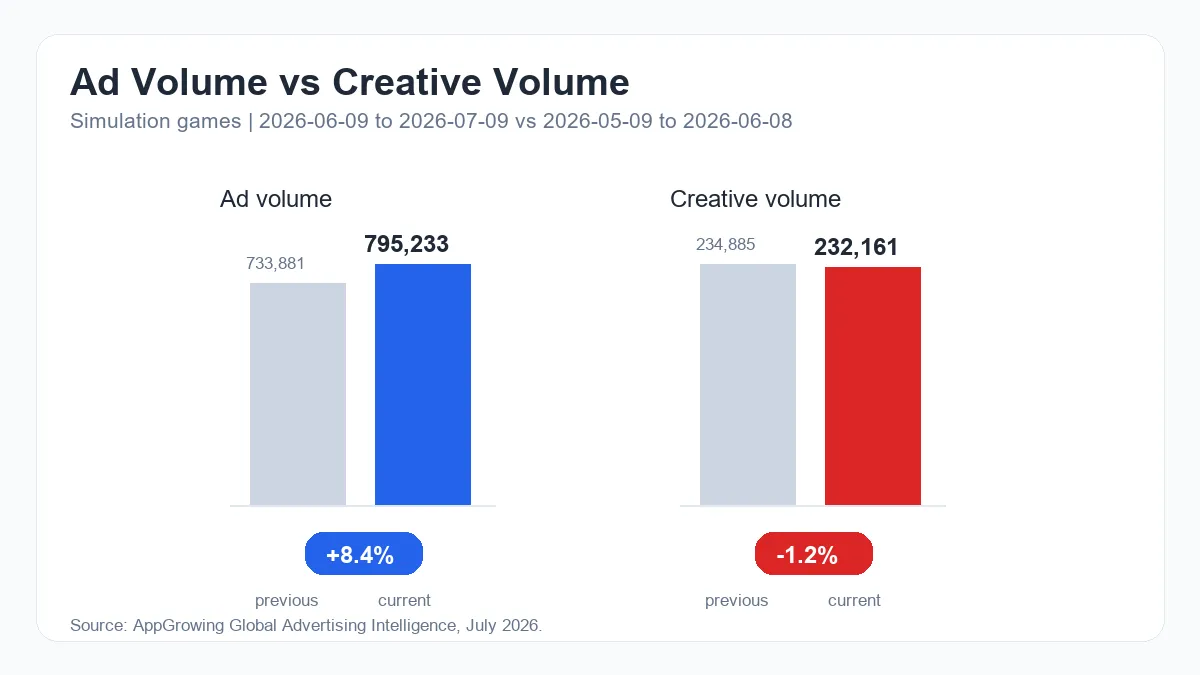
Simulation game teams can mistake heavier delivery for a richer creative pipeline. Why Simulation Games Can Increase Ad Volume Without Expanding Creative Output should be read as a delivery concentration signal, not as automatic proof of broader creative output. Verified AppGrowing data shows ad volume rose from 733,881 to 795,233, or +8.4%, while creative volume moved from 234,885 to 232,161, or -1.2%.
| Metric | Previous Period | Current Period | Change |
|---|---|---|---|
| Ad volume | 733,881 | 795,233 | +8.4% |
| Creative volume | 234,885 | 232,161 | -1.2% |
Why can simulation ads grow without a larger creative pool?
Simulation game ads often repeat upgrade loops, decoration loops, building tasks, management goals, merge mechanics, and completion rewards. Higher ad volume shows more visible delivery around those promises, while slightly lower creative volume shows that the asset pool did not expand with the same direction.
The safer read is reuse of familiar loops. UA teams should first identify which simulation loops are carrying the extra delivery before treating the category as a broad creative expansion.
Where should the review task go first?
The review should start at the loop level. Upgrade, renovation, management, rescue, and merge scenes should be grouped separately because each one carries a different audience promise.
If new assets did not increase, the team should check whether a small set of loops is being pushed harder or whether older creatives are being refreshed through first-scene, subtitle, or pacing changes.
When does this become real creative-output expansion?
It becomes creative-output expansion only when new loops, new character motivations, or new task scenes enter the pool alongside the ad-volume increase. More delivery alone does not prove that.
For Simulation games, this signal should trigger loop-level creative auditing before any decision to increase script production.
