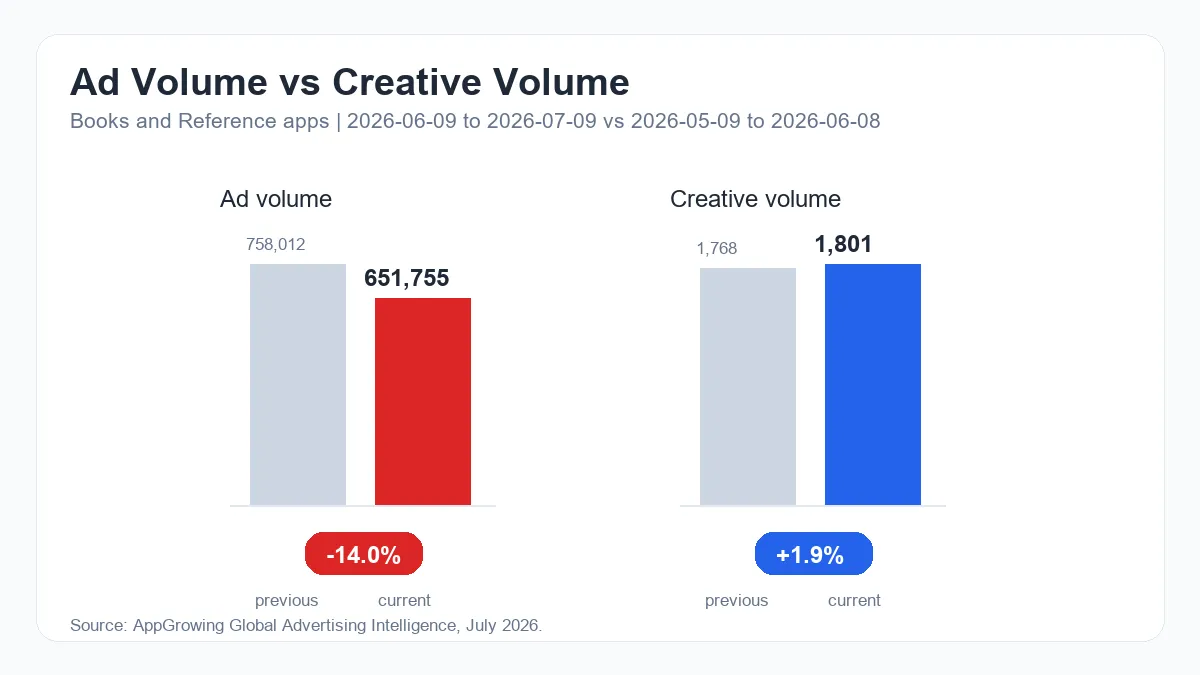
Reading app teams may lower watchlist priority when ad volume falls, but creative volume tells a different story. Why Reading Apps Need Creative Monitoring When Ads Fall but Creatives Rise should be treated as a low-volume testing signal. Verified AppGrowing data shows ad volume fell from 758,012 to 651,755, or -14.0%, while creative volume rose from 1,768 to 1,801, or +1.9%.
| Metric | Previous Period | Current Period | Change |
|---|---|---|---|
| Ad volume | 758,012 | 651,755 | -14.0% |
| Creative volume | 1,768 | 1,801 | +1.9% |
Why should teams still inspect creatives when ads fall?
Lower ad volume means visible delivery contracted, but higher creative volume means testing did not contract in the same direction. For reading and story apps, that can point to new story premises, access promises, or genre packaging.
A delivery-only view would miss those low-volume tests.
How should reading creatives be separated?
Start with story premise: revenge, romance, identity reversal, family conflict, or power progression. Then tag the entry promise: free reading, chapter unlock, immersive plot, or fast updates.
Finally, decide whether the asset only changes cover art and subtitles or introduces a new narrative conflict. Only the second case deserves script discussion.
What monitoring cadence fits this signal?
Reading apps should stay on a lighter but consistent watchlist. Teams do not need to assume delivery expansion, but they should record new story angles and new entry promises.
If ad volume later recovers, the current creative tests may become the directions that receive broader delivery.
