Why does a sports moment not automatically create product action?
An event creates an attention window, but it does not explain why a viewer should download or buy. The official NFL schedule places Week 1 of the 2026 regular season from September 10 through September 15, and this creative review was verified on September 17. For a sports-commerce app such as Fanatics, the ad still has to convert season context into team identity, then support that identity with visible merchandise, licensing, offer, or shopping evidence.
Which bridges appeared in the current Fanatics sample?
The review used 12 higher-cumulative-impression primary videos and four supplementary materials with clearer visual or transcript evidence. Several high-exposure records lacked complete visual descriptions, so the article limits claims to observable shots. Across the 16 reviewed materials, nine used a game, league, team, jersey number, or stadium context. Ten showed a product, worn item, catalog, or shopping interface, while eight used limited, new, app-exclusive, or reward-based urgency.
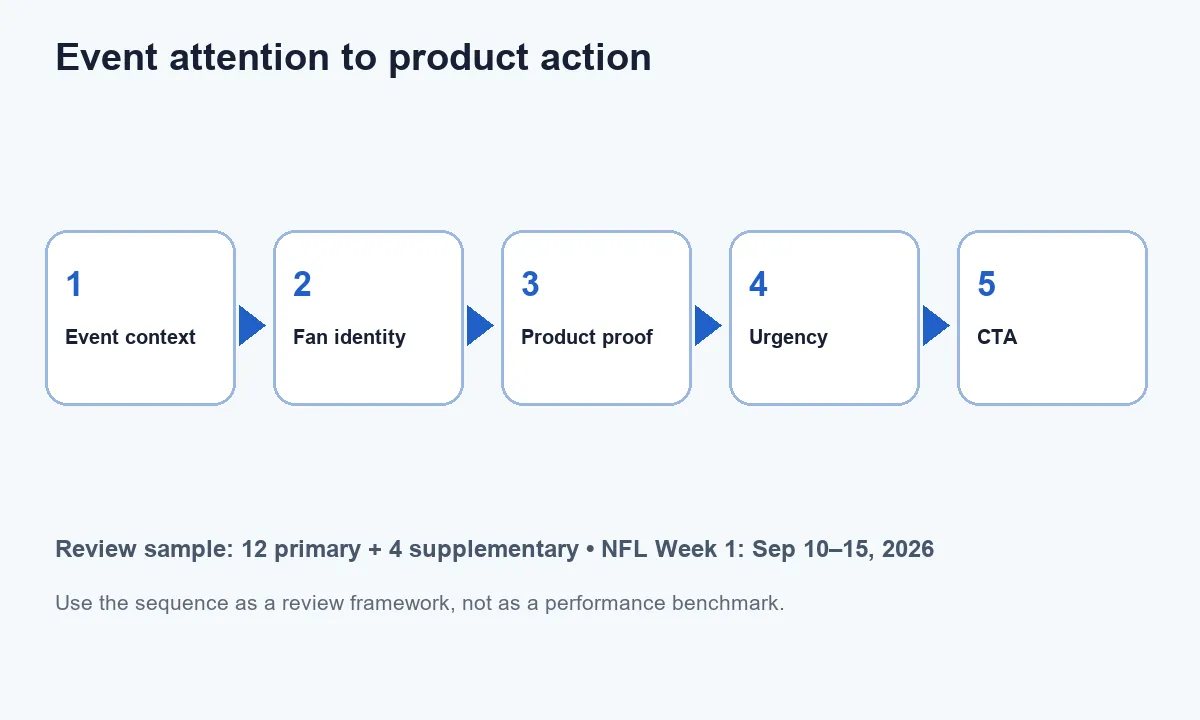
What is the five-step path from season context to CTA?
The stable sequence is event context, fan identity, product proof, urgency, and CTA. A team logo, jersey number, stadium, or celebration earns emotional attention. Wearing, collecting, or remembering a championship lets the viewer project identity. Product photography, licensing marks, and catalog interfaces prove that the merchandise exists. Limited-time, new-drop, free-shipping, or app-exclusive language creates a reason to act. The download or shopping action closes the loop. The sports moment is only the first step.
Which product-proof signals are strongest?
A team logo alone proves relevance, not the offer. Stronger evidence includes a person wearing the product, a jersey shown on a stand, an in-app catalog recording, an official licensing mark, or a clear relationship between merchandise, tickets, and rewards. One supplementary material with a readable voice-over joined Fan Cash, official merchandise, and tickets in a single benefit statement. That demonstrates ecosystem breadth inside the creative, but it still does not establish sales performance.
How should teams schedule event-driven monitoring?
Around kickoff, playoffs, finals, or major matchups, split the watchlist into event-context, product-proof, and offer-action groups. Review whether those groups form a continuous path rather than counting every material that contains a team logo. If event-led executions expand while product proof becomes thinner, inspect the transition to the catalog or landing experience. If product proof remains clear but the CTA is weak, test a more explicit app-exclusive or shopping action.
What belongs in the next sports-commerce brief?
Name the event window, league or team entity, fan-identity cue, real product shot, licensing or trust signal, offer boundary, and CTA. Do not use “hype” or “passion” as substitutes for planned shots, and do not turn an undated “limited” label into a hard deadline. The most useful controlled variable is the timing of the cut from sports context to merchandise. That transition determines whether event emotion becomes understandable product action.
How should teams handle incomplete semantic coverage?
Five of the 12 primary records lacked complete visual descriptions, so missing evidence cannot be rewritten as “no product” or “no CTA.” The review added four supplementary materials to recover observable bridge examples and kept every frequency tied to its sample scope. Future monitoring should prioritize high-cumulative-impression records whose semantic fields are empty. Until those materials are rechecked, write “not observed” rather than “not used.” That distinction prevents retrieval gaps from becoming creative conclusions.
When is an event-driven article worth refreshing?
Refresh the page when the event stage or creative structure changes, not simply because another day has passed. Useful triggers include the opening window moving into playoffs, attention shifting to a final, a new product-proof format entering the app's ads, or soft “new” language becoming a verifiable offer with dates and conditions. Every refresh still requires a new material query. The September sample and its counts cannot be carried forward as if they describe a later event window.
Not sure whether your NFL-season creative connects fan attention to a clear product action?
Get a free benchmark check based on your specific app or game category.
How can sports identity avoid overpowering the product?
A player, team, or stadium can establish emotion quickly, but the ad can start to resemble sports content when the product arrives too late or too briefly. Record the first product frame during review. Then check whether the team cue continues through color, number, licensing mark, or worn merchandise. Identity should help the viewer understand the item and its relevance, not compete with the item for attention. A useful control keeps the same sports opening but moves the merchandise reveal earlier. Another keeps the timing constant and replaces the generic logo frame with worn-product proof. Those comparisons show whether the bridge is losing clarity at identity, product, or action.
