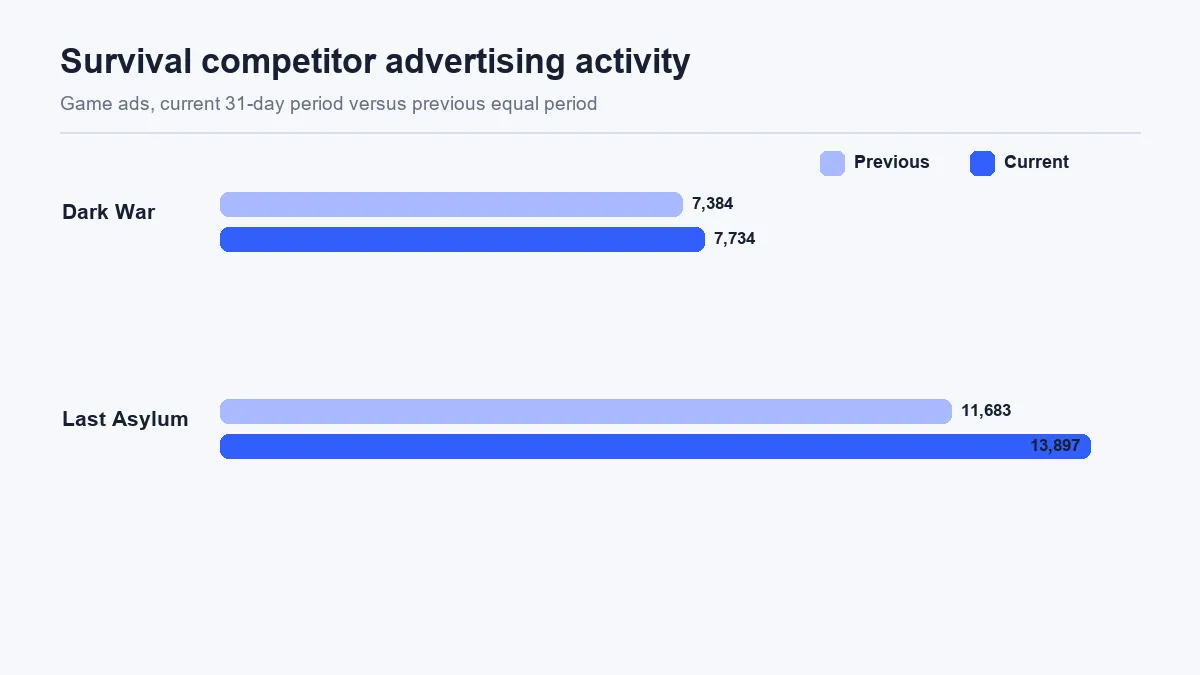
Survival-game teams can keep making the danger larger without ever showing what the player can do. The reusable structure is not a zombie rush or ruined shelter by itself; it is a continuous path from threat to response to payoff. Dark War and Last Asylum both recorded more game ads in the current period, while creative volume rose only modestly. That pattern makes structural review more useful than simply requesting more fear-driven scenes.
| App | Game Ads | Change | Creatives | Change |
|---|---|---|---|---|
| Dark War | 7,384→7,734 | +4.7% | 5,259→5,545 | +5.4% |
| Last Asylum | 11,683→13,897 | +18.9% | 2,225→2,283 | +2.6% |
How does each game establish the threat?
Last Asylum uses a recognizable world before it explains management. In the current sample of more than 100 creatives, about 60% of high-impression assets opened with a Plague Doctor, a glowing green potion, or a dark treatment setting. More than 50 made the bird-mask physician the focal visual, and more than 25 repeated a seventh-day survival challenge. The threat is illness, time, and uncertain treatment rather than a generic zombie attack.
Dark War uses a different entry. The query covered more than 50 Dark War: Survival VN creatives and more than 50 creatives for another Dark War: Survival listing. At least 15 used an explicit no-ad verbal promise, while more than 10 used a dating or relationship parody in which shelter level becomes social status. These are Dark War observations, not shared facts about Last Asylum.
What counts as a visible response and payoff?
A response must show something the player can understand as an action. Last Asylum moves into treating patients, managing potion resources, upgrading hospital facilities, gathering resources, and building a base. Dark War shows debris removal, material collection, furniture construction, shelter cleaning, and expansion. These actions convert a threatening world into a manageable system.
The payoff is the new state produced by those actions. It may be safety, a larger hospital, a restored shelter, a surviving character, or access to another management area. If an ad shows fear but no response, it behaves like a trailer. If it shows a finished base but no initiating threat, it lacks an immediate motive. A complete product promise keeps all three stages legible.
What does faster ad growth than creative growth change?
Last Asylum game ads rose from 11,683 to 13,897, an 18.9% increase, while creatives rose from 2,225 to 2,283, or 2.6%. That relationship calls for a concentration review. Teams should check whether the Plague Doctor, seventh-day challenge, hospital treatment, and base-building families account for a larger share of visible activity.
Dark War moved more evenly. Ads increased 4.7% and creatives increased 5.4%. Its next review should test whether no-ad testimonials, shelter-status parody, and restoration gameplay still form consistent paths. Neither pattern proves campaign performance. It tells the team where to spend review time and which retained structures deserve closer inspection.
How should teams run three interpretable test rounds?
In round one, keep response and payoff fixed while changing only the threat. Compare disease, outside attack, scarcity, and damaged shelter. In round two, keep threat and payoff fixed while changing the response through treatment, collection, construction, cleaning, or cooperation. In round three, keep the first two stages fixed while changing the payoff through safety, facility scale, survivor status, or access.
Each row should also include an expression-review flag. Dark War samples used No Ads and No Pay to Win language, and the broader survival sample contained similar claims. Product, legal, and regional teams must verify those promises against the relevant build and market. The best test is not the most dramatic threat. It is the version in which the player response and product payoff remain clear and supportable.
A weekly monitor should record which stage changed inside each family. If the threat stays the same but the response becomes shorter, check whether the product promise has weakened. If the response stays fixed while the payoff becomes larger, verify that the earlier action can still produce it. Open a new script family only when the relationship among threat, response, and payoff changes materially; otherwise keep the asset as an execution variant within the existing family.
