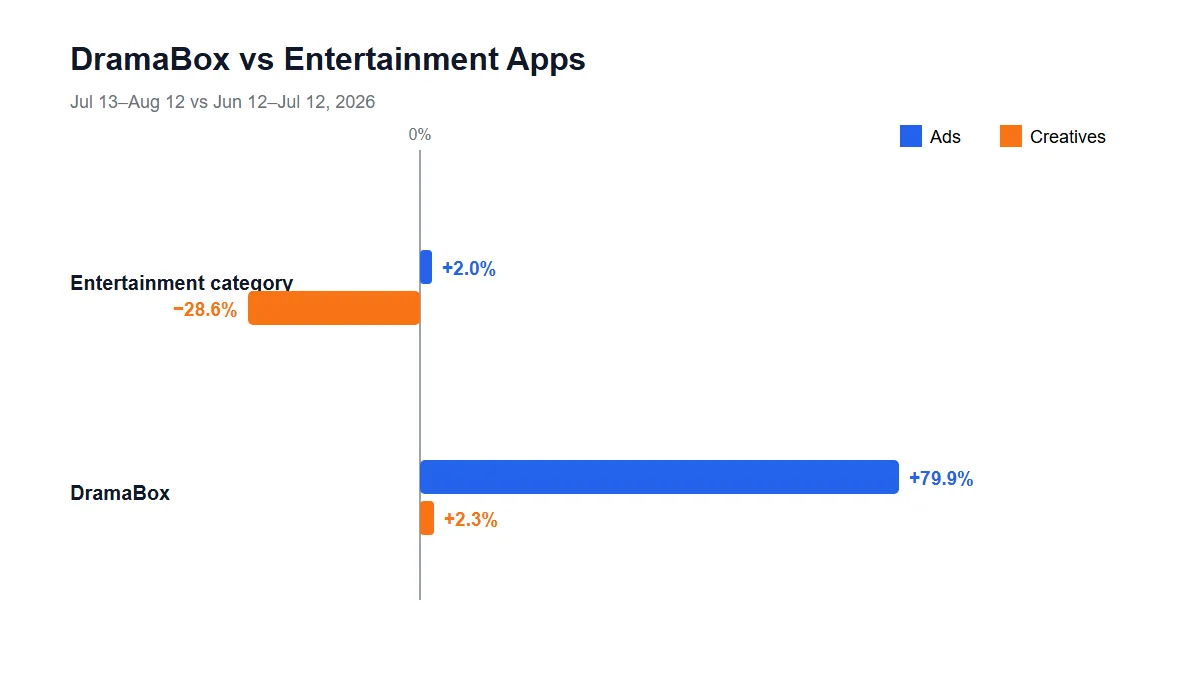
DramaBox expanded observed ad activity far faster than its creative pool. From July 13 to August 12, 2026, DramaBox ad records rose 79.9 percent while creative records rose only 2.3 percent. Entertainment app ads rose 2.0 percent and category creatives fell 28.6 percent. The aggclaw sample supports a mature-story-family expansion diagnosis rather than a broad genre explosion.
How far did DramaBox move from the category direction?
Entertainment app ad records increased from 2,038,884 to 2,080,078, while creative records declined from 1,167 to 833. DramaBox ads increased from 3,069,457 to 5,521,182, while creatives moved from 129,069 to 131,986. Its ad growth exceeded creative growth by 77.6 percentage points.
The category and named-app interfaces have different scopes, so their absolute totals cannot be converted into share. Their directional difference is sufficient for monitoring priority. If app ads grow much faster than creatives, inspect story-family reuse, recuts, and language variants first. If the creative pool also accelerates, then widen the new-theme watchlist.
Which story families are carrying the expansion?
The official STORYMATRIX entity matched 130,205 material records in the aggclaw window. The analysis reviewed the top 200 by cumulative impressions plus Spanish-tagged and Arabic-tagged samples, producing about 400 unique records after deduplication.
Within an annotated top subset of 80 records, forced or contract marriage, divorce reversal, and marriage ultimatums represented about 26 percent. Dragon bonds, rebirth, chosen-one plots, and magic represented about 20 percent. Betrayal, jealousy, secret identity, and love triangles represented about 17 percent. These are shares inside the annotated sample, not platform-wide genre shares.
High-exposure examples reinforce the reuse diagnosis. A forced-marriage opening reached 16,710,104 cumulative impressions. A fantasy-mech execution reached 14,235,247. A taboo-premise execution reached 14,233,386 and was linked to 500 ads. The marriage-ultimatum script appeared across at least five material IDs, while the boy-and-dragon-egg family appeared in English, Spanish, and Arabic variants.
Which openings and cliffhangers need monitoring?
The first three seconds repeatedly use seven hook families: emotional close-ups, confrontational lines, taboo premise text, questions to the viewer, dragon or mech spectacle, action already in progress, and unfinished number or time cues. Character relationships center on spouses, betrayal triangles, parents and children, masters and disciples, secret-identity lovers, and cross-species bonds.
Escalation often moves from a private conflict to public humiliation or a power reveal, then adds spectacle or identity reversal. Cliffhangers cut mid-sentence, stop an unfinished countdown, end on a question overlay, or move directly to a title card. A dedicated CTA text field was not available, so the pattern of placing the end card at the emotional peak remains a semantic inference.
Monitoring should separate theme from structure. A marriage-themed execution can open with an emotional close-up, taboo text, or a confrontational line. It can close with an identity reveal, revenge setup, or unfinished question. When the theme remains stable but the opening or ending mechanism changes, record a new structure test inside the same family rather than labeling it a new genre.
How should localization teams separate themes from variants?
Create a family fingerprint from the plot premise, character relationship, conflict type, escalation order, and final cliffhanger. Treat language, subtitles, dubbing, cast, and cut length as variant fields. English, Spanish, Arabic, Thai, Korean, and Turkish executions show expression languages only; they do not establish country delivery.
If the central plot and conflict sequence remain the same while language or selected shots change, keep the records in one family. If the relationship and escalation mechanism change, mark a new theme. If only the opening changes from an emotional close-up to a question overlay, mark a hook variant.
A weekly review can produce two connected tables. The story-family table records the premise, relationship, conflict, escalation, and cliffhanger. The variant table records language, cast, opening device, cut length, active days, and linked-ad count. Promote an execution into a separately developed direction only when the family logic and the delivery variant both change in a meaningful way.
Not sure which DramaBox story families and localization variants deserve separate watchlists?
Get a free benchmark check based on your specific app or game category.
The most useful DramaBox monitoring unit is not total creative count. It is the mature story fingerprint being scaled across languages and edits. That unit can be turned directly into a theme watchlist and localization test matrix.
