Z Route: Redemption entered the current industry-lookup Top 50 while its observed official-package ads and creatives contracted. That combination is a new monitoring signal, not evidence of demand growth. Teams should examine the reusable zombie-highway, failure-comedy, mission-selection and 4X carry-over modules inside the smaller pool.
Why does a Top 50 entry not prove demand expansion?
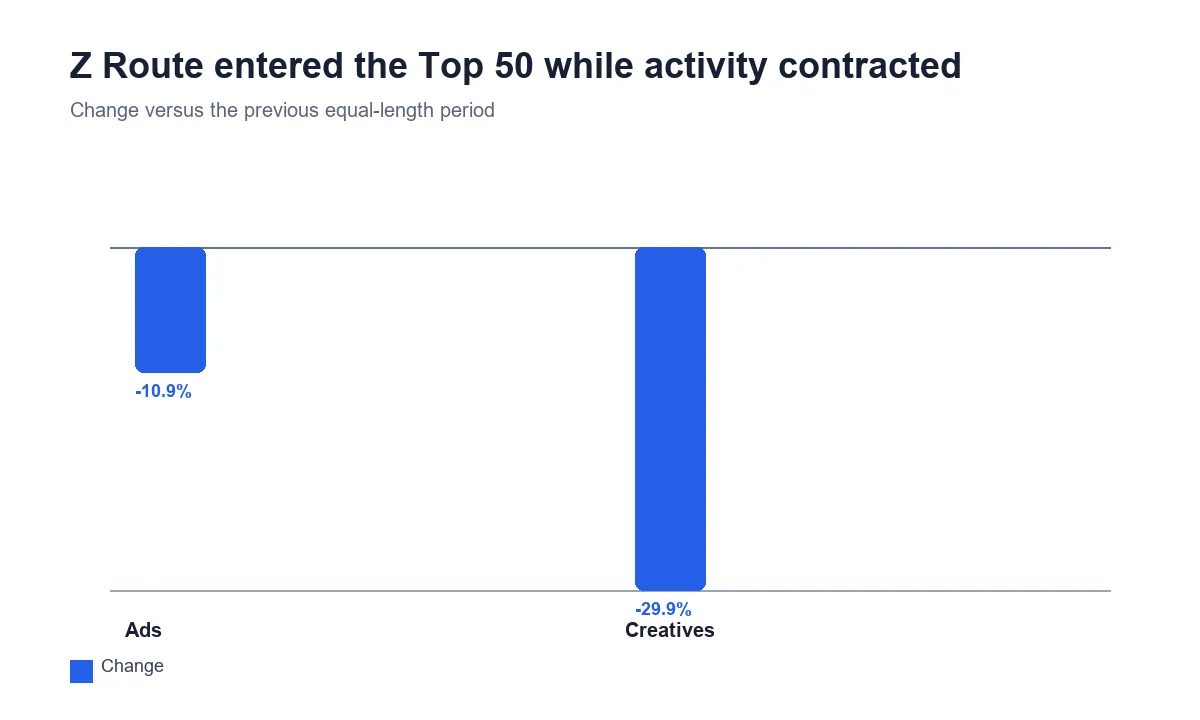
Z Route: Redemption entered the current AppGrowing Top 50 with 12 UV and 13 PV from August 6 to 12, 2026. Its absence from the previous Top 50 means it did not meet that ranking threshold; it does not mean previous searches were zero. Meanwhile, official-package ad records fell from 7,213 to 6,426, down 10.9 percent, and creative records fell from 870 to 610, down 29.9 percent. This is a new competitor-lookup signal alongside a contracting creative pool.
The working question is why marketers started checking the title, not whether player demand suddenly exploded. Teams may be scouting a new strategy competitor, reviewing its advertised subgame or watching how a smaller asset pool is deployed. The data supports monitoring priority. It does not establish downloads, revenue or campaign efficiency.
Record new-entry status as a categorical fact. Do not calculate growth from an unknown value outside the previous Top 50, and do not substitute zero for the missing rank. The current UV and PV can be reported directly, while the verified ad and creative fields supply the only valid period-over-period percentages.
Which modules define the main Z Route creative family?
The official entity directly matched 631 materials in the aggclaw window, and 91 of the top 100 cumulative-impression materials carried usable semantic fields. Creative 342dd recorded 7,054,484 cumulative impressions and 130 active days. Creative 52b90 recorded 6,212,872 and 157 days. The recurring body uses desert or snow highways, armored vehicles, zombie crowds, weapon upgrades and score feedback.
Executions are assembled from interchangeable modules. An opening may use a streamer challenging fake game ads, a countdown track, or combat already in progress. The middle may add a motorcycle rider, rocket dog, bridge defense or a short 4X-building segment. The ending often combines an exaggerated failure character with a mission-selection screen. Modular reuse helps the system preserve variety while total creative activity contracts.
A modular map should separate opening, playable body, strategy carry-over and ending. For Z Route, those slots can be filled by an authenticity challenge, highway combat, territory-building footage and a failed-character CTA. Comparing slots reveals recombination even when the number of distinct files is falling.
Need a verified benchmark for this category or competitor?
Ask for a free review using your own app, category and monitoring question.
How do failure comedy and gameplay proof work together?
Roughly one quarter to three tenths of the semantic sample used a failure gag near the ending. Fail or FAILED text, exaggerated character reactions and monster close-ups create a comic loss. The next shot moves directly to a mission or level selector, producing a fail, retry and download sequence rather than a dead end.
Gameplay proof comes from road shooting, zombie clearing, bridge defense and visible weapon numbers. A smaller subset adds formations, resource building or territory defense later in the video to suggest a deeper strategy layer. Teams should tag the immediate subgame proof separately from the 4X carry-over. Combining both under one hook label hides which part actually anchors the execution.
Use the representative material IDs as audit anchors rather than performance winners. Their cumulative impressions and active days help reviewers find durable executions in the raw response. The semantic description then supports a sample-level statement about what appears on screen; it does not establish why the execution accumulated distribution.
What should remain on the watchlist during contraction?
Keep four primary units. Track the real-person authenticity challenge, the zombie-highway body, the failure-comedy ending and the mission-selection CTA. Record motorcycle, tower-defense and 4X scenes as replaceable modules. Representative top materials also provide active-day and linked-ad baselines for deciding which combinations remain durable.
If ad activity falls again, inspect the modules attached to the longest active days and widest ad reuse. If ads recover while the pool remains small, monitor recombination density. If creatives also recover, separate genuinely new modules from new edits of the highway and failure skeleton. Use this pattern to guide competitor review, not to judge effectiveness.
Repeat the retrieval with the same entity and ranking rule. If a new module appears across several high-ranked samples, add it to the family map. If only editing, actor or subtitle details change, keep it as a variant. This makes contraction measurable without mistaking cosmetic changes for strategic renewal.
