Looking back at China's games market in Q1 2026, Modo Game Interactive's My Garden Tale may well be the most unexpected breakout title.
After announcing Yang Zi as the game's brand ambassador in February, its market performance entered a phase of rapid growth, frequently ranking near the top of both WeChat Mini Game charts and the iOS games chart. Its overseas version, My Garden Tale, has also launched successively in markets such as North America and Japan, where it has performed strongly.
Last month, this dark horse gained a new competitor. According to media reports, Riftsky Games launched The Cozy Florist in South Korea, where it quickly climbed the rankings and broke into the Top 40 on the iOS grossing chart.
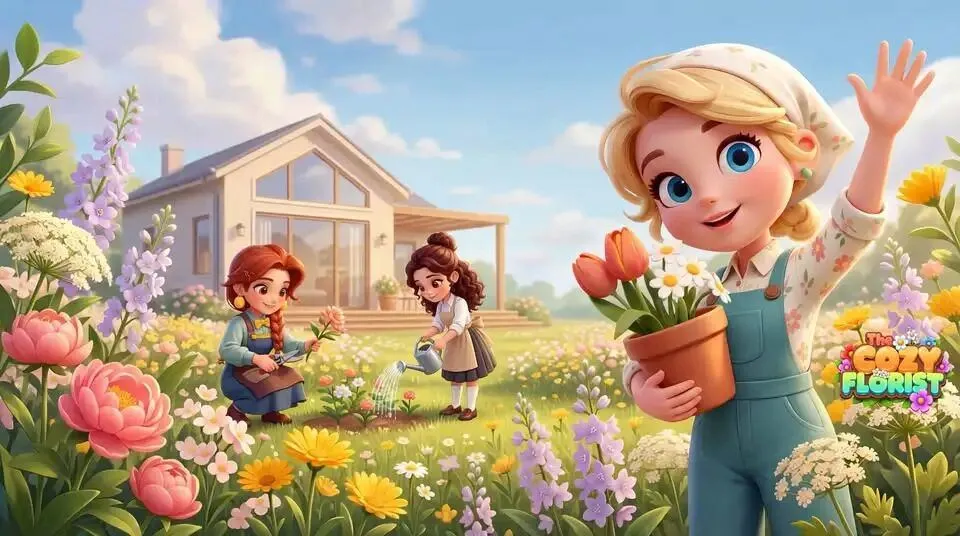
Many have attributed the successive success of these two titles to the marketing hook of "grow flowers in-game, receive real flowers". In AppGrowing's view, however, giving players real flowers is only the surface-level incentive. The deeper reason lies in how these games differentiate themselves through the packaging of emotional value.
1. More Card RPG Than Management Sim
In terms of core gameplay design, The Cozy Florist and My Garden Tale are not significantly different. The main distinction is perhaps that The Cozy Florist adopts a more Western cartoon-style art direction, clearly positioning itself for overseas markets.
At first glance, these "garden games" appear to follow a very classic management simulation structure: grow flowers, harvest them, fulfil orders, then reinvest and upgrade. Yet once you play them in more depth, it becomes clear that both titles differ considerably from the conventional management sims many players have in mind. They are closer to card RPGs wrapped in the shell of a management game.
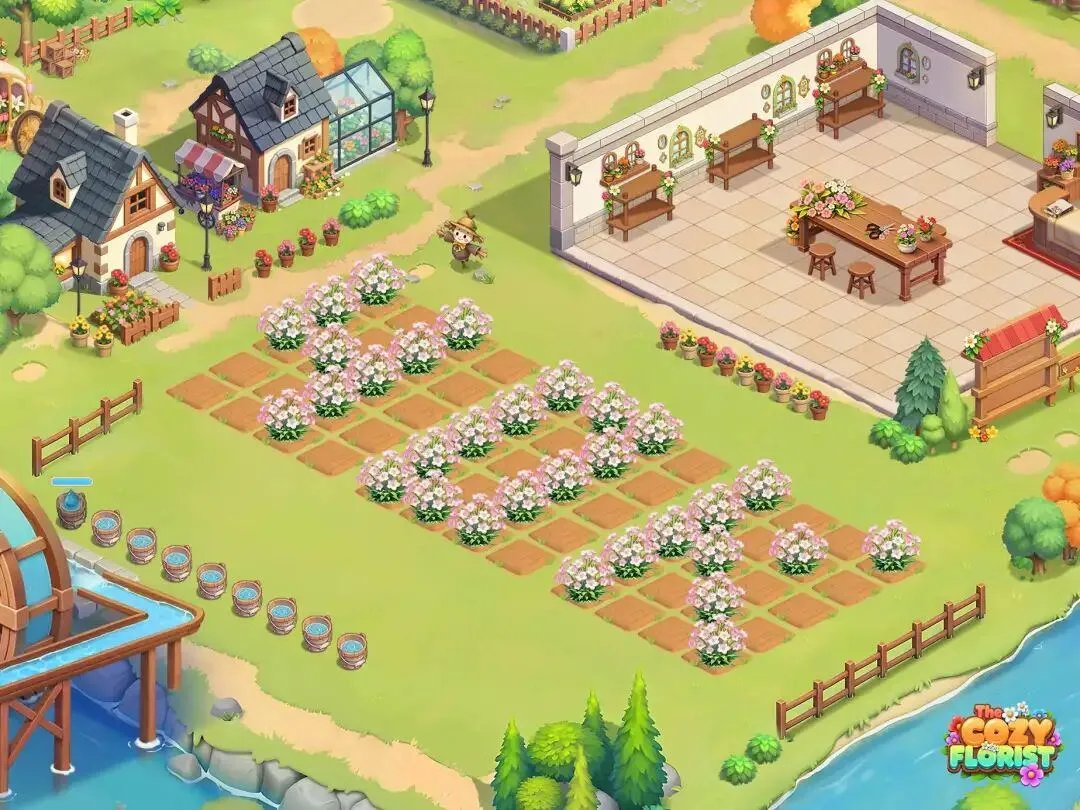
Flower varieties function like card characters, while cultivation resembles card levelling. Planting requires resources such as water and fertiliser, much like spending stamina to clear stages. Combining different flowers to complete orders is essentially the equivalent of applying different card strategies to pass levels.
On top of these fundamentals, My Garden Tale also includes guild-based GvG gameplay, while The Cozy Florist introduces social competition. Its mechanic allowing players to "steal friends' flowers" encourages alliances and rivalries, creating an additional driver for retention.
Viewed from this perspective, unlike titles such as Gossip Harbor, which combine management simulation with merge gameplay, these two "garden games" are moving in the opposite direction. Their gameplay depth is no longer limited to the management sim framework. One could even argue that female-oriented mini games are beginning to evolve towards more midcore or hardcore design.
2. Emotional Value Is the Real Core
The main storylines of both games largely follow a female empowerment and comeback narrative: the protagonist catches a cheating partner at the beginning, then restarts her life. Melodramatic conflict and the satisfaction of turning one's life around still hold strong appeal for female users, and also align with the current content trends seen in female-oriented short dramas and AI comics.
Combined with the gameplay and marketing concept of "grow flowers in-game, receive real flowers", this emotional value is amplified to the greatest extent. Users are not simply attracted by the garden theme. Rather, they are drawn into a complete emotional journey: hitting rock bottom, starting over, creating something beautiful, and ultimately receiving a reward from the real world.
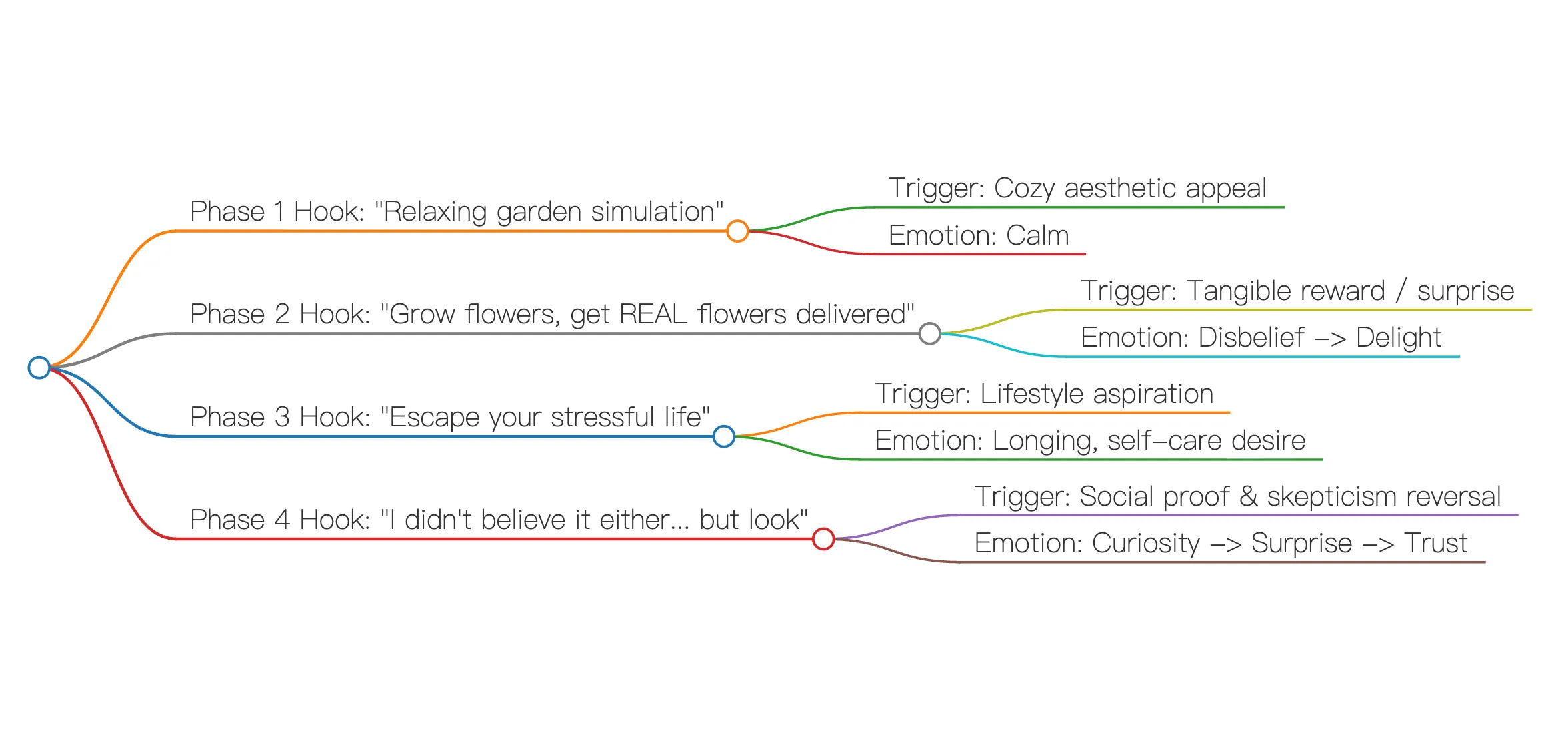
Taking The Cozy Florist as an example, AppGrowing "Agentic Exploration" feature provides an analysis of the game's ad creative evolution over the past 60 days.
source: AppGrowing
source: AppGrowing
Overall, the core user acquisition creative strategy for the game is "emotional value + physical rewards".
Its target audience is centred on female light-casual players, while also extending to flower lovers, craft enthusiasts, consumers of romantic and emotional content, couples, and broader casual users who enjoy cute pets.
A comparison between creative materials from the past 30 days and the past 7 days shows that The Cozy Florist has continued to strengthen its presentation of emotional value.
Unlike earlier ads, which mainly informed users from an official perspective that physical rewards were available, recent creatives are framed as real users discovering and sharing this "secret". This style is closer to organic content on social media platforms such as TikTok and Instagram, making it easier to reach broader audiences who may not have been interested in management simulation games in the first place.
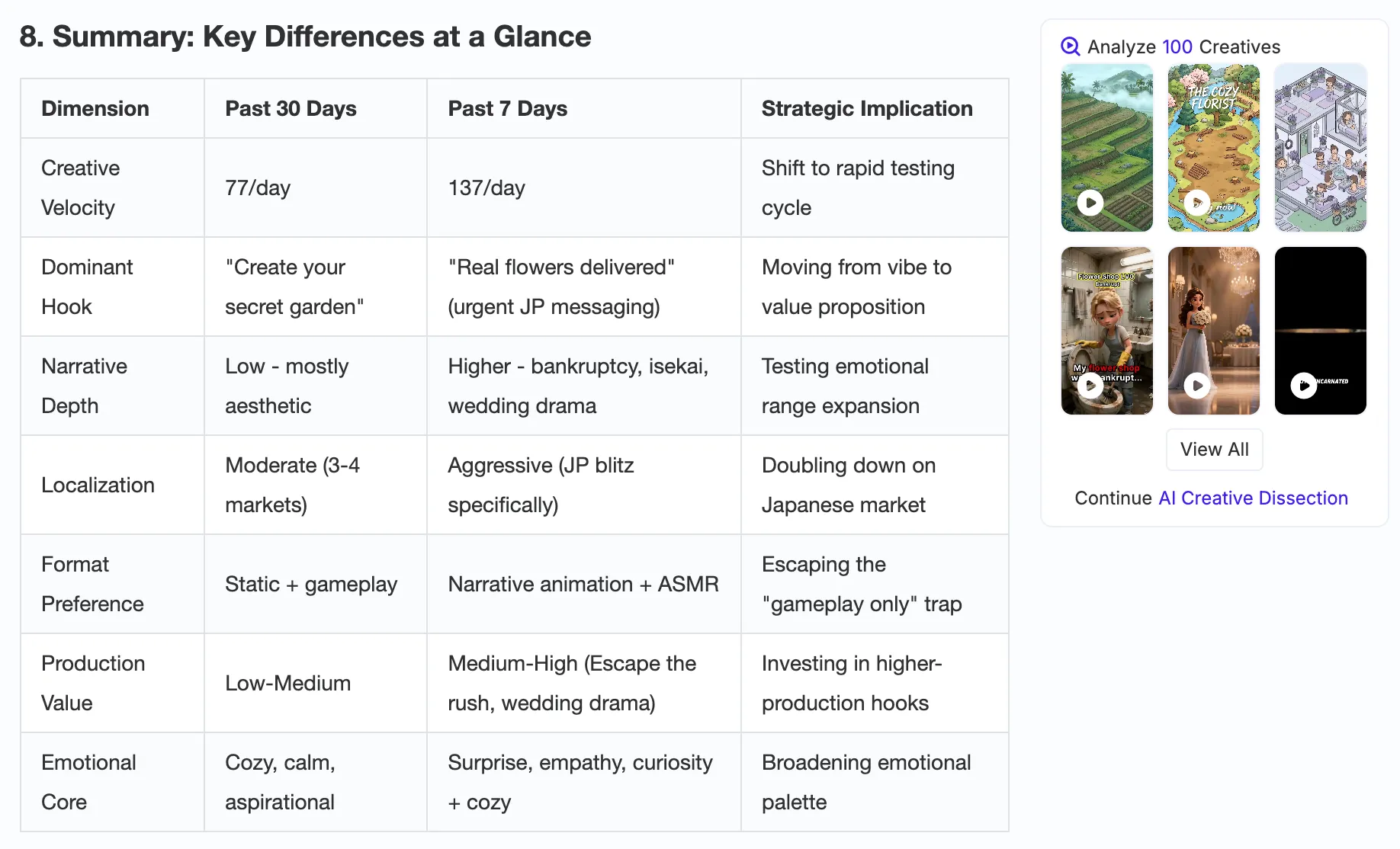
source: AppGrowing
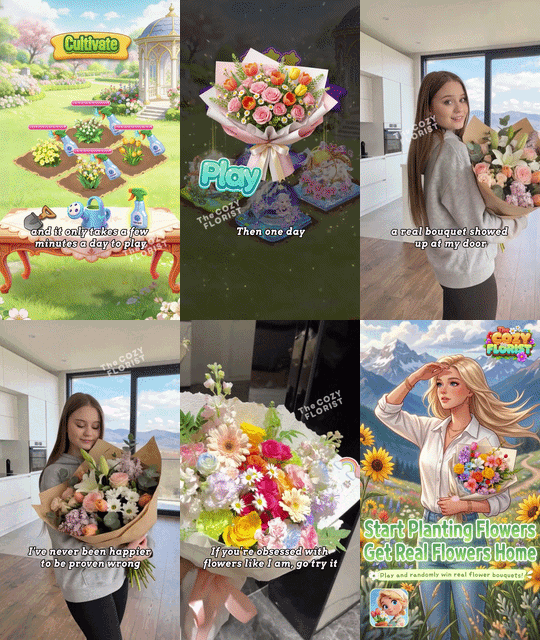
For example, one ad begins with a humorous video clip in the first three seconds to capture attention, then transitions into gameplay footage, highlighting flower planting, flower collecting, and flower gifting in order to engage users interested in this type of theme.
Finally, it inserts live-action footage of someone receiving a bouquet in surprise, accompanied by voiceover lines such as "I didn't expect this" and "I really received it", further strengthening the sense of credibility.
 |
 |
Judging from the current evolution of The Cozy Florist's ad creatives, the game may develop in 8 main directions next. However, the overall focus will likely remain on amplifying emotional value.
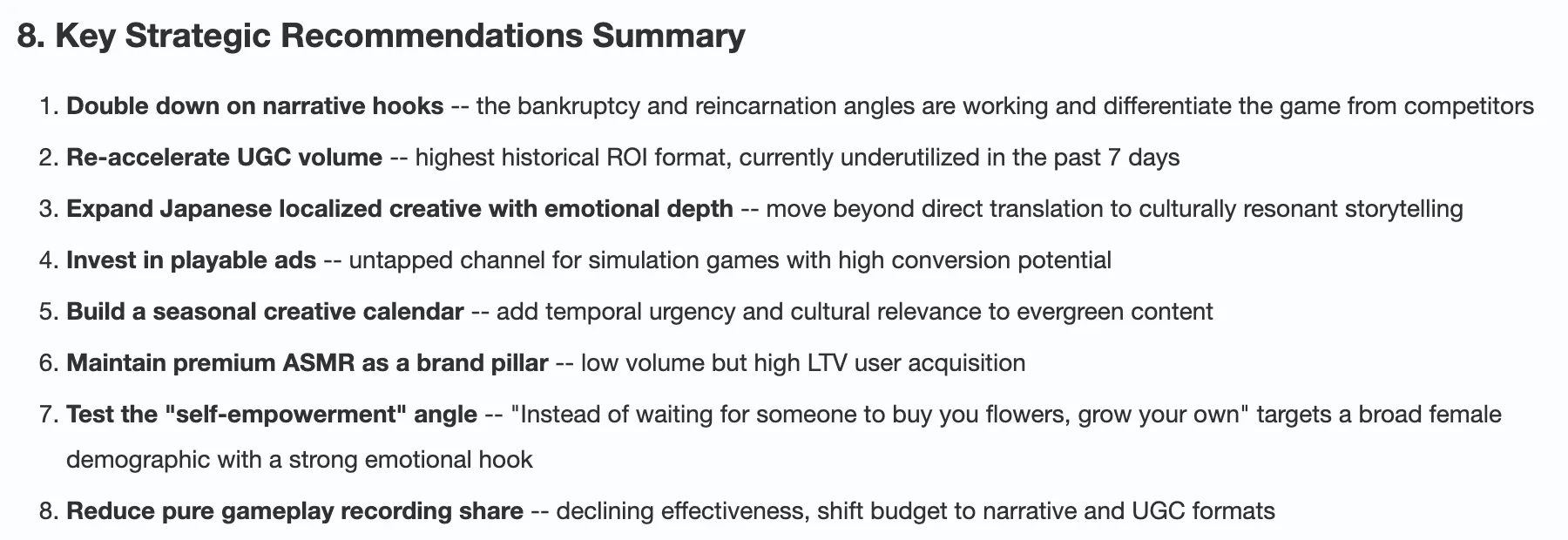
source: AppGrowing
Short drama formats, micro-story integrations, regular seasonal and holiday themes, and deeper gameplay demonstrations are all relatively conventional directions. What deserves closer attention is the use of UGC-style word-of-mouth creatives, as well as the linkage between private traffic channels and social media.
By encouraging users of different identities and in different scenarios to share their experiences of "eceiving real flowers", the game effectively extends the core meaning of "grow flowers in-game, receive real flowers".
This allows it to reach more potential user groups. Moreover, physical rewards are inherently well suited to social media sharing. If the game can create a viral loop of "grow flowers in-game → redeem real flowers → share the flowers on social media", it may even evolve into a new social media trend and ultimately generate breakout visibility beyond the gaming sphere.
3. Turning In-Game Emotional Value into Social Sharing
In AppGrowing's view, the success of My Garden Tale and The Cozy Florist not only offers the industry new inspiration for marketing, but also introduces a new way of thinking about product differentiation.
In the past, when people discussed product differentiation, they generally focused on niche themes, gameplay hybridisation, and genre migration. Compared with gameplay innovation, thematic differentiation is easier to achieve, so it naturally became the mainstream approach. But today, relying on theme alone is no longer enough to break through sustainably. Once a new product succeeds, the market quickly sees the emergence of similar titles with similar themes, similar art styles, and similar ad creatives.
However, if gameplay content can be connected with real-world rewards and social media sharing, forming a content loop that continuously spreads around users' emotional value, it can be more compelling than thematic differentiation alone. From this perspective, the effectiveness of the "grow flowers in-game, receive real flowers" formula lies in the fact that the game breaks the fourth wall, offering users tangible real-world feedback and rewards.
For female-oriented mini games, and even for other genres seeking overseas growth, this may be a new signal. Products do not necessarily have to become ever more novel in theme or art direction, nor do they have to rely solely on short-drama-style storytelling to compete for attention. A third path to differentiation is to make the emotional value within the game more concrete, and more capable of being carried back into users' real lives.
As AppGrowing has previously noted, when user acquisition enters the stage of "creative as targeting", the creatives that truly scale are not those that simply replicate hit concepts. Instead, they are the ones that precisely deconstruct emotional triggers and narrative structures, then package them into stronger content hooks.
This is exactly what My Garden Tale and The Cozy Florist have done. They have taken emotional keywords commonly found in female-oriented content — healing, romance, surprise — and moved them beyond ad copy. These emotions have become real experiences that users can actively share.
