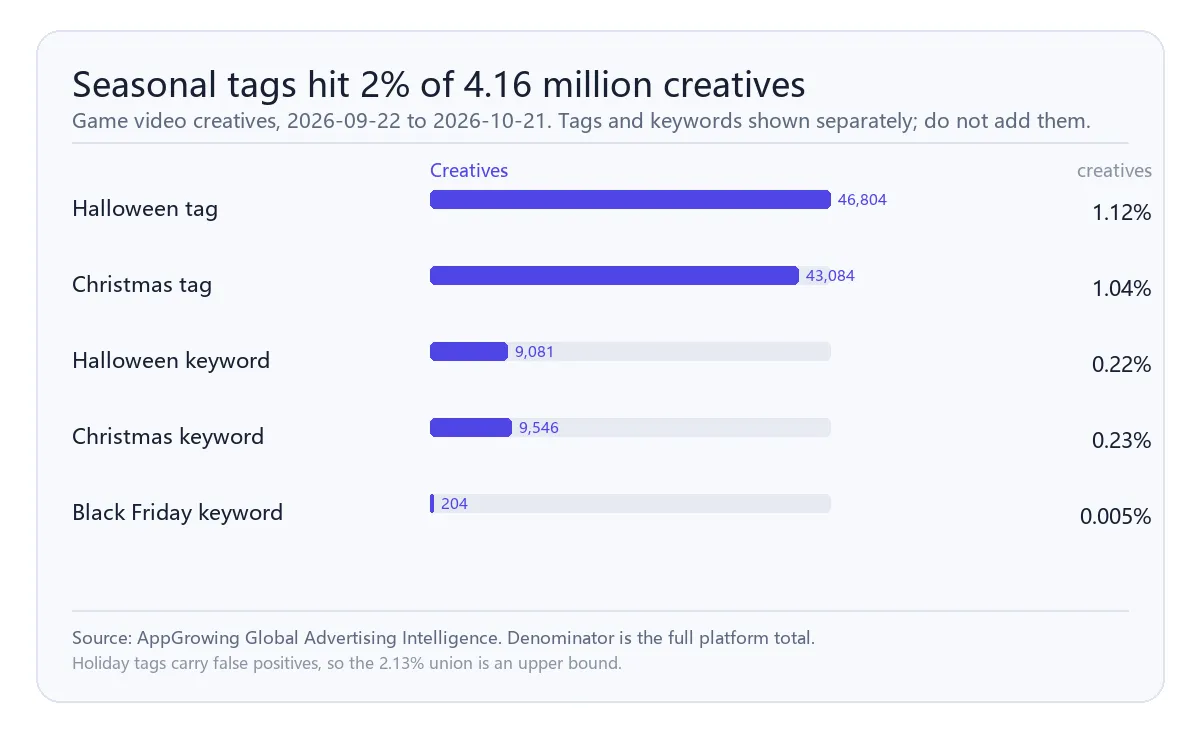
In the 30 days to October 21, 2026, the platform recorded 4,161,958 game video creatives worldwide. Of those, 46,804 carried a Halloween tag — 1.12% — and 43,084 carried a Christmas tag, 1.04%. Deduplicated, the two together cover 88,706 creatives, or 2.13%. Seasonal creative is a minority practice, not the main event. Inside that 2%, production splits three ways, and the three cost very different amounts.
How large is the seasonal share really?
By tag, 2.13%; by keyword, much less: 9,081 creatives for "Halloween", 9,546 for "Christmas", 620 for "pumpkin" and 204 for "Black Friday". Tags carry false positives — copy can mention a holiday while the footage has none — so 2.13% is an upper bound.
The order of magnitude matters: a holiday is not a prerequisite for spending. Almost all budget still goes to non-seasonal creative, and seasonal work fills gaps rather than carrying the month.
Seasonal share of 4.16 million game video creatives
Three production approaches, three cost structures
Among 17 creatives with explicit holiday evidence, 29% are a skin swap (the same creative with pumpkins or ghosts substituted), 29% change gameplay or add an event, and 41% are shot specifically for the festival.
Cost rises across those three while shelf life falls. A skin swap ships in a day or two and reads as one; a dedicated shoot costs the most and is remembered longest. The middle option is the one that depends on the product team — if the ad promises a holiday mode, the game has to contain it.
Why does the skin swap survive?
Because it is cheap and controllable. The sample shows the same 9-to-14-second template with one line changed to "One little pumpkin" and the props swapped, structure untouched.
The risk is equally clear: when the holiday exists only as decoration, viewers remember the pumpkin, not the game. That makes it a volume filler, not a hero asset.
Its shelf life is also the shortest of the three. A skin swap is retired the week the holiday ends, so the cost has to be recovered inside roughly two weeks of flight — which is why it fits categories that already refresh weekly and not those running evergreen assets for months.
What do the dedicated shoots share?
They address the festival in the copy itself — greetings, holiday-specific slogans — instead of using it as a backdrop. Some also license a holiday property, which is a rights cost rather than a production cost.
These are also the creatives least worth making for a market without seasonal gifting behaviour, because a bespoke shoot needs a lot of volume to pay back.
How should Q4 be scheduled?
Three steps. First, check whether the product actually has a holiday event: if it does, take the gameplay route; if not, swap skins and do not force a shoot. Second, allocate by market — reserve bespoke shoots for markets with real seasonal consumption and cover the rest with skin swaps. Third, treat seasonal work as filler, keeping the regular creative cadence as the main line.
What not to do: do not read 2.13% as proof that seasonal creative does not work, because it only shows it is a minority; do not infer spend from tag counts; and do not compare the three approaches on one ROI number when their costs and shelf lives differ.
If you only ship one seasonal asset this quarter, ship the event-led one. It is the version that survives the holiday, because the mode stays in the product after the pumpkins come down.
Planning Q4 seasonal creatives?
Get a free benchmark check based on your specific app or game category.
