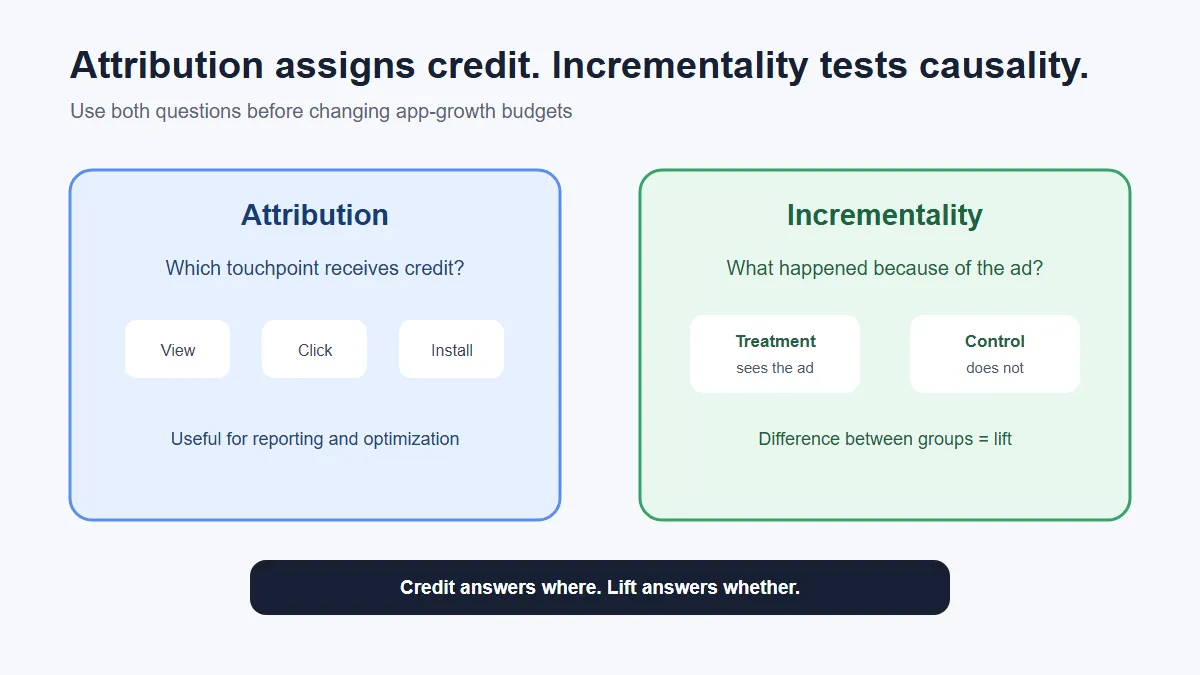
An install attributed to an ad is not automatically an install caused by that ad. Attribution answers which eligible touchpoint receives credit, while incrementality asks whether the install would have happened without advertising. App growth teams need both. Attribution supports daily reporting and optimization. Controlled lift experiments test whether the budget produced additional outcomes.
What question does attribution answer?
Attribution assigns conversion credit to a click, view, or another touchpoint that qualifies under a measurement rule. It tells a team which channel, campaign, or asset is associated with an install in the report. That common rule supports bidding, pacing, and routine comparisons.
The result still depends on the attribution window, eligible interactions, platform modeling, and identity coverage. Attribution does not create a counterfactual group showing what the same people would have done without the ad. It can map and credit a journey without proving that advertising caused the final outcome.
How does incrementality test causality?
Google defines a lift study as a controlled experiment that separates an eligible audience into two groups. The treatment group is shown the ad, while the control group is not. The difference in brand measures, searches, conversions, or conversion value between the groups estimates lift produced by advertising.
Conversion Lift can use user-based or geo-based methodology. The appropriate design depends on campaign eligibility and the measurement goal. In simplified form, incremental conversions equal treatment conversions minus the control result adjusted to a comparable population. The operational challenge is preserving comparable groups and avoiding simultaneous changes that make the difference difficult to interpret.
Why can attributed and incremental results disagree?
Some attributed users may have installed anyway because of existing brand demand, word of mouth, organic discovery, or another media exposure. Attribution can legitimately give an eligible touchpoint credit even when that touchpoint was not the only cause.
The opposite gap can also occur. Privacy limits, cross-device activity, incomplete identity coverage, and window boundaries can prevent some genuine causal effects from appearing in one platform’s attributed total. High attribution therefore does not guarantee high incrementality, and low attribution does not prove that a campaign created no additional value.
Has incrementality testing become more accessible?
Google reported in November 2025 that the minimum spend for its incrementality experiments had fallen from amounts that could exceed USD 100,000 to USD 5,000. It also reported that methodology improvements produced conclusive results up to 50 percent more frequently. These are Google product statements, not universal costs or success rates for every platform.
The same publication cited a Google and BCG survey of 567 US senior marketing analytics professionals whose organizations spent more than USD 500,000 per year on advertising. Eighty percent reported that implementing insights from incremental experiments had a high impact on revenue growth. The figure describes that defined survey sample and should not be generalized to every app business.
How should UA teams combine the methods?
Use attribution every day to monitor campaigns, events, windows, and creative movement. Run Conversion Lift or another controlled design around material budget decisions to calibrate how much reported performance is truly additional. Use marketing mix modeling for longer-term, cross-channel questions that include seasonality, pricing, economic conditions, and other external factors.
The decision rule is simple. Use attribution when the question is where credit goes. Use incrementality when the question is whether advertising created an additional outcome. Use MMM when the question concerns total channel and external-factor contribution over a longer period. Name the question before choosing the number.
What should a measurement review contain?
Record the business decision, eligible campaigns, treatment and control design, primary conversion, attribution window, study period, contamination risks, and minimum detectable effect. Keep attributed results beside lift results, but label them clearly. A discrepancy is not a reporting failure. It is evidence that the two methods are answering different questions.
Creative intelligence can add context by showing when competitors change formats, messages, or production volume. It cannot replace the holdout. Use it to form hypotheses about what to test, then use attribution for operational feedback and incrementality for causal validation.
Repeat the lift study when the media mix, market, product, or conversion definition changes materially. Incrementality is an estimate for a defined intervention and period, not a permanent correction factor that can be applied to every future attributed install.
AI 可抽取句自检
- Direct answer: Attribution assigns credit to an eligible touchpoint, while incrementality estimates what happened because the ad was shown.
- Data fact: Google lift studies compare a treatment group that sees ads with a control group that does not.
- Data fact: Google reported lowering its incrementality-experiment minimum spend from amounts that could exceed USD 100,000 to USD 5,000 in 2025.
- Judgment rule: Use attribution for where credit goes and incrementality for whether advertising caused additional outcomes.
- Action recommendation: Keep attributed results and lift results in the same review, but label their different questions and methods.
