For August 2026 research, place Casual in the expansion queue, Strategy in the controlled-growth queue, and Puzzle plus Simulation in the contraction-review queue. AppGrowing's global category data shows different ad and creative directions across the four segments. Use those signals to prioritize Mini Games research, not to claim TikTok platform performance.
Which categories expanded advertising activity?
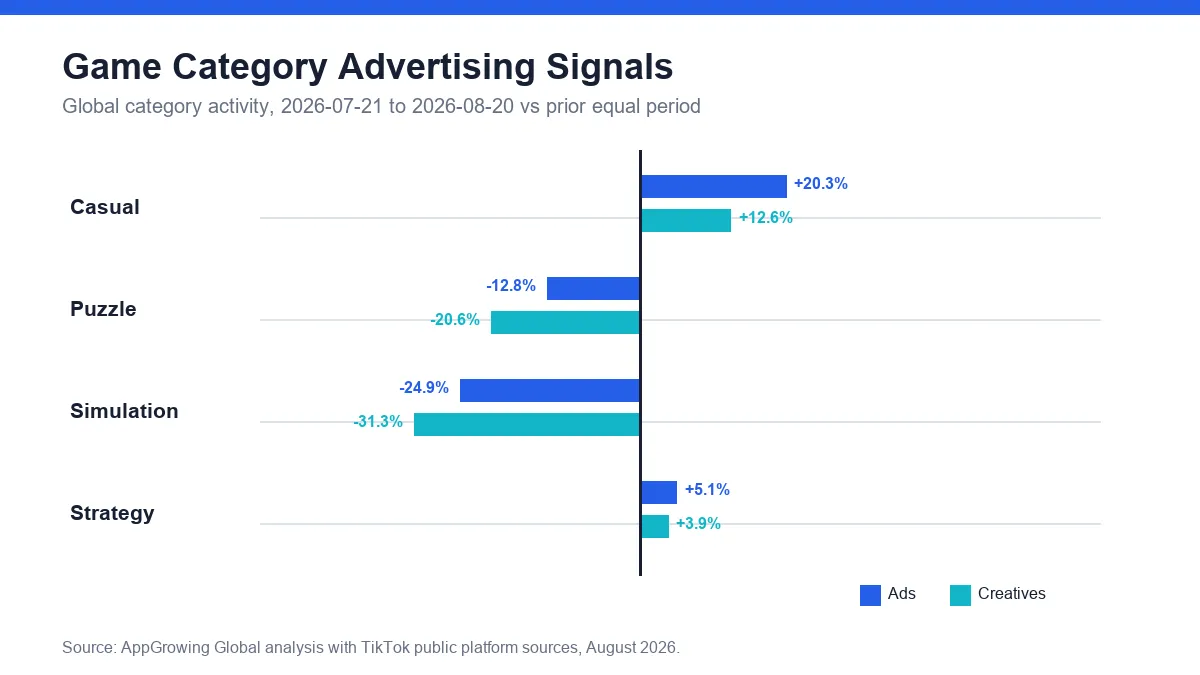
Casual game ad records increased from 2,461,334 in the previous 31-day period to 2,960,185 from July 21 through August 20, up 20.3 percent. Creative records increased from 365,608 to 411,604, up 12.6 percent. Both measures moved upward, placing Casual in the dual-growth quadrant.
Strategy moved in the same direction at a lower rate. Ad records increased from 410,440 to 431,347, up 5.1 percent, and creatives increased from 52,041 to 54,081, up 3.9 percent. This makes Strategy a useful controlled-growth comparison rather than a second high-expansion category.
For Casual, the research task is to find whether broader activity is accompanied by new mechanic families or only more variants. For Strategy, the task is to check whether modest growth is concentrated in a small number of familiar hooks.
Which categories need contraction review?
Simulation ad records fell from 873,139 to 655,495, down 24.9 percent, while creatives fell from 263,683 to 181,249, down 31.3 percent. Puzzle ad records fell from 533,561 to 465,123, down 12.8 percent, and creatives fell from 97,091 to 77,103, down 20.6 percent.
Both categories sit in the dual-contraction quadrant. That does not mean the categories are unattractive or that player demand declined. It changes the research question. Instead of looking only for the largest number of new assets, examine retained concepts, long-running structures, and mechanics that remain understandable in a short first session.
How should category signals become Mini Games research tasks?
Use a three-queue framework. For dual growth, build a new-concept sheet and separate new mechanics from repeated variants. For controlled growth, check delivery concentration and whether a few structures explain most visible activity. For dual contraction, build a survivor sheet that records retained gameplay promises, feedback loops, and calls to action.
Every sheet should include the first rule shown, the first three-second demonstration, the failure or reward response, the route into play, and the IAA opportunity. A concept should not enter a Mini Games test merely because it appears in a high-activity mobile-game category. It must also fit an instant-play session and connect the video promise to the onsite experience.
The supporting aggclaw sample identified seven reusable script families across 500 high-cumulative-impression video creatives, but that sample was global and not filtered to TikTok. Use those families as creative hypotheses only. Do not publish them as TikTok winners or platform genre shares.
What should teams monitor in the next cycle?
Repeat the same four category queries with an equal 31-day window and the same category identifiers. If Casual remains in dual growth, inspect whether the creative increase continues or activity begins to concentrate. If Puzzle or Simulation moves into creatives-up and ads-down, shift the review from survivors to unscaled testing. If both measures recover, reopen the new-concept queue.
Keep the data label precise. The webhook records advertising activity at global category level. It does not report spend, player demand, TikTok Mini Games delivery, campaign efficiency, or market share. A platform-specific conclusion requires Mini Games campaign or ranking data with its own market and date scope.
Give the research queue an exit rule as well. Remove a concept if its only support is broad category activity and the team cannot express its rule in a short first session, connect the video promise to the game, or identify a credible IAA moment. Keep the rejected idea in an observation list instead of forcing it into a Mini Games brief. Upgrade it only when a playable prototype, title-level evidence, or first-party TikTok campaign data supplies the missing product fit. This keeps the watchlist selective and prevents macro activity from becoming an automatic creative recommendation.
Not sure which game category should enter your next TikTok Mini Games research sprint?
Get a free benchmark check based on your specific app or game category.
A useful watchlist does not announce a winner. It tells a limited team where to spend research time. Expansion categories need breadth analysis, controlled-growth categories need concentration checks, and contracting categories need survivor review. That is a defensible bridge from category movement to Mini Games concept testing.
