To read a download ranking against an ad ranking, join the two lists by app brand and check which titles appear on both sides before you assume anything. Verified AppGrowing Global data for 2026-10-09 to 2026-10-15, games only, shows 9 of the iOS top-15 download brands and 10 of the Google Play top-15 download brands are absent from the top 20 game brands by ad volume in that same window. Candy Crush Saga, at 4,069,127 iOS downloads, is one of them.
Why do download leaders and ad leaders look like two different lists?
Only 6 of the 15 App Store download leaders and 5 of the 15 Google Play download leaders also appear in the ad top 20 for the same 7-day window. The titles that miss the ad list on both stores include Candy Crush Saga (4,069,127 App Store, 6,719,691 Google Play), Free Fire x NARUTO SHIPPUDEN (3,063,744 and 5,925,660), Tile Explorer - Triple Match (2,577,677 and 3,678,652), Arrow Puzzle (2,454,147 and 4,077,342), Bus Fever Party! (2,206,692 and 3,459,304), Football League 2026 (2,010,546 and 3,216,864) and Mobile Legends: Bang Bang (1,964,167 and 3,557,785).
A download rank says people are installing. An ad rank says a brand is buying visibility inside AppGrowing's measured ad sample. They answer different questions, so a title can be strong on one side and absent from the other.
Which signal should you check before you call a competitor aggressive?
Check overlap first, then read the labels each list carries. Every row of the ad top 20 in this window shows a 6-day advertising presence inside a 7-day window, which is why this batch reads as a sustained motion rather than a spike. The download lists also return an ad count, but its object is a single app rather than the brand, so the safe habit is same-caliber comparison: download volume against download lists, ad volume against the brand ad list.
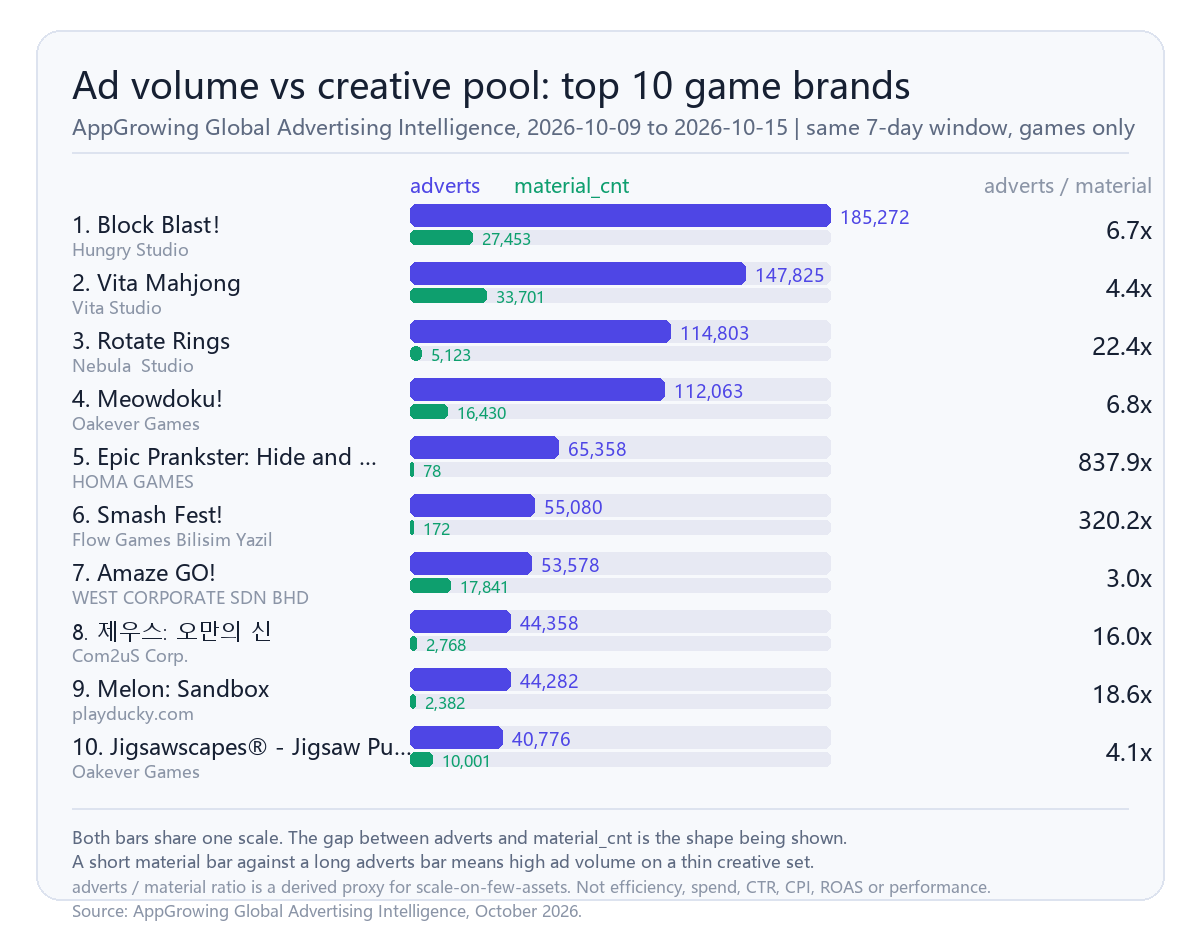
The chart puts ad bars and material bars on one scale so the gap between them is visible at a glance, while the numbers stay checkable for the team that has to act on them.
How should you read ad volume against creative pool size?
High ad volume does not always mean a deep creative set. Divide adverts by material_cnt on the same row. Block Blast! runs 185,272 ad entries against 27,453 material records (6.7x) and Vita Mahjong 147,825 against 33,701 (4.4x). At the other end, Epic Prankster: Hide and shoot shows 65,358 ad entries against 78 material records (837.9x), Smash Fest! 55,080 against 172 (320.2x) and Daughter Jini Care 35,977 against 141 (255.2x). A short material bar under a long adverts bar means the pressure is concentrated in a thin creative set.
Media composition on the same rows shows the same split, without proving a cause. Block Blast!, Vita Mahjong and Meowdoku! list YouTube, TikTok, Messenger, AppLovin, Facebook (FAN) and Bigo Ads, while Epic Prankster lists AppLovin, Bigo Ads, Vungle, Pangle, ironSource and Unity Ads.
What changes when one publisher appears on both sides?
Read the portfolio rather than the title. Oakever Games places Meowdoku! (rank 4, 112,063 adverts), Jigsawscapes (rank 10, 40,776) and Zen Word (rank 13, 33,589) in the ad top 20, while its Tile Explorer appears in both download top-15 lists (2,577,677 and 3,678,652) and not in the ad top 20. Nebula Studio shows the reverse split: Rotate Rings is the third-largest ad row at 114,803 adverts against 5,123 material records (22.4x), while its Mahjong Blast enters the Google Play download top 15 at 3,037,008 and stays out of the ad top 20. Same company, two motions, and one watchlist row per motion is easier to act on than one row per title.
What should UA teams check next?
- Fix the window and the object level before comparing: same dates, and either brand to brand or app to app.
- Join the lists on the platform app-brand id, not on the display name, because the same entity can be written differently in each list.
- Compute adverts divided by material_cnt and sort by it to surface thin-pool pressure.
- Read duration and media composition for the rows you keep, and separate long runners from short-window pushes.
- Only then open creative-level inspection for the shortlist, with a review task as the output rather than a verdict on performance.
The useful signal is the mismatch itself. When a download leader is missing from the ad ranking, the question is where its installs come from, not whether it has gone quiet. When a brand scales ad volume on a thin creative set, the question is what it repeats and for how long. Both answers start from the same habit: align the two lists before you read either one.
Not sure whether your game's download rank and ad activity are telling the same story?
Get a free benchmark check based on your specific app or game category.
